arXivTrading, Microstructure & Execution
The opposing informational effects of AI trading
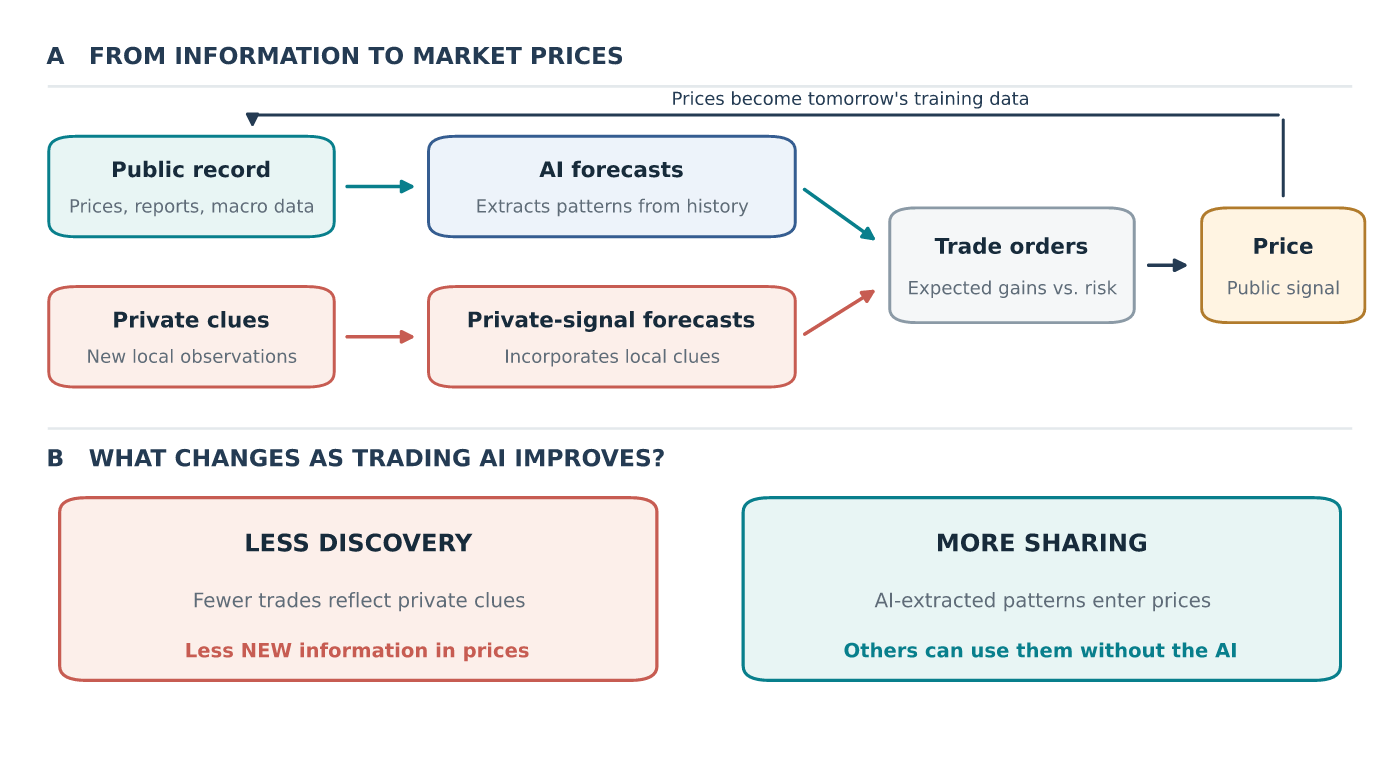
Better AI can improve individual forecasts while weakening price informativeness by substituting public-data analysis for private observation, reducing private information aggregated into prices.
Featured in No. 140 on 20 Nov 2026 · 3 days after release
- Released
- 17 Nov 2026
- First featured
- No. 140 · 20 Nov 2026
- Published in
- Not yet, as far as Semantic Scholar knows
- Fanfare
- 3 of 5
- Identifier
- arXiv:2611.18872
- Authors
- Hajime Shimao
Abstract
From arXiv (CC0).
Better artificial intelligence (AI) can improve individual forecasts without making prices better at revealing new information. In a competitive market with resource-constrained forecasting, more capable algorithms can substitute analysis of public records for private observations, reducing the private information aggregated into prices. The same trades can convey sophisticated public-data analysis to investors unable to perform it themselves. We establish conditions under which these effects coexist and the private benefit of further computation falls. Numerical equilibrium calculations and finite-data neural-market experiments exhibit corresponding patterns. Out-of-sample earnings forecasts and controlled language-model tasks show related patterns of information substitution. In the neural experiment, wider adoption increases the predictive value of price for limited observers, reduces it for advanced observers, and lowers the benefit of upgrading by 44\%. Retraining by investors who did not upgrade can amplify the loss of private-information precision. The informational consequences of AI trading depend on what prices reveal and who can use them.
Citations and venue from Semantic Scholar (ODC-BY), refreshed weekly. Summary: Quant Letter (CC BY 4.0).