Backtesting High-Dimensional Expected Shortfall
Orthogonal methods remove bias in downside-risk backtests when estimating high-dimensional Value-at-Risk and Expected Shortfall forecasts.
Featured in No. 139 on 13 Nov 2026 · 2 days after release
- Released
- 11 Nov 2026
- First featured
- No. 139 · 13 Nov 2026
- Published in
- Not yet, as far as Semantic Scholar knows
- Fanfare
- 2 of 5
- Identifier
- arXiv:2611.13882
- Authors
- Zaichao Du et al.
Abstract
From arXiv (CC0).
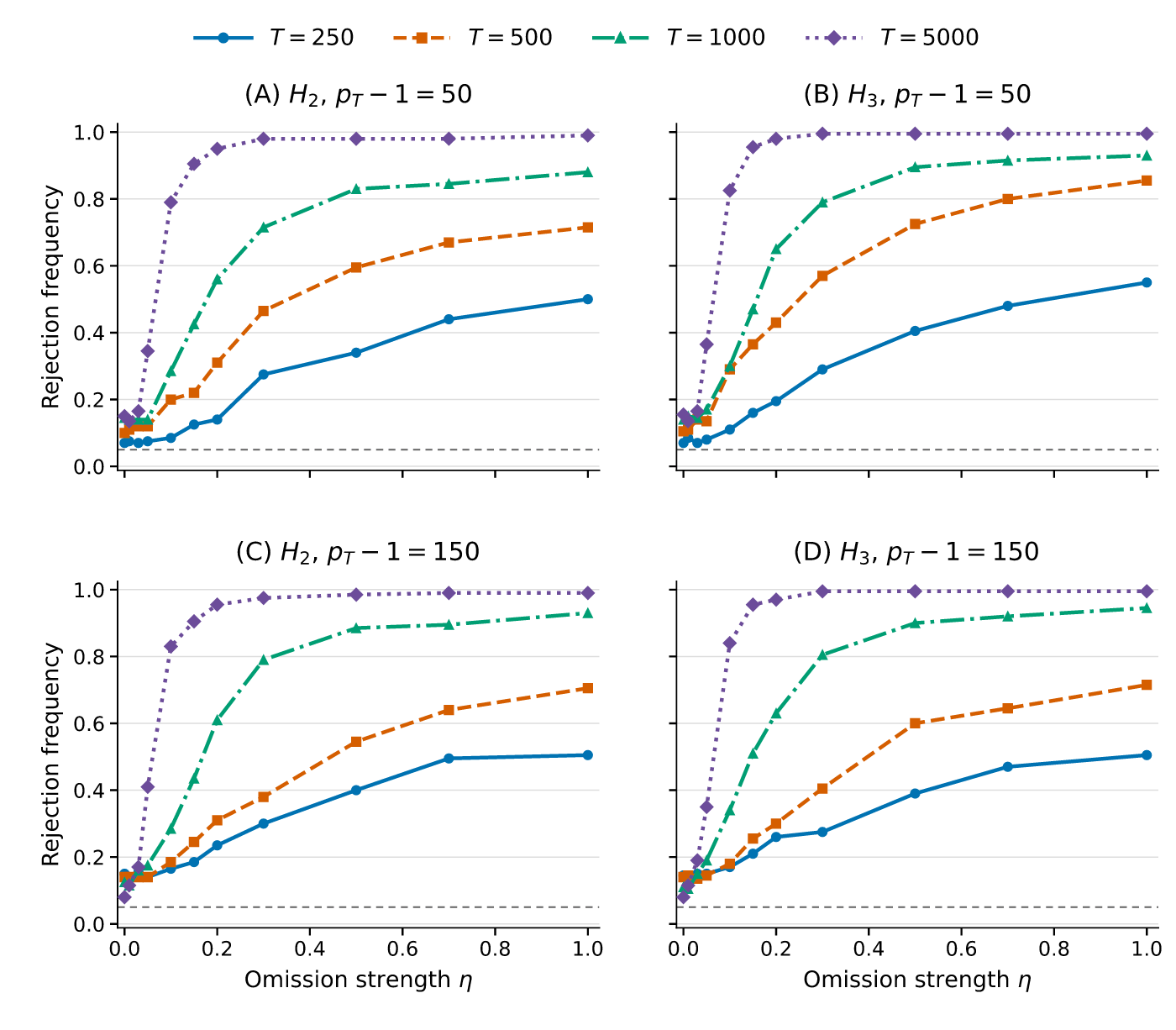
Forecast evaluation increasingly uses high-dimensional predictors, but estimation and regularization of large predictive models can distort conventional backtests. This issue is particularly important for forecasting downside risk, where the signal-to-noise ratio is low. We develop out-of-sample Expected Shortfall (ES) backtests that remove the large first-order bias effects of estimating high-dimensional Value-at-Risk, ES, and the evaluation instrument. In a linear ES specification, the proposed methods are easily implemented as Double Lasso with a tail-size-adjusted score as a generated dependent variable. More generally, we characterize orthogonal ES backtesting moments, and establish oracle equivalence and valid inference under time-series dependence and repeated estimation with overlapping and expanding training windows. Simulations show that conventional backtests can severely overreject ES optimal forecasts, whereas orthogonalization improves size control. An application to downside-growth forecasting for G7 economies finds evidence against a US growth-only ES specification, even though forecast-oriented regularization selects no additional financial predictors. The application also shows that accounting for estimation can change rejection decisions in either direction. These findings highlight the distinct roles of predictive variable selection and backtesting in the evaluation of high-dimensional tail-risk models.
Citations and venue from Semantic Scholar (ODC-BY), refreshed weekly. Summary: Quant Letter (CC BY 4.0).