E-Backtesting Expected Shortfall without Value-at-Risk Forecasts under Time-series Models
Sequential backtests for Expected Shortfall using only observed losses and ES forecasts control false rejections, with time-series extension under AR-GARCH structure proving convergent under grid refinement.
Featured in No. 135 on 16 Oct 2026 · 2 days after release
- Released
- 14 Oct 2026
- First featured
- No. 135 · 16 Oct 2026
- Published in
- Not yet, as far as Semantic Scholar knows
- Fanfare
- 2 of 5
- Identifier
- arXiv:2610.17681
- Authors
- Ruodu Wang and Jingcheng Yu
Abstract
From arXiv (CC0).
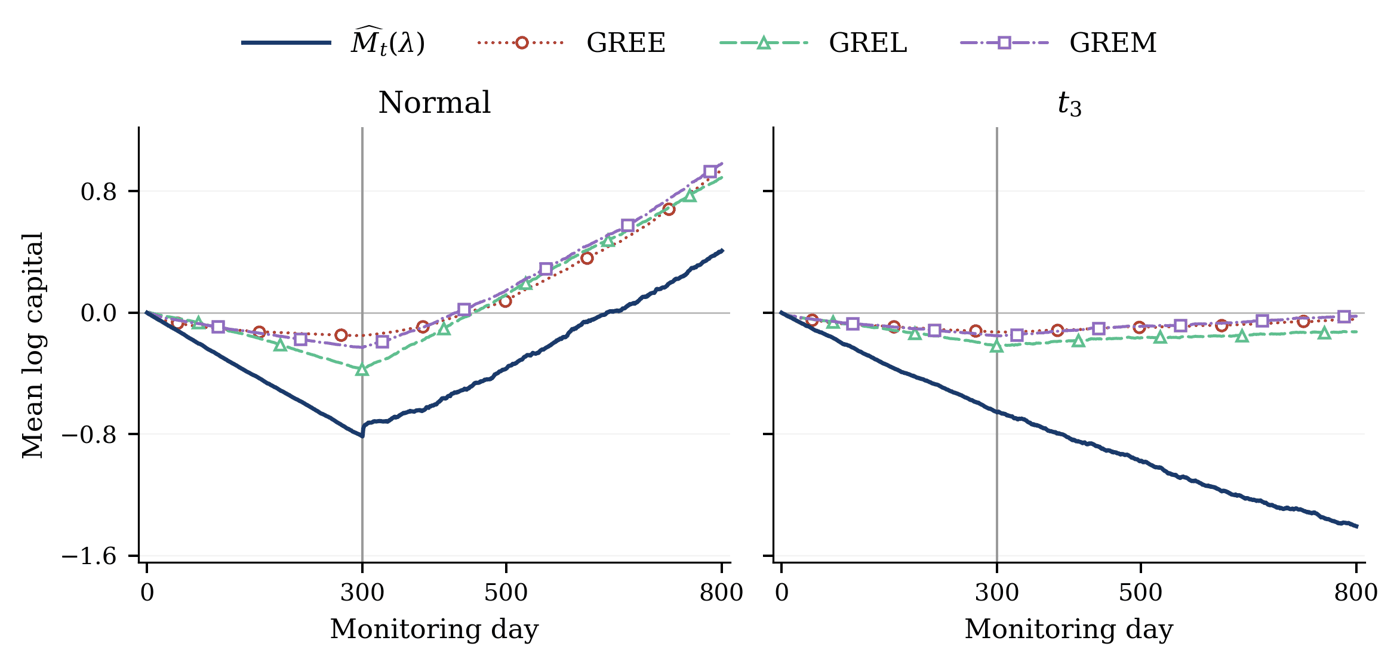
Expected Shortfall (ES) measures the average size of tail losses. Its sequential backtests typically also require a Value-at-Risk (VaR) forecast. We develop two e-backtesting methods using only observed losses and ES forecasts: one for iid losses only and the other for time series under an AR-GARCH conditional VaR structure. Under the stated assumptions, both control false rejections at any stopping time. For the time-series method, validity requires a fixed parameter--quantile pair representing the conditional VaR path and a positive report margin. The time-series statistic takes an infimum over possible parameter and VaR values. We choose the betting process $(λ_t)$ by maximizing an empirical growth rate averaged across candidate parameters. We compute the statistic by continuous VaR profiling on a dense parameter grid. For grid approximations, we prove convergence to the continuous infimum, together with convergence of the probability of false rejection, as the grid is refined over a fixed monitoring period. Lower and upper bounds for the VaR infimum on the parameter grid control the accuracy of the numerical profiling. Simulations, including ES reports that change from over-reporting to under-reporting, and an application to daily NASDAQ losses provide numerical comparisons with VaR--ES e-processes and fixed-sample ES backtests, assessing detection frequencies and the timing of rejections.
Citations and venue from Semantic Scholar (ODC-BY), refreshed weekly. Summary: Quant Letter (CC BY 4.0).