ML-QuantSubscribe

Quant Letter

November 2026, Week 2

The week in quantitative finance research: 90 papers from arXiv, SSRN and RePEc, screened and ranked, 7–13 Nov 2026.

Papers
90
New this week
90
With figures
52
High fanfare
15

From the editor

This week: generalization and robustness in execution and hedging; and systematic evidence failures in published quant research. Standouts: Microstructure Invariance For Execution Policies shows trained policies transfer across assets and venues. RL Hedging for Options cuts tail losses versus delta. Evidence Audit of 91 LLM Trading Papers catalogs severe methodological flaws—51% ignore costs, 98% have look-ahead bias.

Top picks

If you read five papers this week, read these.

  1. Microstructure Invariance For Execution Policies

    An execution policy trained once on 954 stocks in normalized units generalizes to unseen assets, exchanges, and crypto with minimal performance loss.

    Fanfare 4Trading, Microstructure & Execution
    Zero-shot policy transfer performance across crypto exchange and stock exchange pairs with confidence intervals.
  2. Pre-registers and audits 91 LLM trading papers, finding 51% ignore trading costs, median test window is 12 months, and 98% fail to control for look-ahead bias in model training.

  3. Residual reversal timing and monthly aggregation weights
  4. A systematic audit of 1,820 economics and finance papers finds 10% of claims show discrepancies between code and description, with 49% containing potentially serious errors affecting central results.

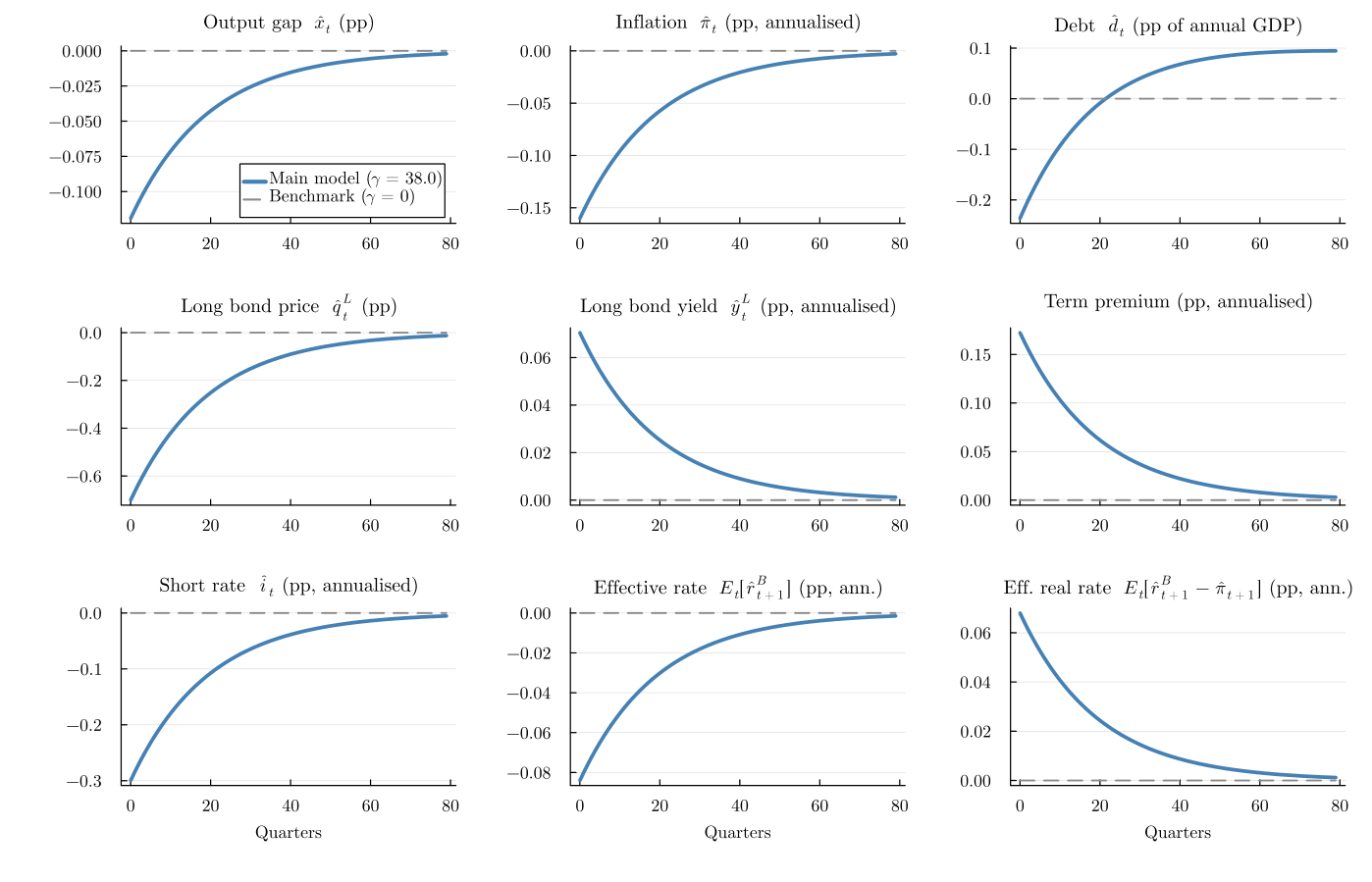
  5. Nine-panel grid showing impulse responses to maturity shock under monetary dominance

What's rising

Topics drawing unusually many papers this week.

  1. Earnings and analysts

    1.5×

    6.4% of this week's 689 new papers, 1.5x its share over the previous 7 weeks (4.3%).

  2. Foundation models

    2.1×

    1.9% of this week's 689 new papers, 2.1x its share over the previous 7 weeks (0.9%).

  3. Insurance

    1.5×

    4.5% of this week's 689 new papers, 1.5x its share over the previous 7 weeks (3.0%).

GitHub radar

What the quant community starred on GitHub this week, from a panel of 10,589 developers who follow financial machine learning (270 of the 857 we checked starred something). Counts only: we never publish who starred what.

Quant repos rising

  1. Personal finance app for managing money and budgets.

    ★ 14.5k+3,657 this weekRuby

  2. Self-hosted AI agent managing budget, investments, and trades.

    ★ 437+418 this weekPythonNew repo

  3. Forward-testing harness for trading crypto perpetuals on Bybit.

    ★ 145+145 this weekPythonNew repo

  4. Free open source order flow screener for spot and perpetual trading.

    ★ 184+151 this weekTypeScriptNew repo

  5. FinRL-X: AI-native modular infrastructure for quantitative trading.

    ★ 3,938+27 this weekPython

  6. Backtesting engine for quantitative trading and portfolio analysis.

    ★ 648+41 this weekPython

  7. Production-grade charting library for brokers and trading platforms.

    ★ 197+8 this weekTypeScript

  8. Foundation model for the language of financial markets.

    ★ 47.7k+655 this weekPython

What quants are playing with

  1. Agent skills framework for building AI agent capabilities.

    ★ 8,098+8,081 this weekNew repo

  2. Local emulator of AWS APIs for development and testing.

    ★ 6,507+6,510 this weekRustNew repo

  3. Python framework for semantic graph-based reasoning over data.

    ★ 12.5k+3,088 this weekPython

  4. Web best practices guidance for coding agents.

    ★ 9,906+7,280 this week

  5. Understand how software works and build your own.

    ★ 31.1k+12.3k this weekRustNew repo

  6. Open-source plugin for designing and reviewing software with agents.

    ★ 18.4k+5,239 this weekPythonNew repo

  1. Now publishedAlphaSAGE: Structure-Aware Alpha Mining via GFlowNets for Robust Exploration

    Now published in International Conference on Learning Representations · featured 3 Oct 2025, 4 days after release; 30 citations

  2. Now publishedEDINET-Bench: Evaluating LLMs on Complex Financial Tasks using Japanese Financial Statements

    Now published in International Conference on Learning Representations · featured 11 Jun 2025, 1 day after release; 13 citations

  3. Now publishedPassive market impact: a point process approach

    Now published in Finance and Stochastics · featured 12 Dec 2024, 2 days after release; 6 citations

All papers

Filter by venue, topic or fanfare.

Venue
Topic
Fanfare
90 papers

arXiv

Quantitative finance and ML-for-finance preprints

30 papers · 29 figures

Trading, Microstructure & Execution5

01

Microstructure Invariance For Execution Policies

An execution policy trained once on 954 stocks in normalized units generalizes to unseen assets, exchanges, and crypto with minimal performance loss.

Fanfare 4Trading, Microstructure & ExecutionHieu Tran and Hong YuPDF
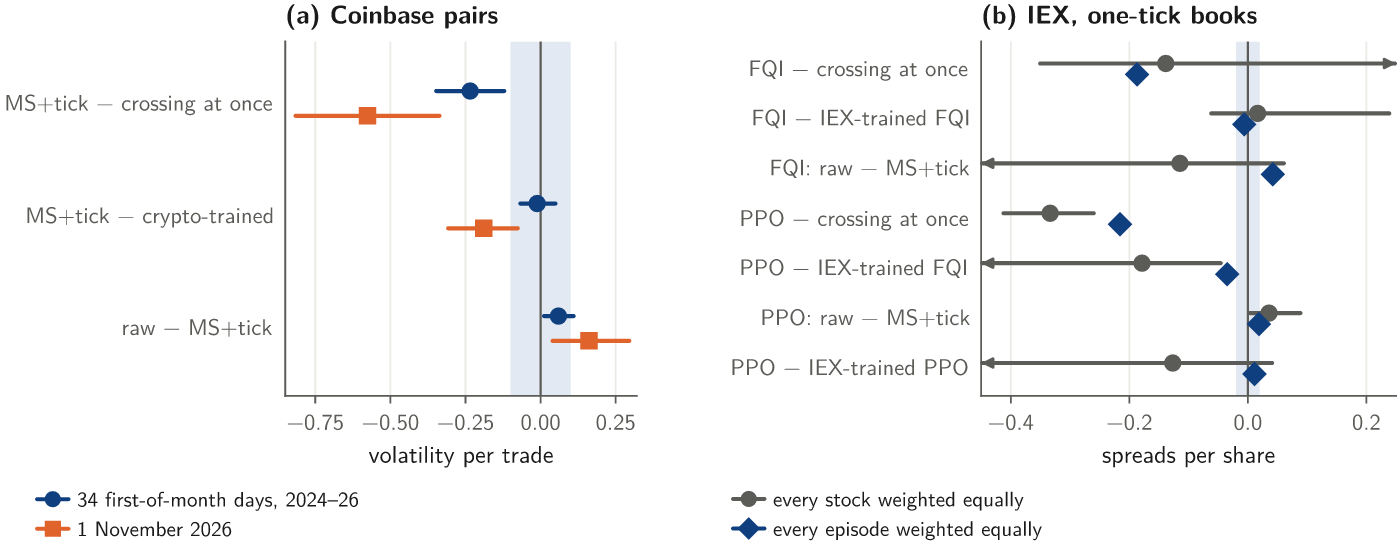
Zero-shot policy transfer performance across crypto exchange and stock exchange pairs with confidence intervals.
Figure 4: The stock-trained policies transfer to crypto and to a second exchange. Paired cost differences; bands: the margins; arrows: intervals beyond the axis. (a) Coi…
02

RL Hedging for Options Market Makers

A reinforcement learning agent trained on historical S&P 500 options data reduces tail losses by 3.1% versus delta hedging, reaching 8.9% in volatile downturns.

Fanfare 3Trading, Microstructure & ExecutionJacky Chen et al.PDF

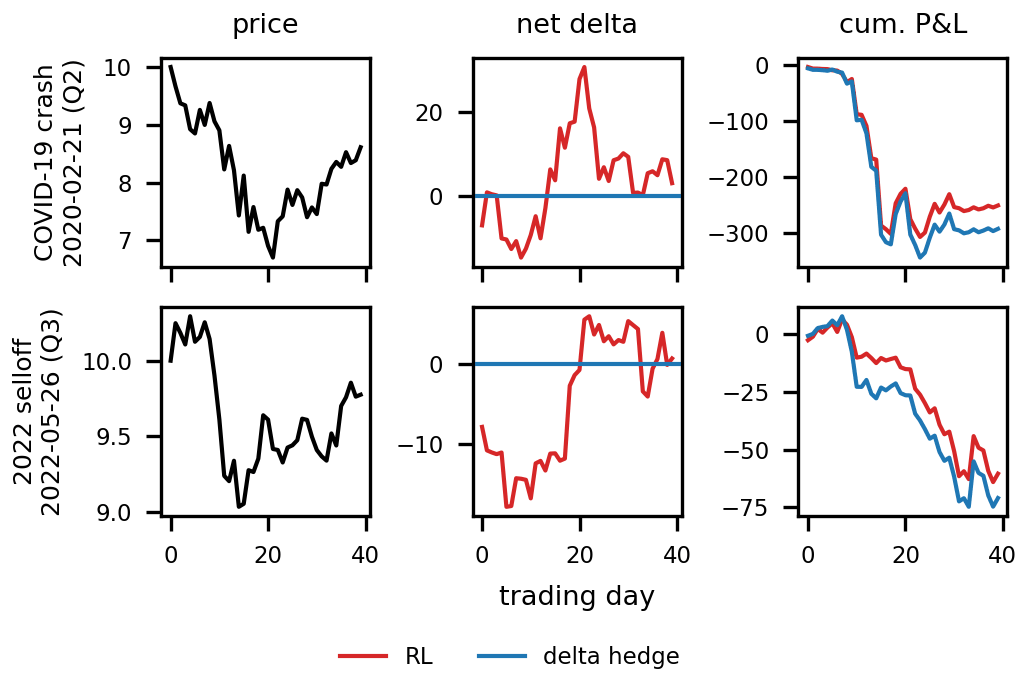
Stress-period paths for empirical TD3 (CVaR 95 ): COVID-19 crash (Q2, top) and 2022 selloff (Q3, bottom)
Figure 2. Stress-period paths for empirical TD3 (CVaR 95 ): COVID-19 crash (Q2, top) and 2022 selloff (Q3, bottom). Price, net delta, and cumulative PnL for empirical TD…
20

Price-Impact Decay Is Not Identifiable

A no-go theorem proves that propagator estimation cannot identify asymptotic impact decay because diffusive prices force fine-tuned decay artificially.

Fanfare 2Trading, Microstructure & ExecutionShunta Fujiwara et al.PDF

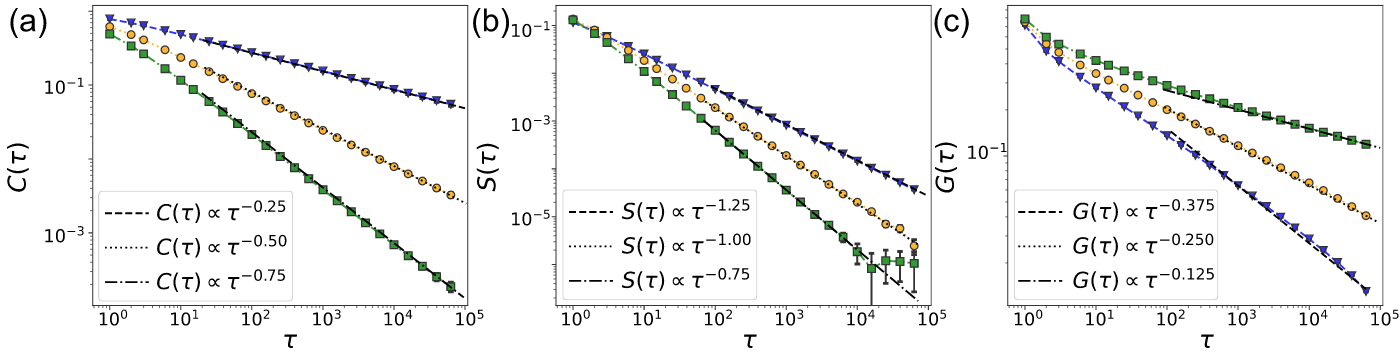
Linear propagator estimation applied to the SFK model with M=1 , \alpha\in\{1.25,1.5,1.75\} , and \delta=1/2 . (a) The
Figure 2: Linear propagator estimation applied to the SFK model with M=1 , \alpha\in\{1.25,1.5,1.75\} , and \delta=1/2 . (a) The order-sign autocorrelation, agreeing wit…
26

Risk Management in RL Market Making

Adding inventory and cash management penalties to reinforcement learning market makers improves resilience and adaptability compared to pure profit-maximizing approaches.

Fanfare 2Trading, Microstructure & ExecutionSiddharth Nand and Bora GuneyPDF

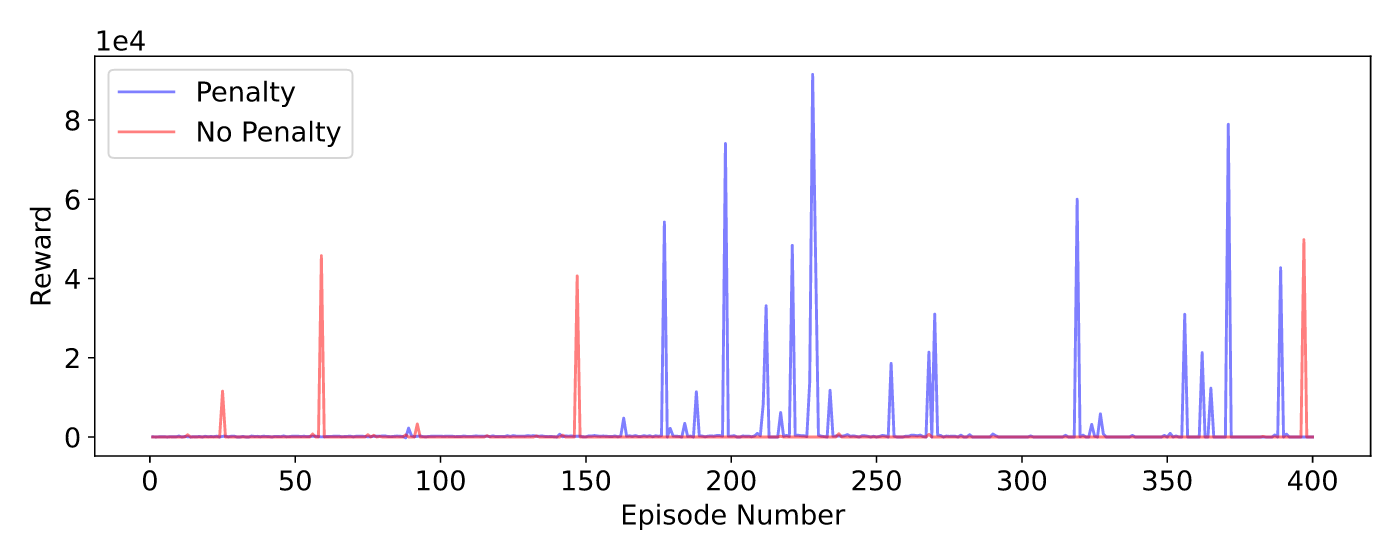
Reward per Episode
Figure 2: Reward per Episode
29

Neural Networks for Optimal Liquidation Maps

Neural networks approximate the solution map of optimal execution under transient price impact, reducing financial costs from kernel misspecification.

Fanfare 2Trading, Microstructure & ExecutionRyan Donnelly et al.PDF

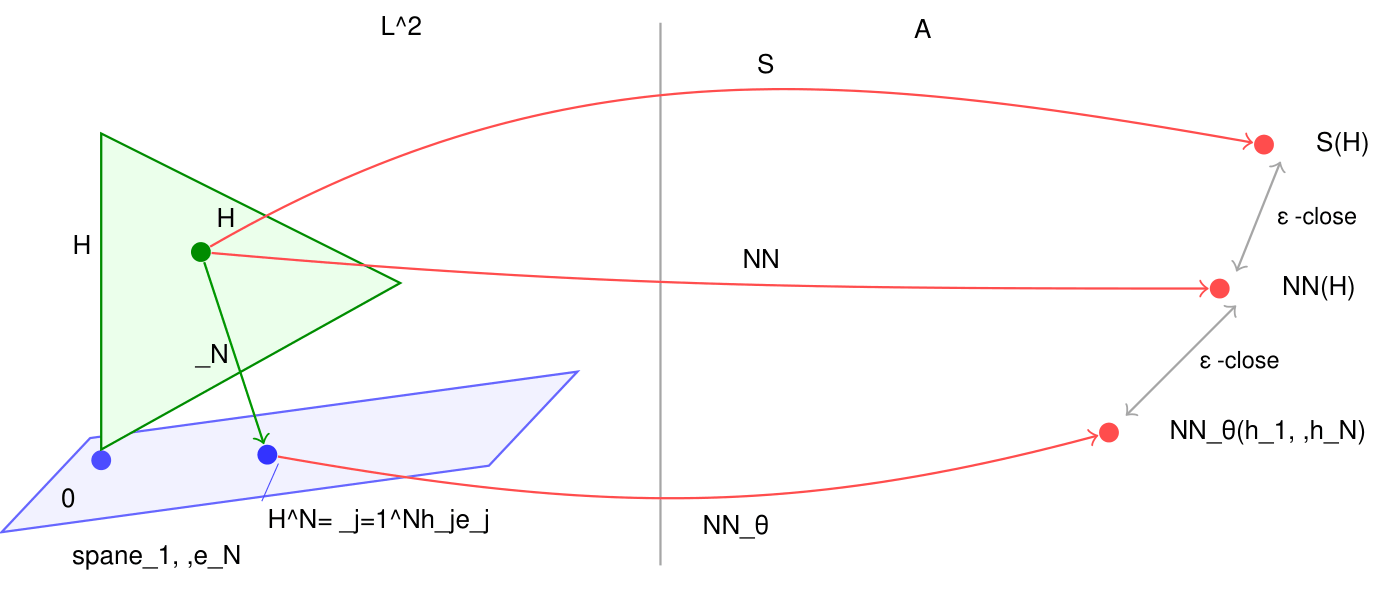
Finite-dimensional encoding of admissible kernels, with all other inputs of the solution map held fixed and omitted for
Figure 1. Finite-dimensional encoding of admissible kernels, with all other inputs of the solution map held fixed and omitted for simplicity. The admissible kernel class…

Econometrics & Forecasting3

03

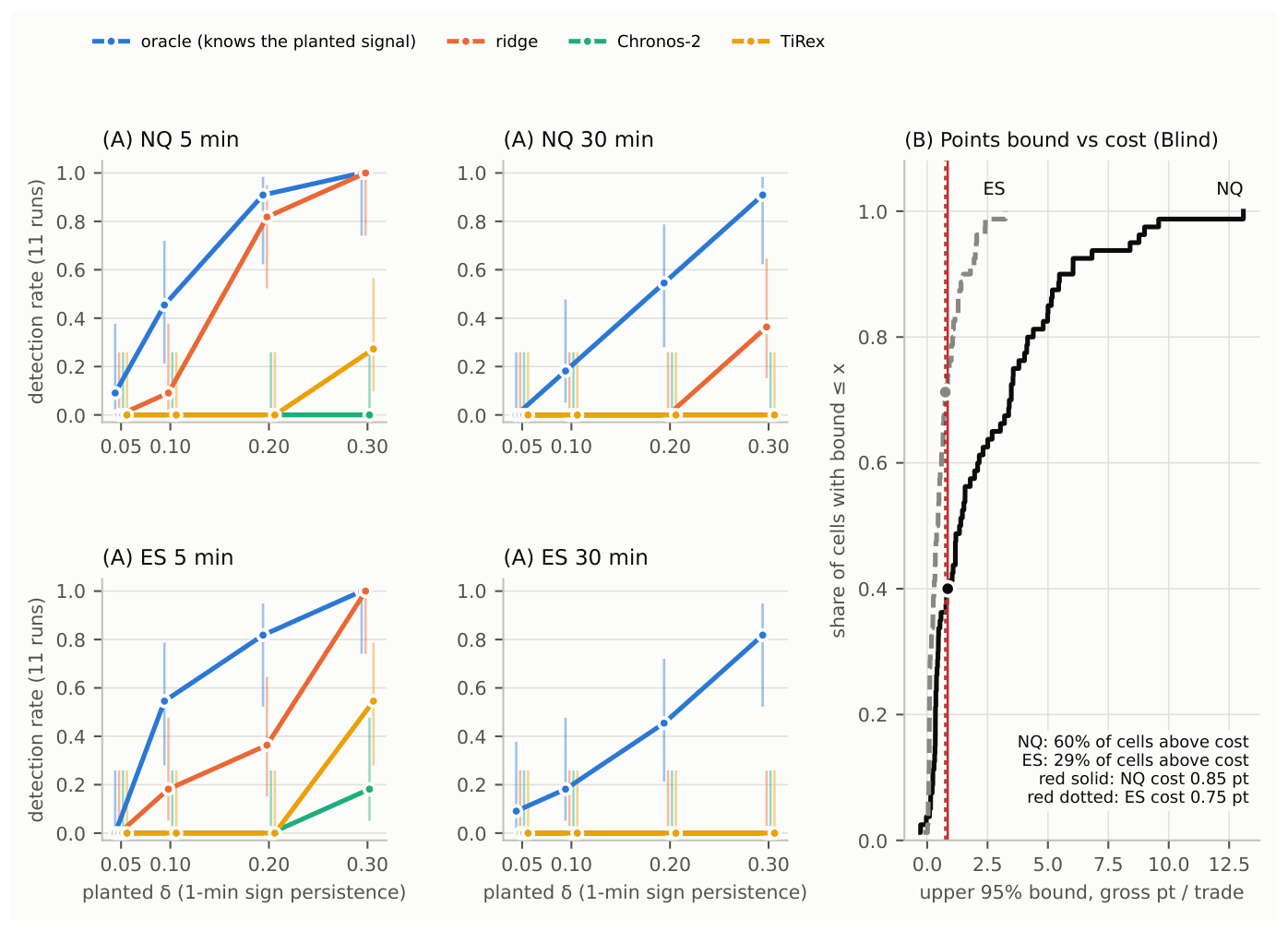
Time-Series Foundation Models for Futures Returns

A pre-registered evaluation finds zero evidence that five frozen time-series foundation models beat a no-change forecast on index futures returns across 160 tests.

Fanfare 3Econometrics & ForecastingRishabh UpadhyayPDF

What the study could detect
Figure 2: What the study could detect. (A) Share of 11 planted-signal realisations in which each forecaster detects the signal (MAE ratio < 1 AND squared-error DM p < .0…
07

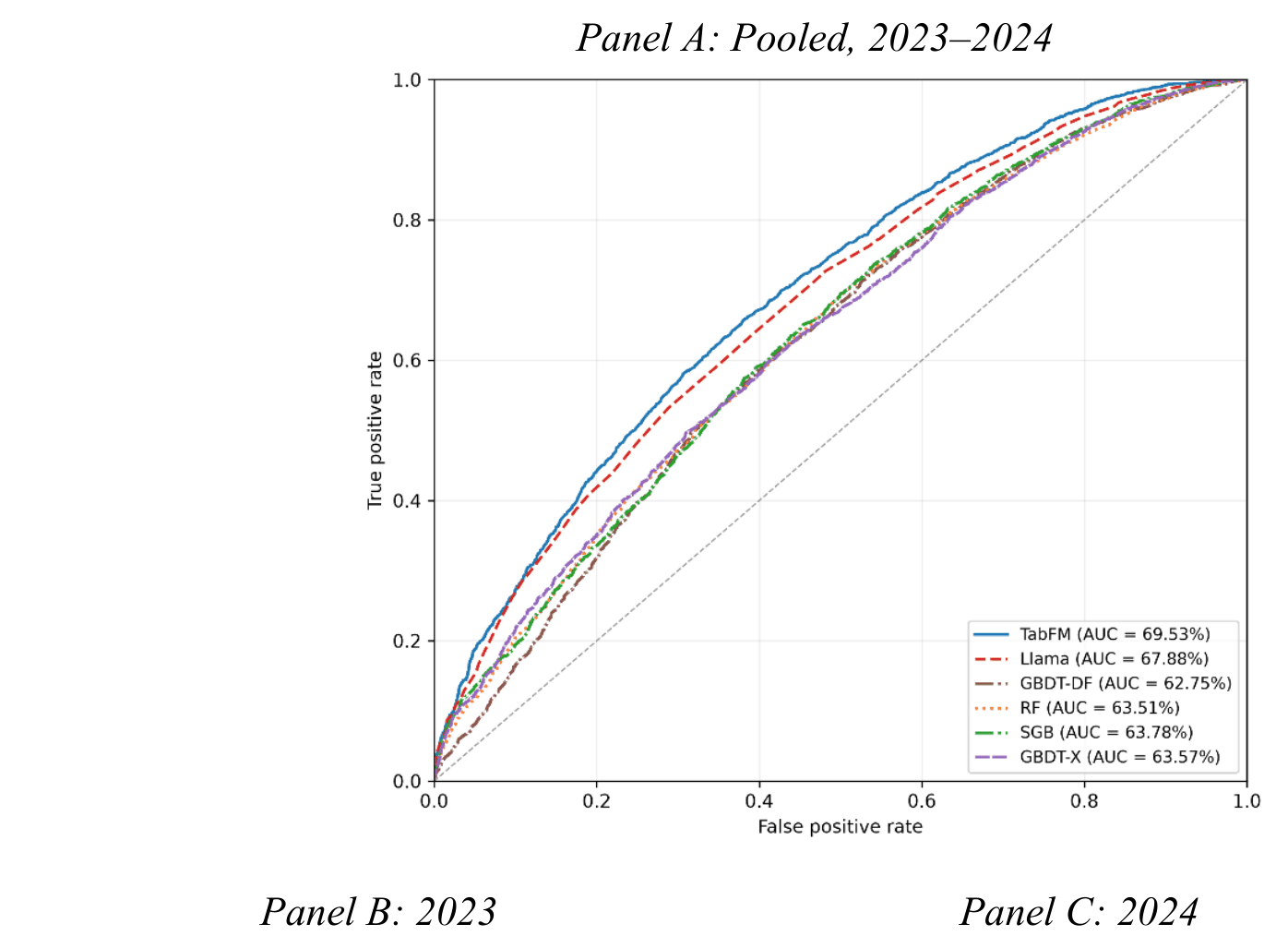
Tabular Foundation Models For Earnings Forecasting

A tabular foundation model pretrained on synthetic data outperforms tree-based and language models at predicting next-year earnings changes.

Fanfare 3Econometrics & ForecastingEd deHaan and Allen H. HuangPDF

ROC curves comparing TabFM, Llama, and tree-based models for earnings forecasting performance.
Figure 1. Receiver Operating Characteristic (ROC) Curves This figure compares ROC curves for TabFM, Llama, GBDT-DF, RF, SGB, and GBDT-X. Panel A shows the pooled sample…
12

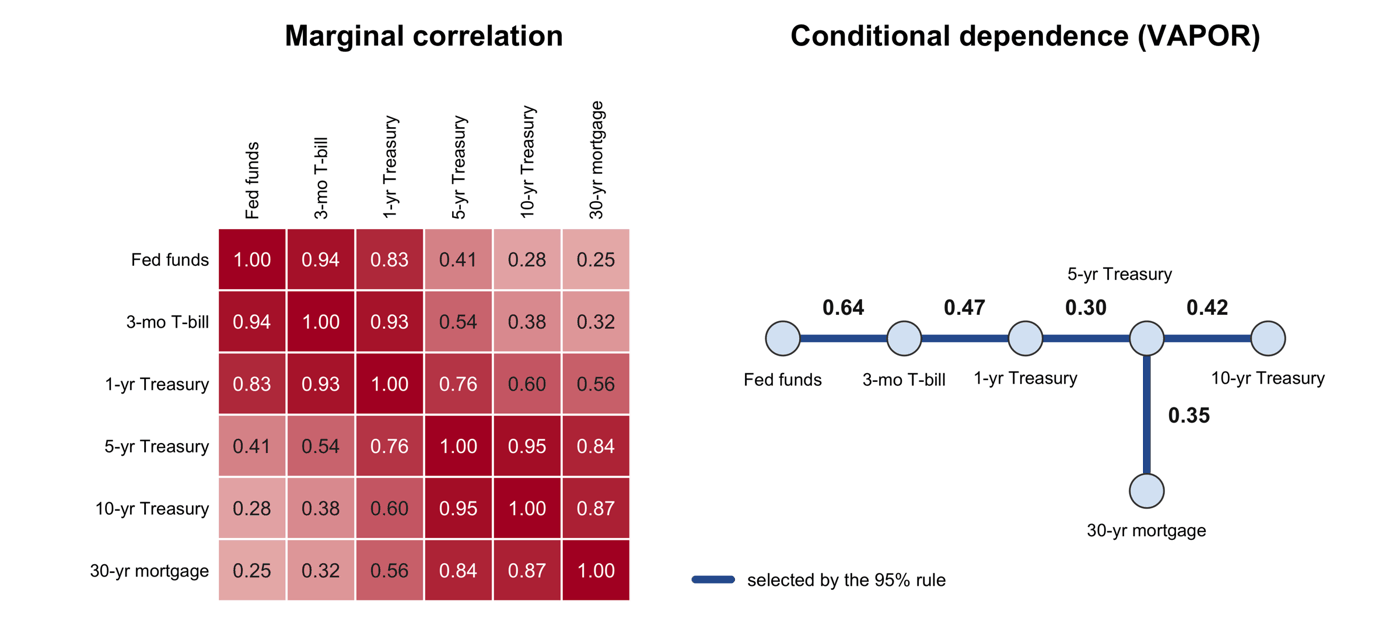
Bayesian Precision Models for Macro Panels

VAPOR jointly estimates vector autoregressive dynamics and factor-structured precision to reveal direct dependencies in high-dimensional macroeconomic time series.

Fanfare 3Econometrics & ForecastingPeter DunsonPDF

Heatmaps comparing marginal correlation versus conditional dependence among Treasury rates.
Figure 1: Marginal and conditional dependence among six interest-rate series in the p=100 panel of economic indicators: the federal funds rate, the three-month Treasury…

ML & AI Methods7

04

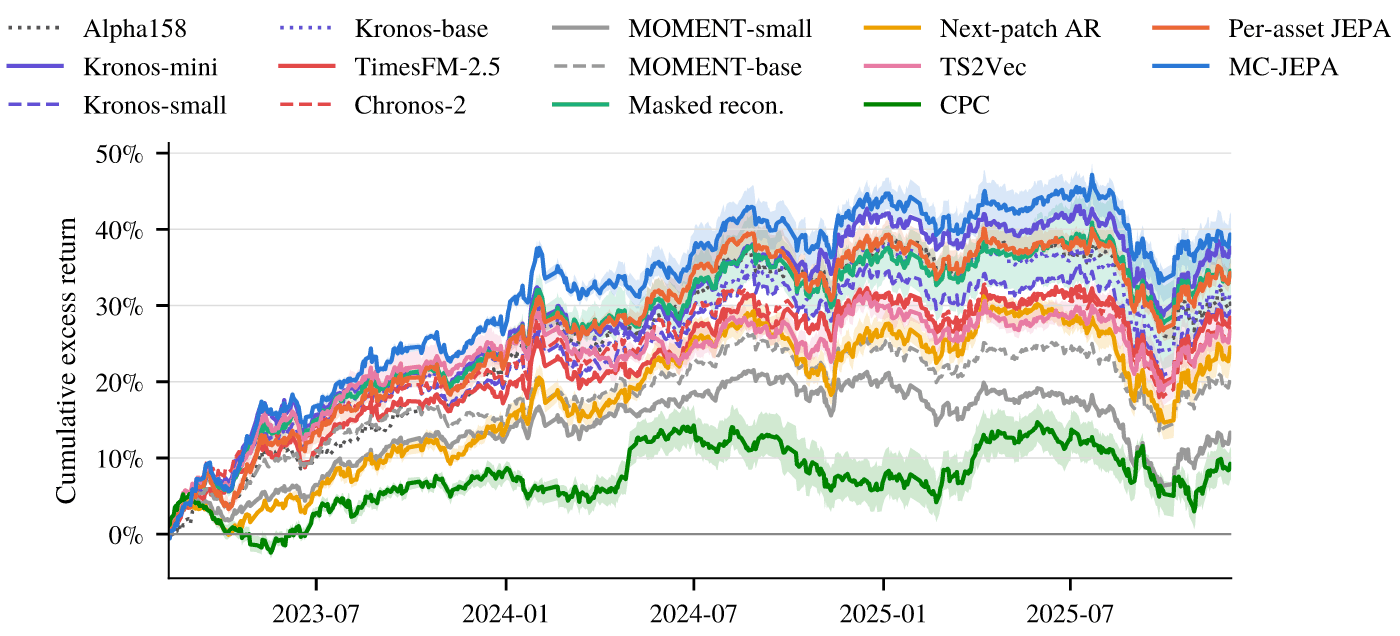
Market-Conditioned JEPA For Asset Prediction

The study conditions self-supervised learning on market factors to improve prediction of returns, exposure, risk, and liquidity across minute-level stock data.

Fanfare 3ML & AI MethodsYuqi Wang et al.PDF

Cumulative excess return over the CSI300 index of the backtest in Table 2 , net of transaction costs
Figure 3 : Cumulative excess return over the CSI300 index of the backtest in Table 2 , net of transaction costs. For the encoders trained in our experiments, lines show…
05

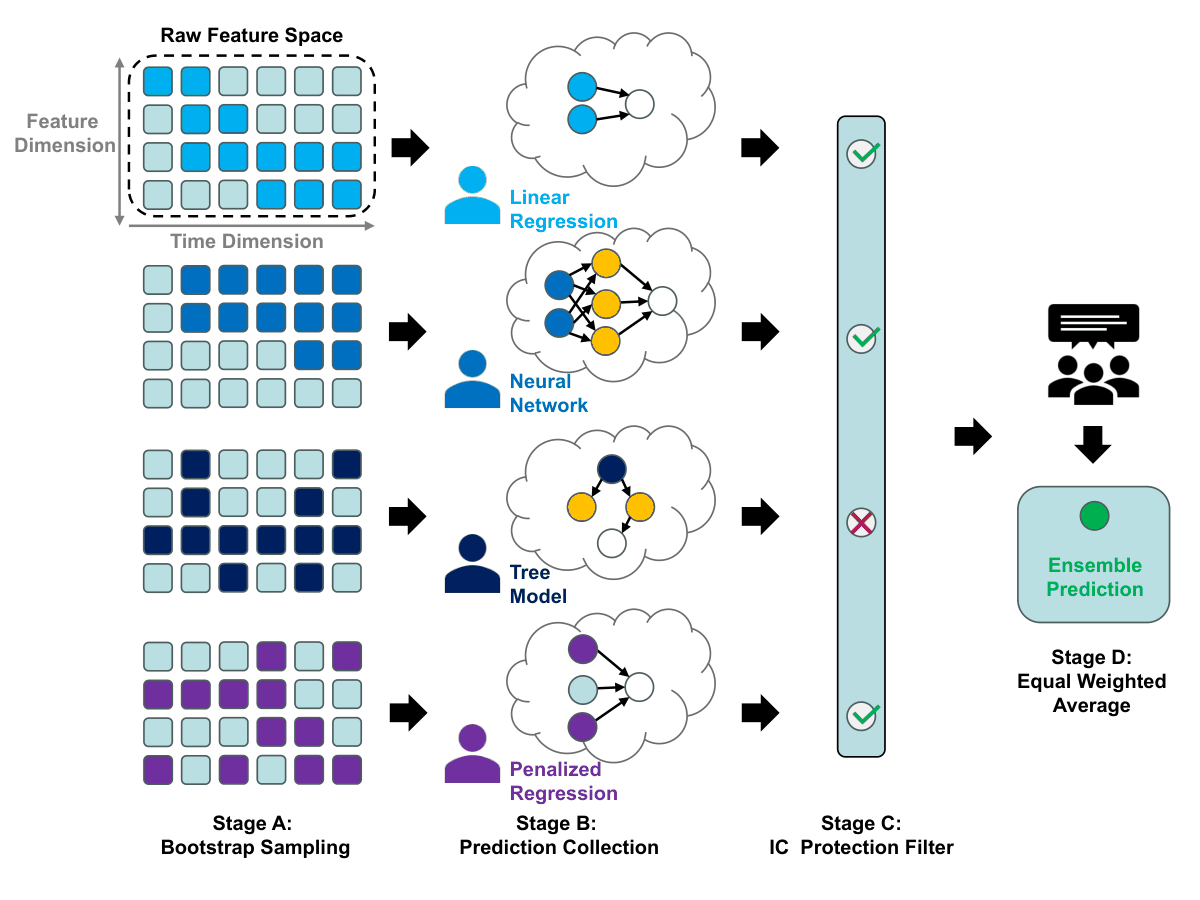
Heterogeneous Ensemble Learning For Cross-Sectional Prediction

Combining linear and nonlinear predictors as specialists improves rank IC by over 13% on daily Chinese stock returns versus neural networks alone.

Fanfare 3ML & AI MethodsDanning LiPDF

Pipeline of the Diversified Expert Ensemble
Figure 1. Pipeline of the Diversified Expert Ensemble. (A) Each predictor receives an independently bootstrap-sampled subset of the raw factor space, combined with a ran…
06

Fine-Tuned Order-Flow Generative Model

A generative model pretrained on crypto order-flow data and fine-tuned for microprice forecasting outperforms gradient boosting and transfers zero-shot to unseen assets.

Fanfare 3ML & AI MethodsFedor ShabashevPDF

Directional skill vs lead time: corr (\mu_{h}, return over (t{+}\text{gap},t{+}\text{gap}{+}h]) against lead gap (as a
Figure 5: Directional skill vs lead time: corr (\mu_{h}, return over (t{+}\text{gap},t{+}\text{gap}{+}h]) against lead gap (as a fraction of h ), with 95% moving-block-b…
21

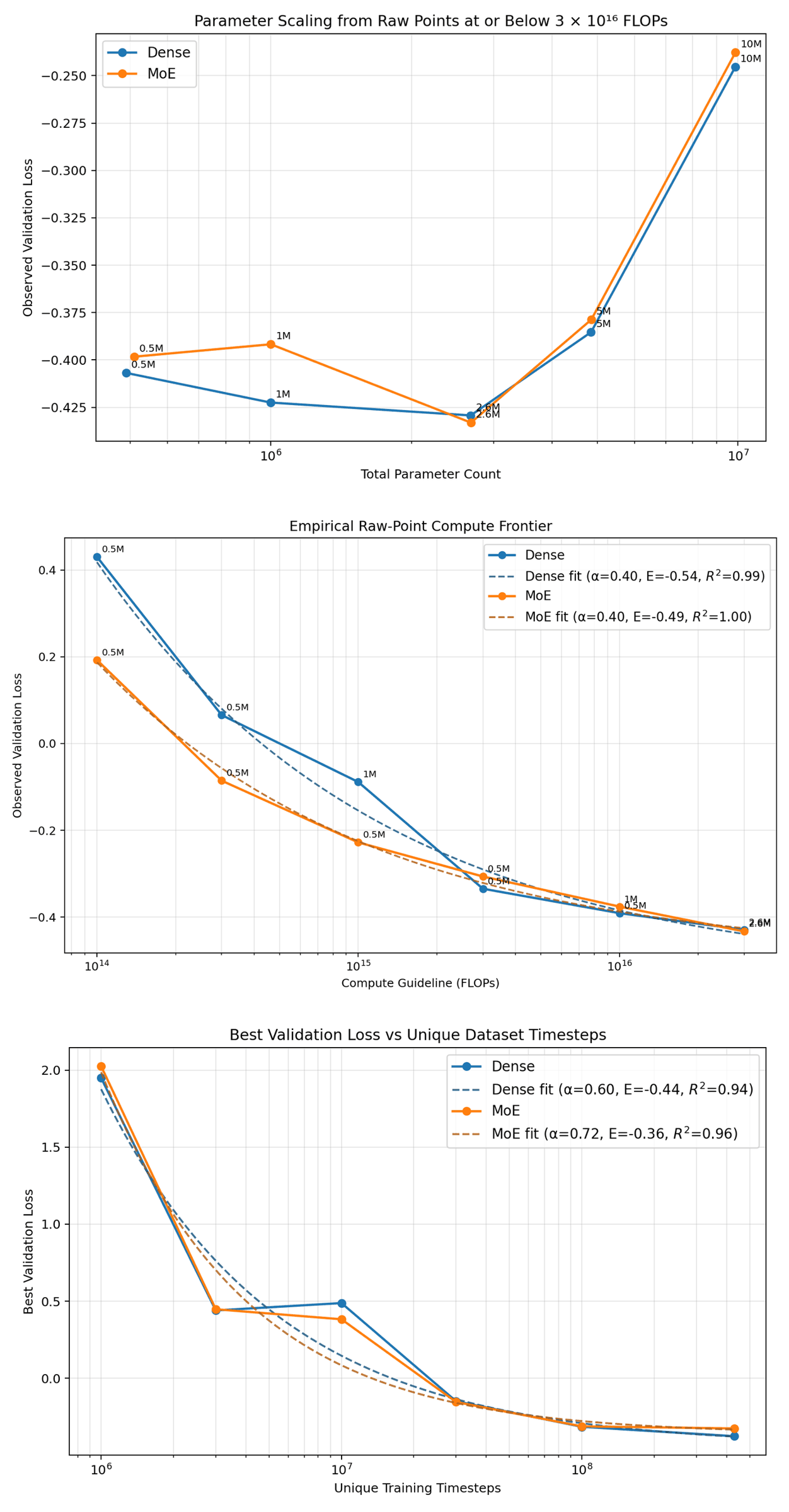
Compact Foundation Model for Financial Forecasting

A 2.68 million-parameter model with grouped-query attention reduces inference latency and matches larger baselines on financial time-series forecasting across multiple assets.

Fanfare 2ML & AI MethodsChiang Qin Zhi et al.PDF

Scaling behavior of dense and MoE TailDART. Lower validation NLL is better in all panels
Figure 2 . Scaling behavior of dense and MoE TailDART. Lower validation NLL is better in all panels.
23

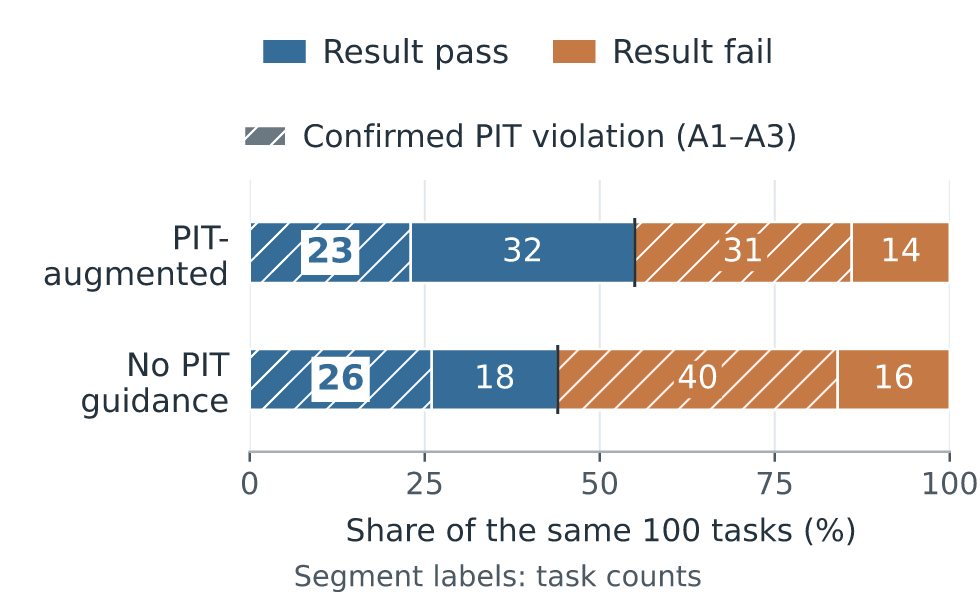
Point-in-Time Benchmark for LLM Agents

Evaluates LLM agents on 408 investment research tasks, finding that half of workflows passing result checks contain temporal violations, revealing a 50.8% gap between output agreement and temporal validity.

Fanfare 3ML & AI MethodsDong Bo et al.PDF

Joint distribution of result outcomes and temporal violations, showing 50% pass with PIT violations.
Figure 4: Joint distribution of result outcomes and confirmed PIT violations on the same 100 audited tasks. Colors encode result outcomes; hatching marks PIT violations…
24

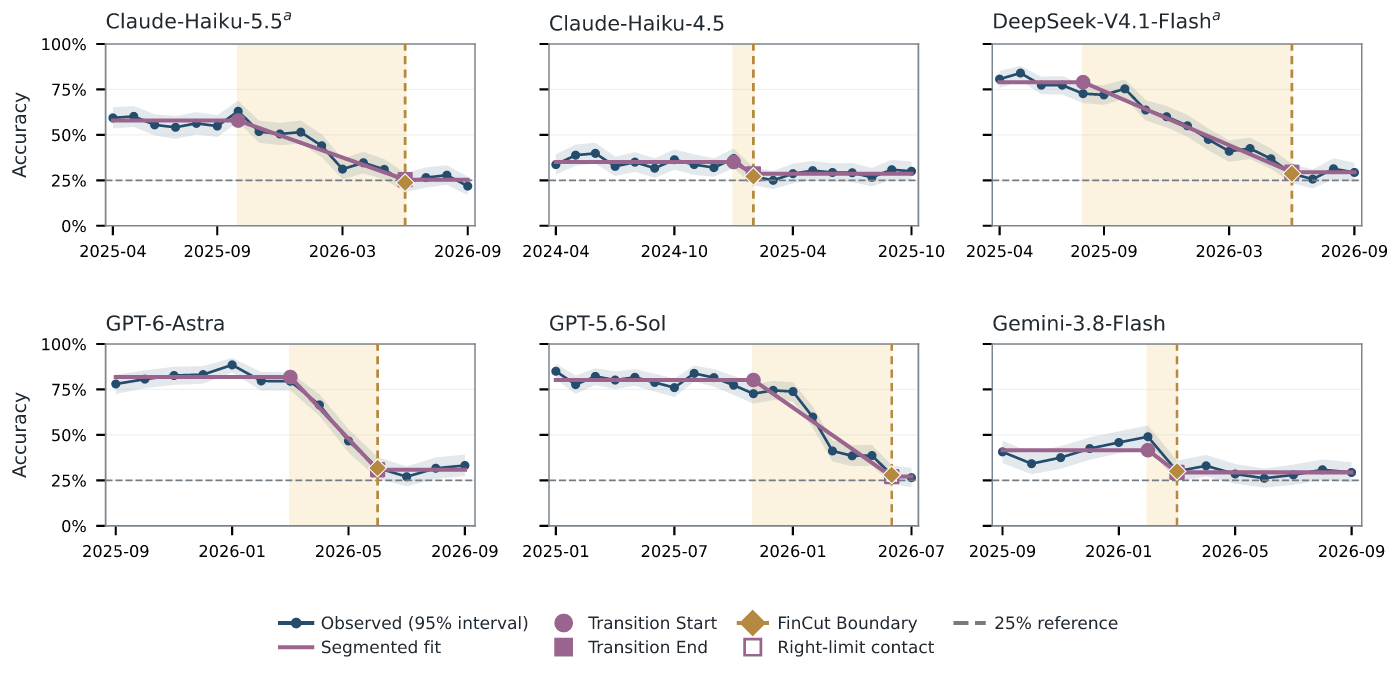
Knowledge Cutoff Benchmark for Financial LLMs

Introduces FinCutBench, a monthly updated benchmark measuring parametric knowledge boundaries in financial LLMs, tracking 9,000 questions from 2023 to 2026 to detect look-ahead bias.

Fanfare 3ML & AI MethodsSiyuan Li et al.PDF

Monthly accuracy trends with knowledge cutoff boundaries for six financial LLMs, shaded confidence intervals.
Figure 2: Monthly accuracy and overall FinCut Boundaries. Each panel uses the model’s stopping window. Blue shading shows pointwise 95% fact-group bootstrap intervals; p…
30

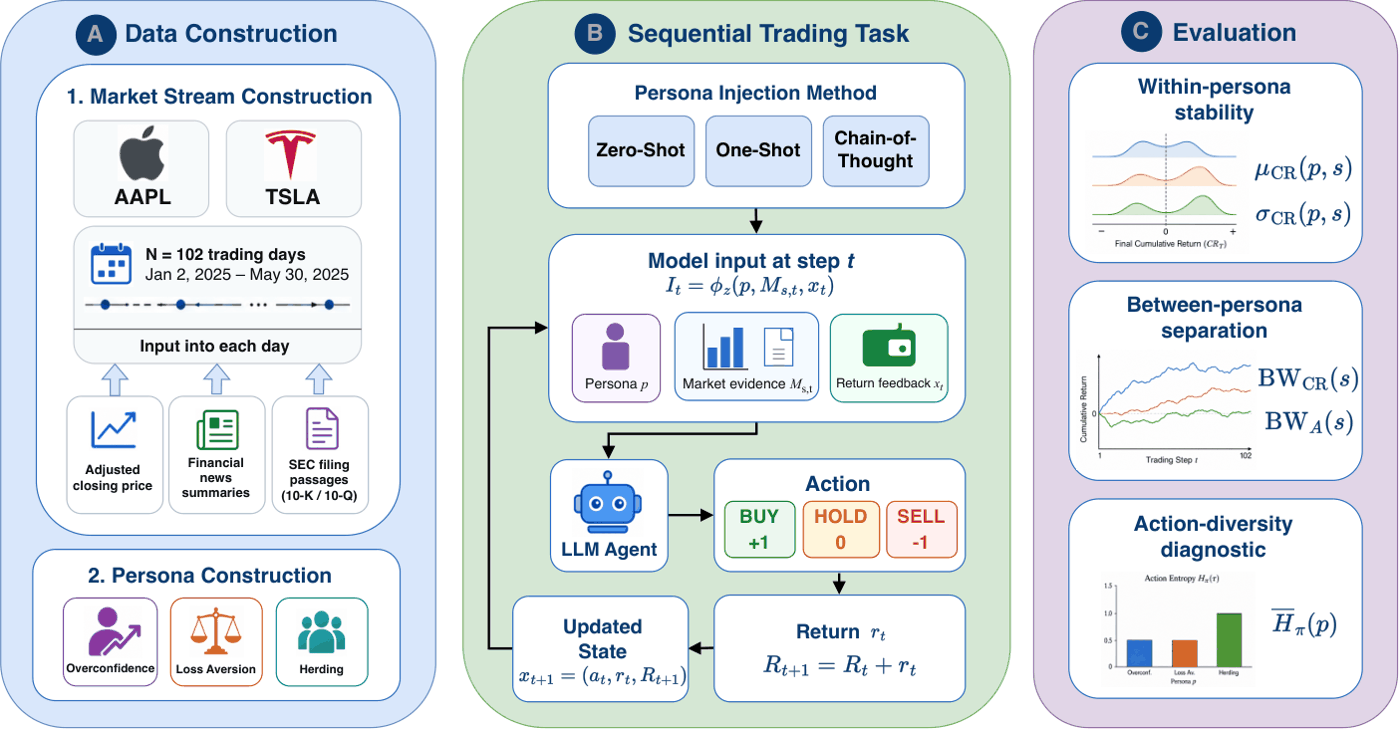
THEATRON Benchmark For LLM Persona Persistence

A financial-replay benchmark reveals that persona conditioning shifts LLM behavior but does not reliably produce stable, coherent persona-specific policies.

Fanfare 1ML & AI MethodsYuyan Wang et al.PDF

Overview of the Theatron benchmark pipeline
Figure 1: Overview of the Theatron benchmark pipeline.

Portfolio & Allocation5

08

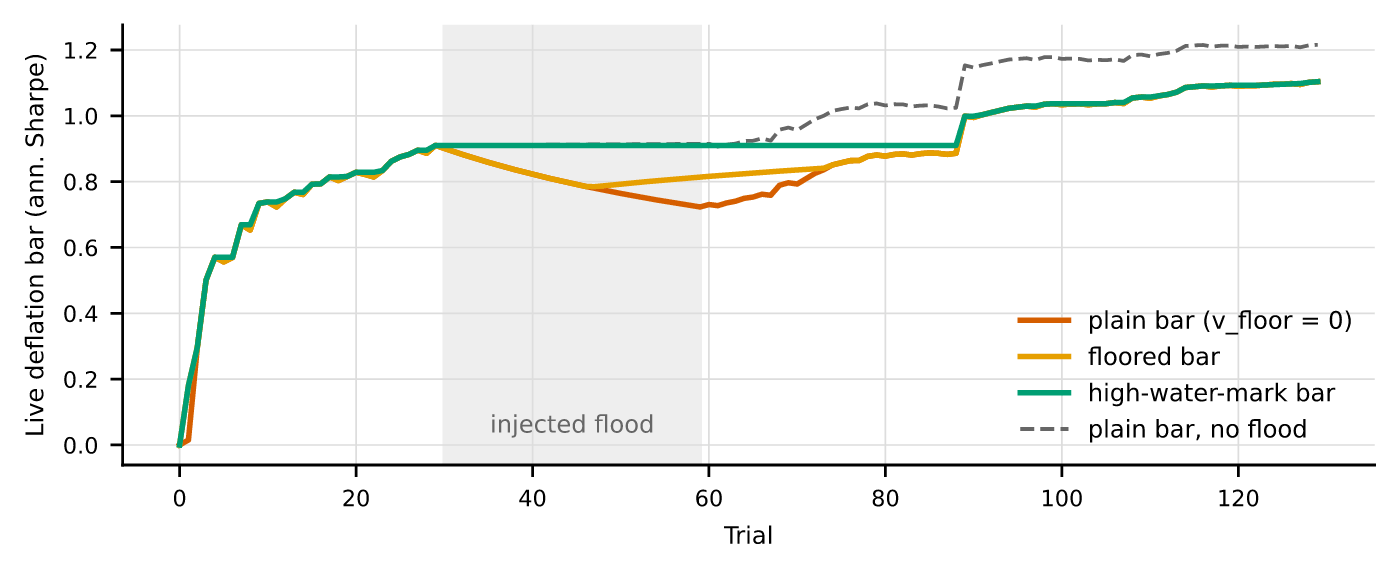
In-Loop Deflation In Strategy Discovery

Moving backtest corrections inside autonomous searches exposes a variance-dilution effect; gating with safeguards eliminates spurious discovery across 53 audited runs.

Fanfare 3Portfolio & AllocationEray GençayPDF

One representative real trial stream under the scripted near-mean flood (shaded), with alpha-wealth stopping
Figure 4. One representative real trial stream under the scripted near-mean flood (shaded), with alpha-wealth stopping. The plain bar falls, the variance floor arrests t…
10

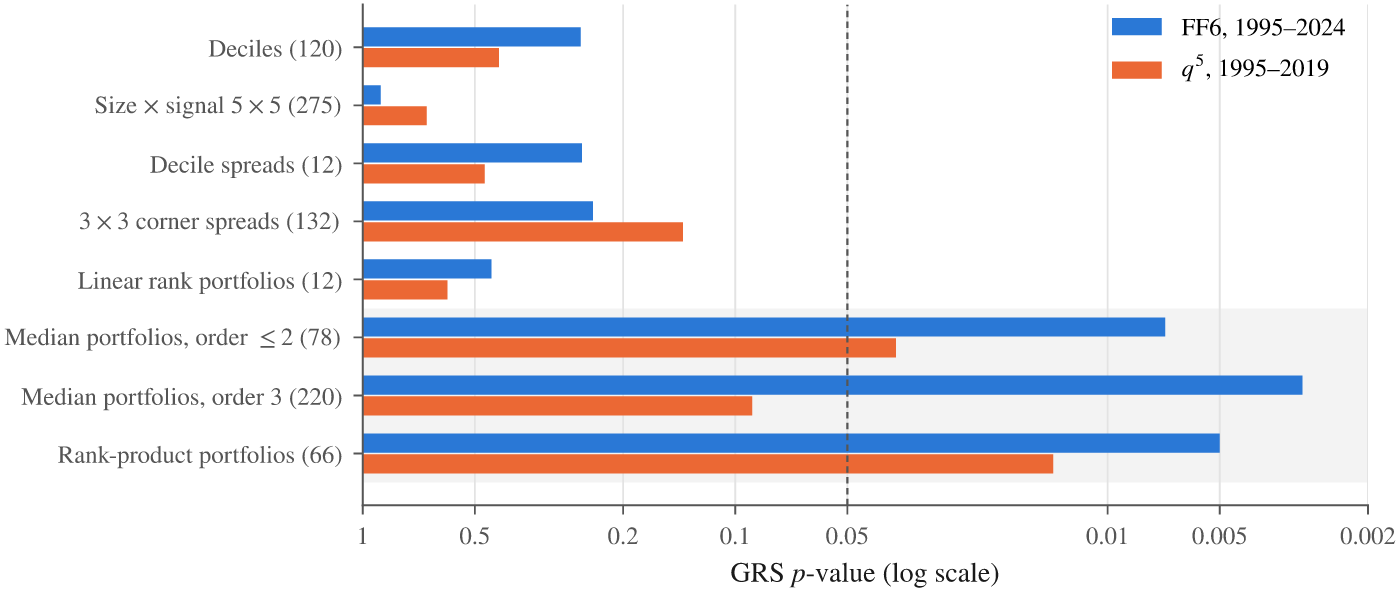
Boolean Rules and Factor Portfolio Turnover

Walsh decomposition reveals how interactions among signals drive turnover and persistence; most single-signal portfolios beat quoted spreads but few multi-signal combinations do.

Fanfare 3Portfolio & AllocationZiyao Wang et al.PDF

Figure OA.3: GRS p -values of FF6 (1995–2024) and q^{5} (1995–2019) for test assets built from the same twelve signals. Bars extend to the right as p falls; the dashed l…
13

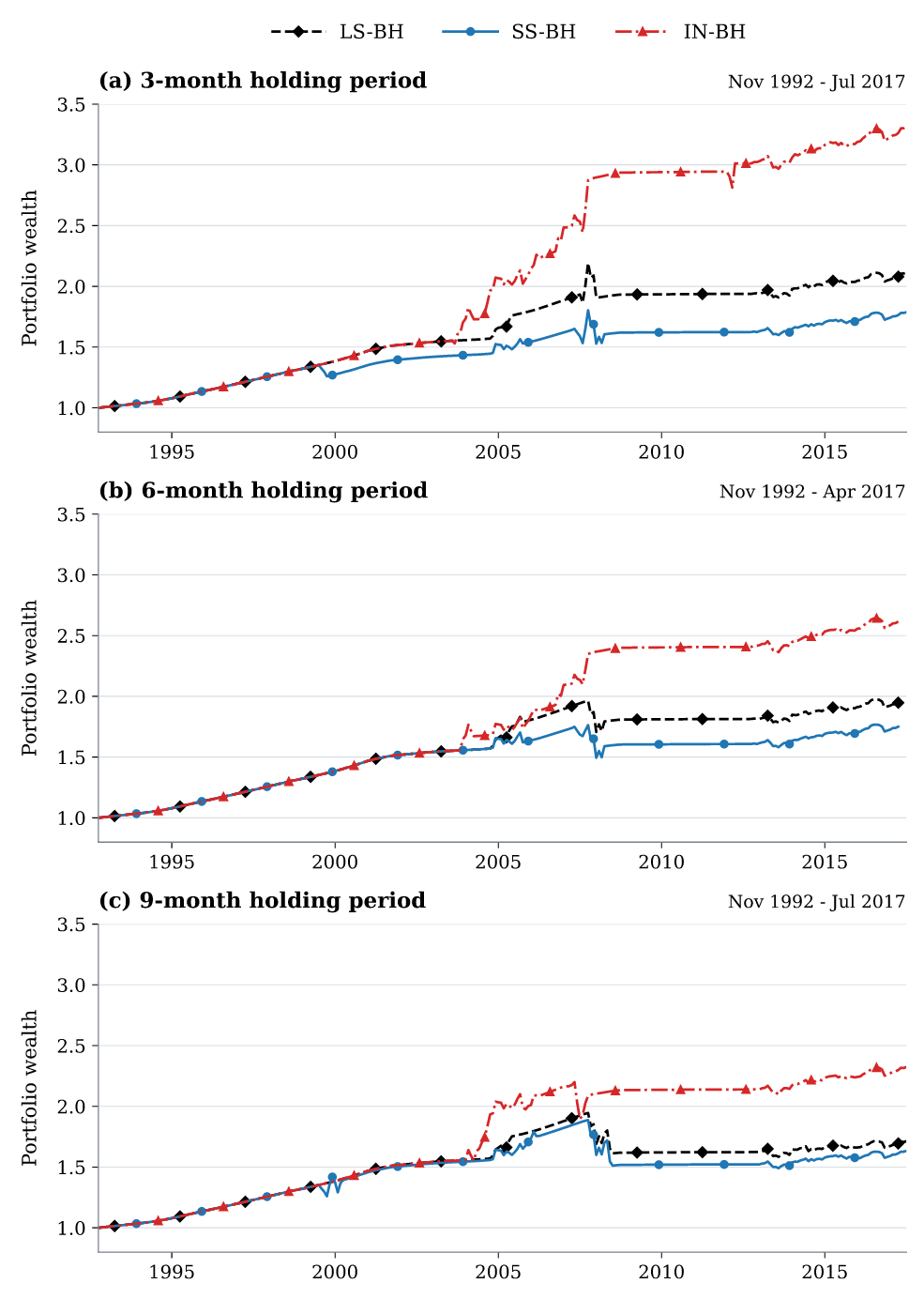
Radial Weighting for Mutual Fund Selection

Develops a robust procedure using radially weighted alpha estimation to identify skilled mutual funds, controlling false discovery rates even under heavy-tailed returns and cross-fund dependence.

Fanfare 3Portfolio & AllocationPing Zhao et al.PDF

Portfolio wealth trajectories over time comparing three fund selection methods across holding periods.
Figure 4 : Subsequent portfolio wealth after rolling 69-month estimation. Panels use holding periods of three, six, and nine months.
14

Neurosymbolic RL for Portfolio Mandates

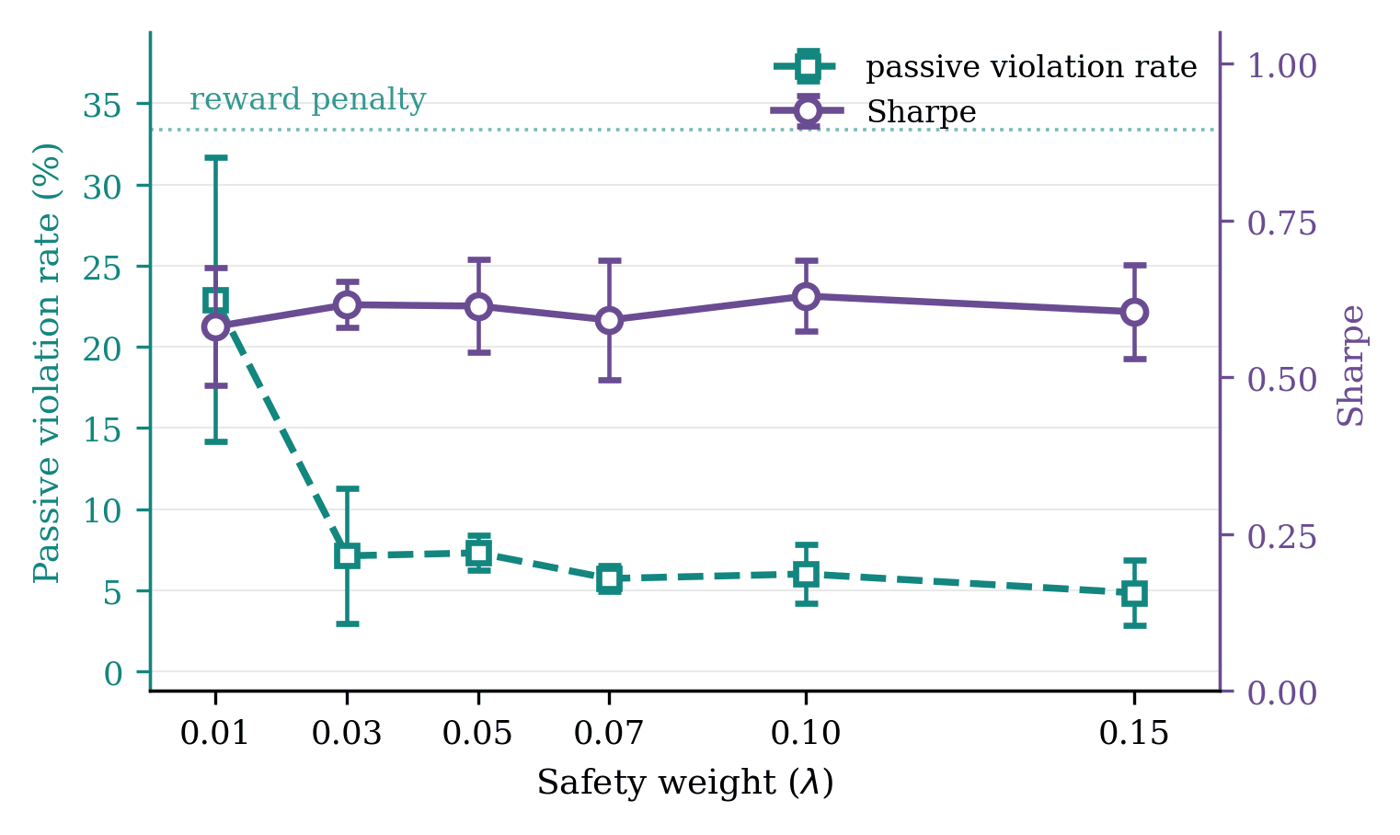
Presents a continuous-action reinforcement learning method that learns to internalize investment policy constraints without post-hoc correction, reducing mandate violations from 96% to 4.8%.

Fanfare 3Portfolio & AllocationZeynep Yıldız et al.PDF

Passive violation rate drops steeply with safety weight lambda, then plateaus near 5%.
Figure 3. PLPG-MC dose–response. Line plot of passive violation rate against the safety weight lambda, falling steeply up to about 0.03 and then flattening near 5 percen…
28

Bayesian RL for Mean-Variance Portfolio Optimization

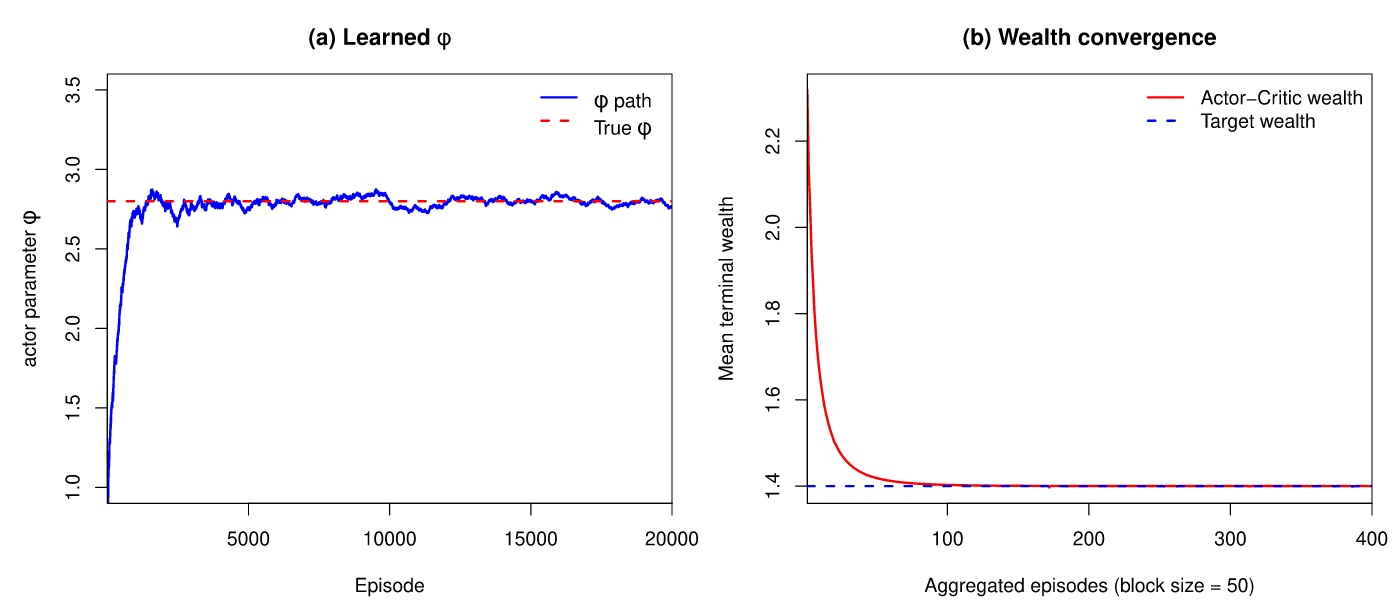
A continuous-time reinforcement learning framework using Thompson Sampling balances wealth and information gain, with exploration endogenously tied to posterior uncertainty.

Fanfare 2Portfolio & AllocationKexin Chen et al.PDF

The learned parameters and average reward along one sample trajectory ( \mu=0.3 , \sigma=0.1 )
Figure 2: The learned parameters and average reward along one sample trajectory ( \mu=0.3 , \sigma=0.1 ).

Asset Pricing & Factors3

09

Seasonal Patterns in Global Futures Markets

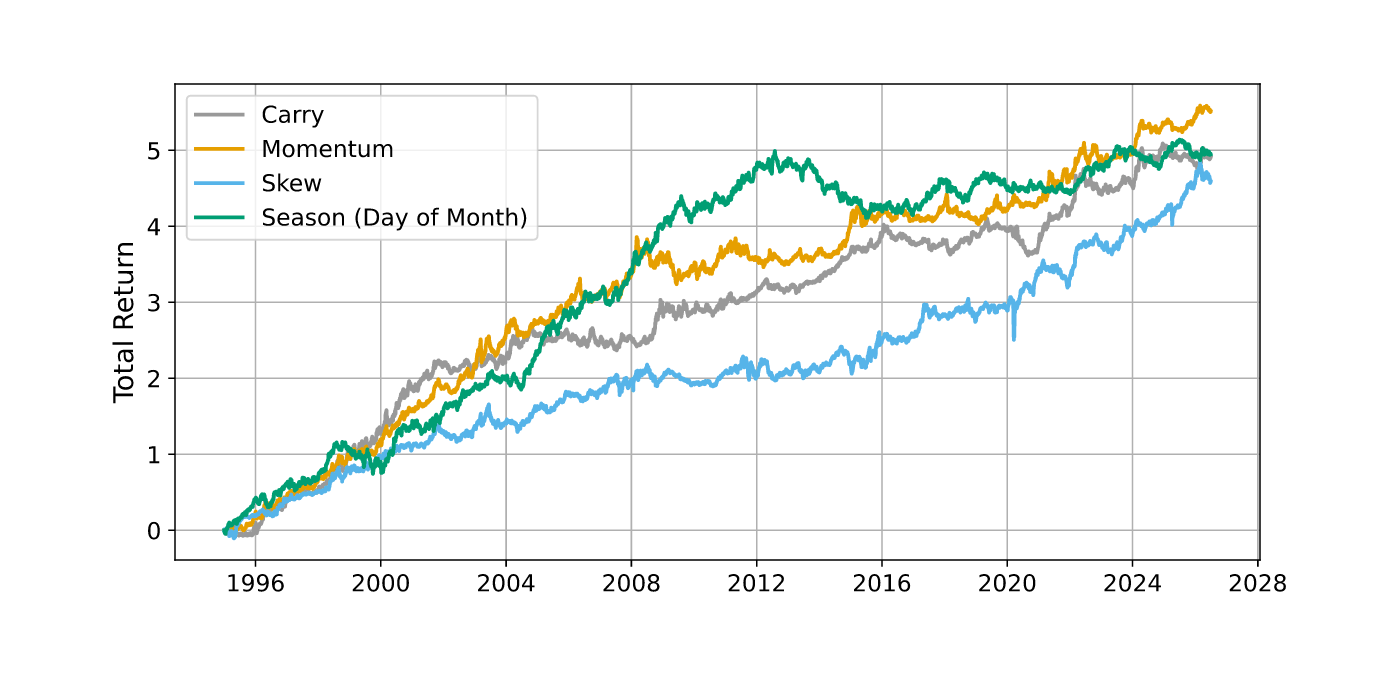
The research identifies five seasonality anomalies across bond, commodity and equity futures; slower seasonal patterns produce positive net returns after costs while fast patterns do not.

Fanfare 3Asset Pricing & FactorsAndrew Butler et al.PDF

Gross out-of-sample total return and Sharpe ratio for models fit using the day-of-month seasonality factor
Figure 5 : Gross out-of-sample total return and Sharpe ratio for models fit using the day-of-month seasonality factor. The out-of-sample period is January 1995 through J…
16

Learning from Earnings Surprise Magnitude

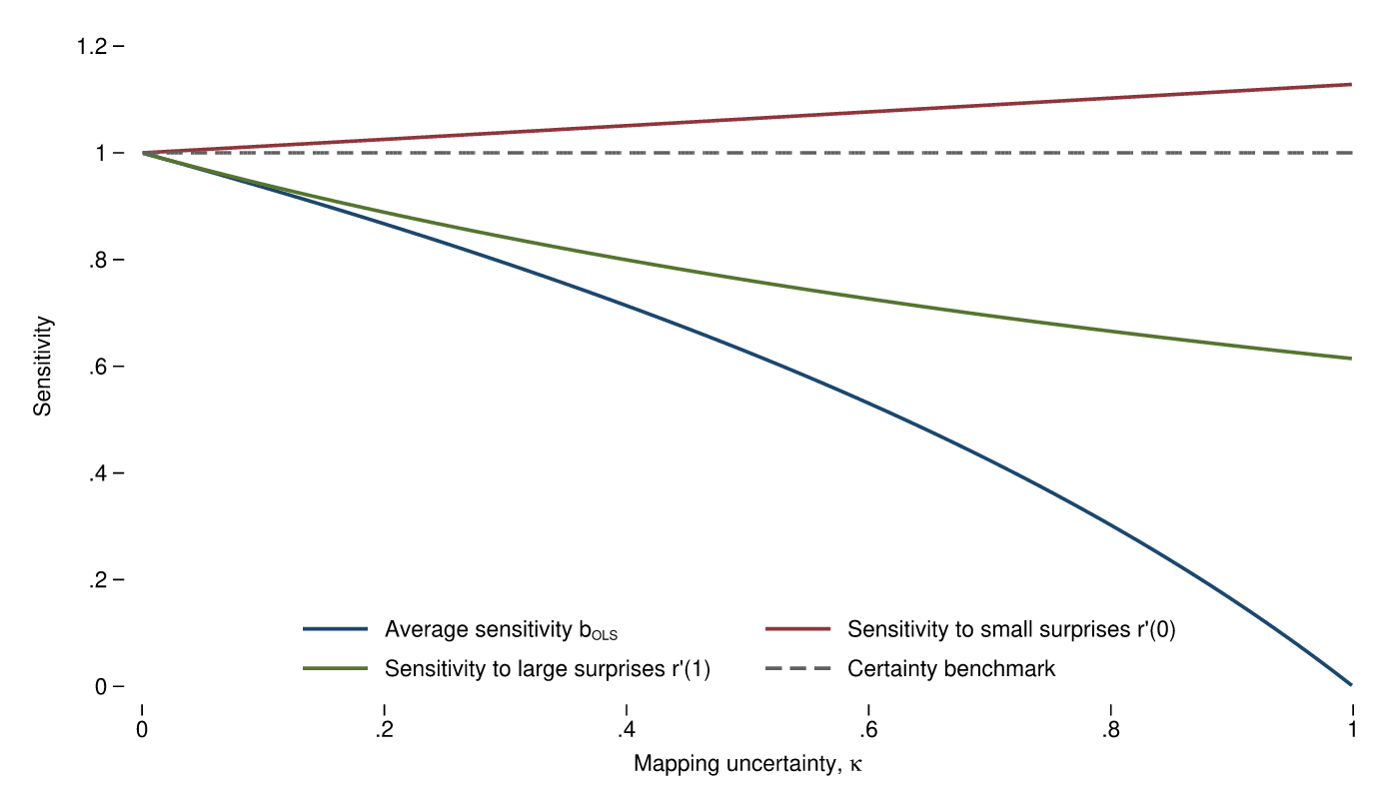
The study shows that investors learning about both news and valuation multipliers from earnings surprises respond less on average but more sharply near zero when multiplier uncertainty is high.

Fanfare 3Asset Pricing & FactorsThomas Graeber et al.PDF

Average and local sensitivity decrease with multiplier uncertainty, sharper response near zero.
Figure 2 : Effect of Multiplier Uncertainty on Average and Local Sensitivity
25

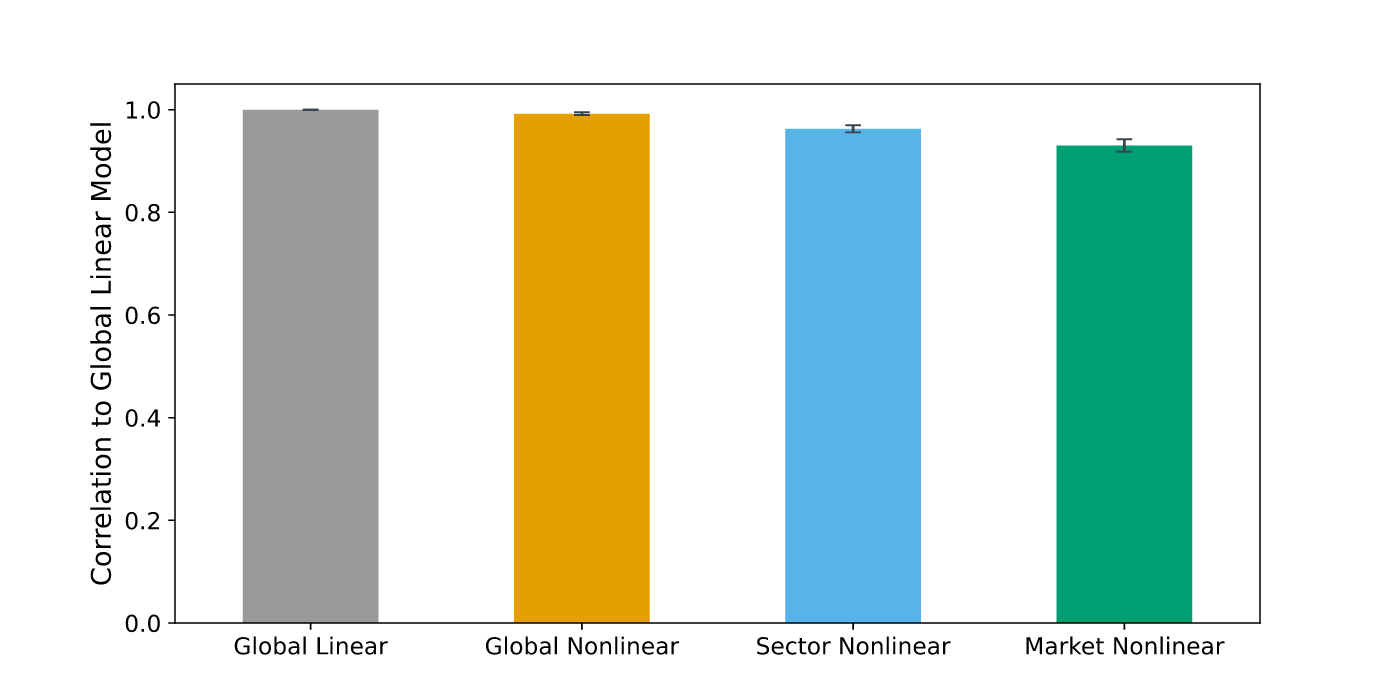
Market-Specific Momentum Models Beat Global Factors

Fitting nonlinear time series momentum models to individual markets rather than globally produces modestly better out-of-sample returns despite smaller sample sizes.

Fanfare 2Asset Pricing & FactorsAndrew Butler et al.PDF

Average out-of-sample correlation to the Global Linear model, evaluated across 1 , 6 and 12 -month time series momentum
Figure 9 : Average out-of-sample correlation to the Global Linear model, evaluated across 1 , 6 and 12 -month time series momentum features. The out-of-sample period is…

Crypto & DeFi3

15

Pre-Consensus Trade Approvals for DEXs

Introduces FirstSwap, a decentralized exchange giving traders early price guarantees before consensus via a scaled admissibility protocol, improving welfare and reducing arbitrage losses.

Fanfare 3Crypto & DeFiWilliam Diamond et al.PDF

17

Optimal Trading Speed On Blockchain

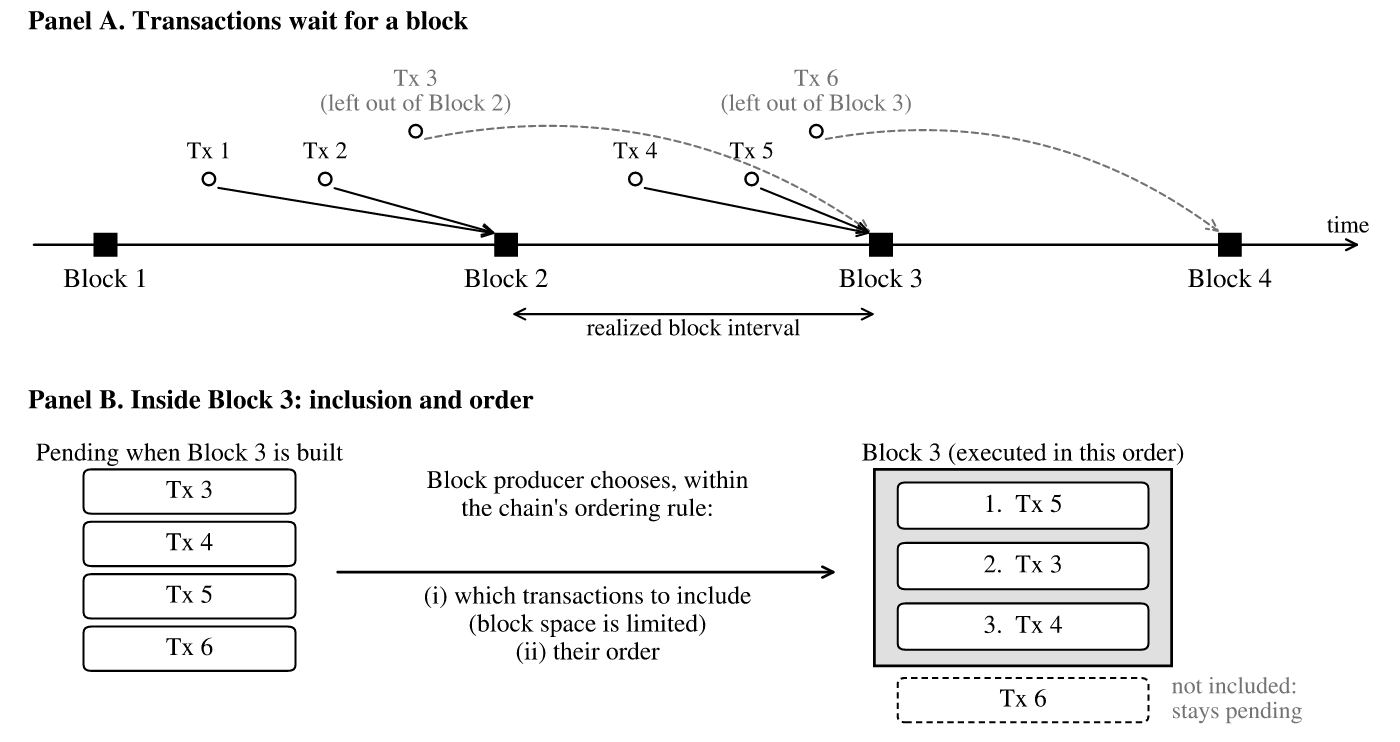
Faster blocks lower priority-fee competition and shift rents to arbitrageurs; Base Flashblocks data confirms liquidity peaks at interior speeds.

Fanfare 3Crypto & DeFiRuizhe Jia and Shihao YuPDF

Transaction execution on a blockchain
Figure 3 : Transaction execution on a blockchain. This figure illustrates how transactions wait for blocks and how they are ordered within a block. Panel A places six tr…
27

Multi-Agent Framework for Crypto Futures Trading

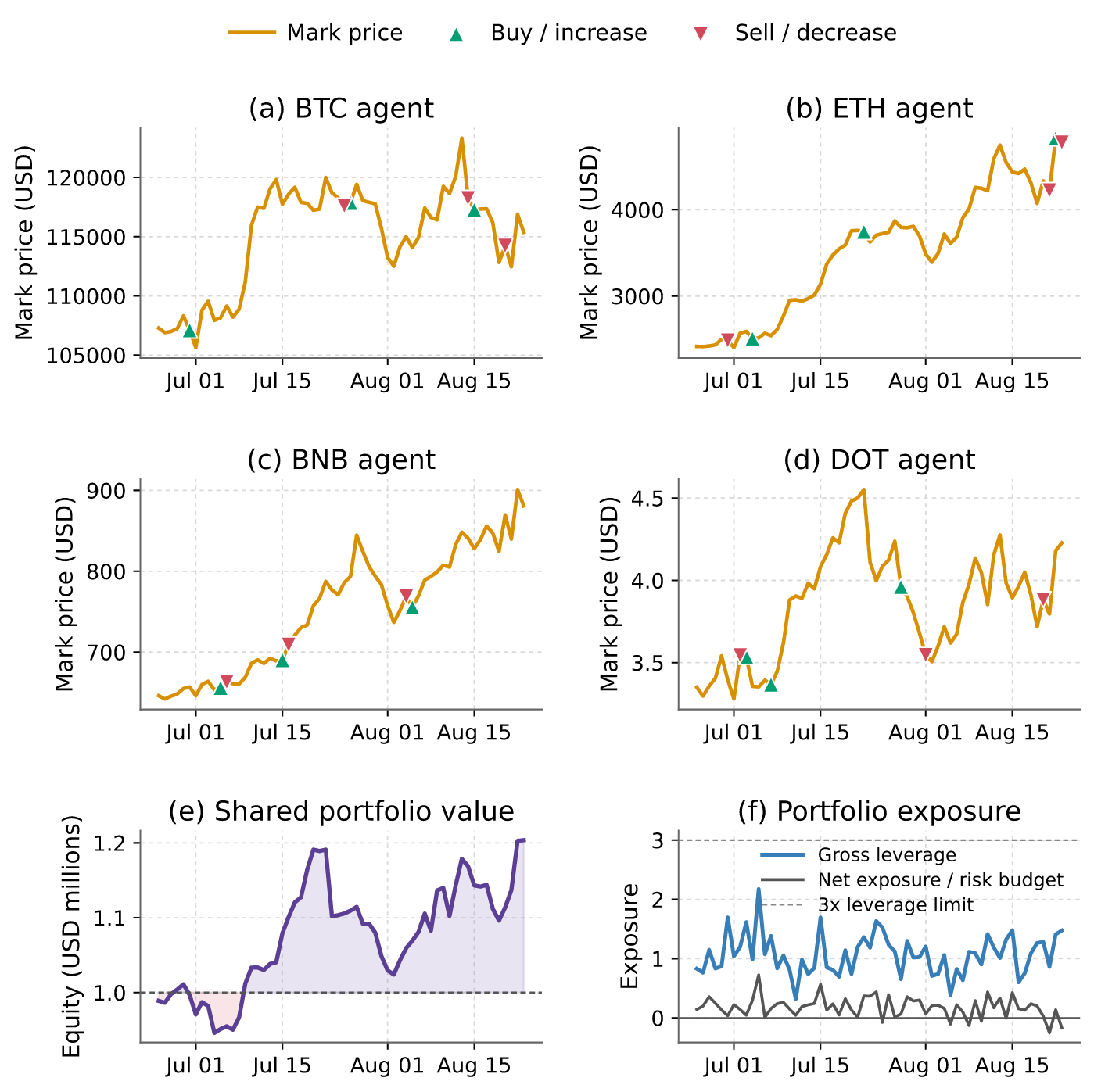
A micro-macro-micro framework combining numerical states with linguistic market interpretations and cross-asset communication improves coordinated trading decisions in perpetual futures.

Fanfare 2Crypto & DeFiJiashun Wang et al.PDF

Four crypto agents' price movements and shared portfolio dynamics over time with exposure metrics.
Figure 3: A representative four-agent M3FT trading episode, showing asset-level target-exposure changes and shared-account portfolio dynamics.

Risk, Credit & Banking2

19

Backtesting High-Dimensional Expected Shortfall

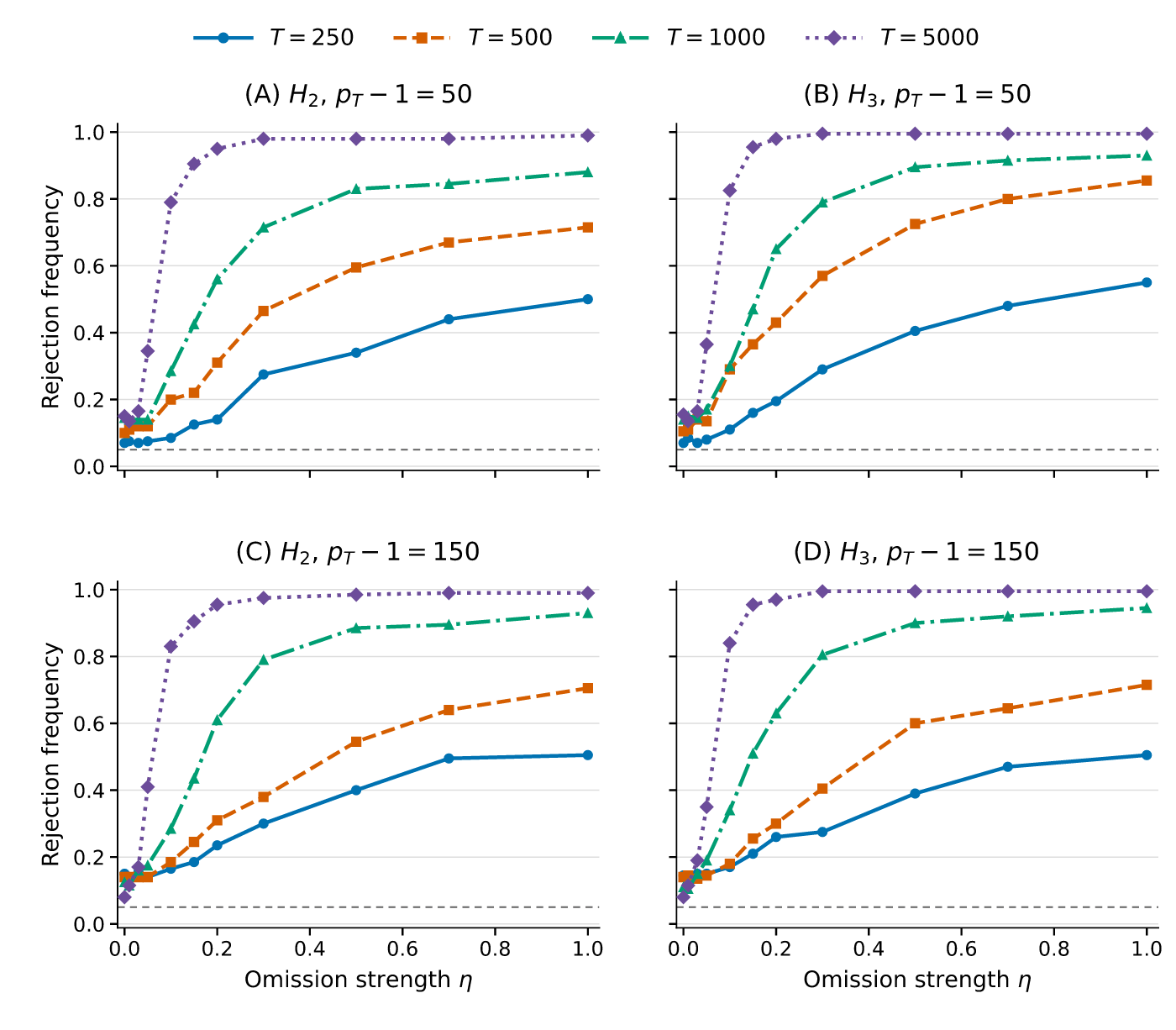
Orthogonal methods remove bias in downside-risk backtests when estimating high-dimensional Value-at-Risk and Expected Shortfall forecasts.

Fanfare 2Risk, Credit & BankingZaichao Du et al.PDF

Power against omitted predictors
Figure 1: Power against omitted predictors. Columns compare H_{2} (VaR and ES omissions) and H_{3} (ES-only omissions); rows correspond to 50 and 150 predictors. Curves…
22

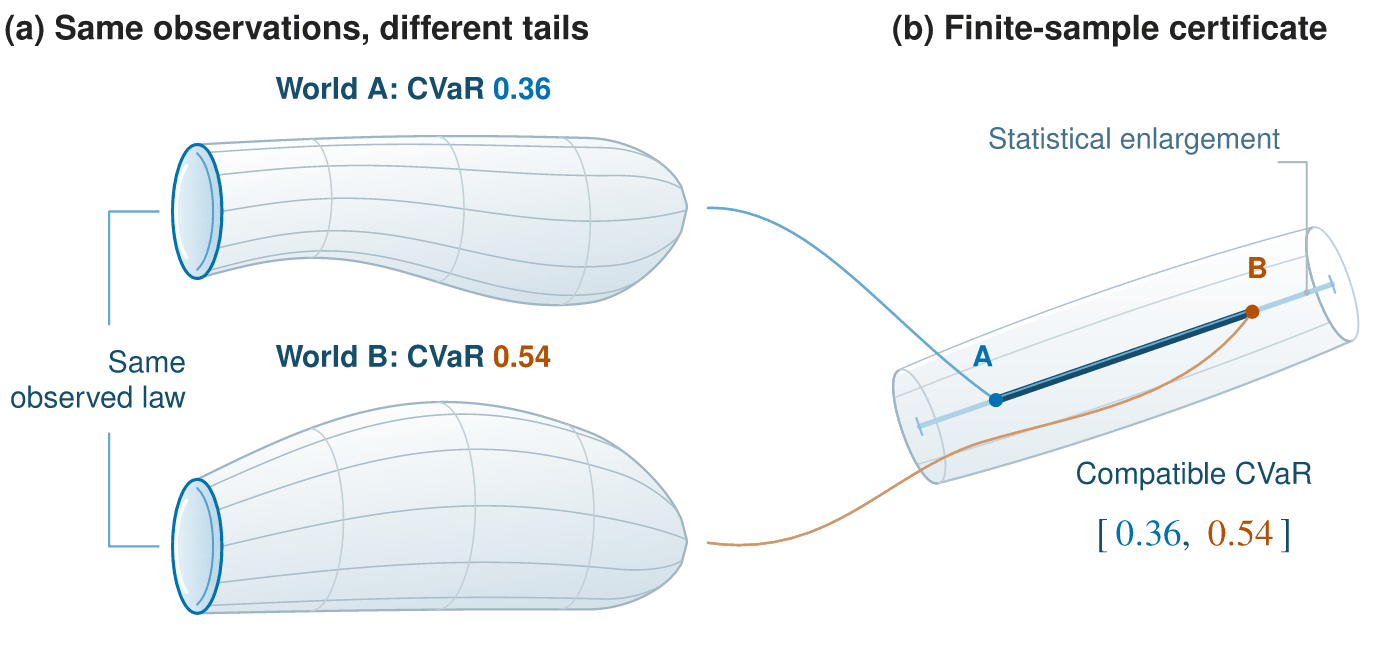
Certifying Tail Risk Under Selective Labels

The research derives bounds on conditional value-at-risk when outcome data is hidden, enabling statistical certificates for tail-risk claims across predictors.

Fanfare 2Risk, Credit & BankingEl Mustapha MansouriPDF

CVaR bounds showing how selective labeling creates ambiguity in tail risk assessment.
Figure 1: Risk ambiguity and statistical uncertainty for one fixed predictor. (a) The same observed law is compatible with hidden-outcome laws giving population CVaR 0.3…

Also notable2

11

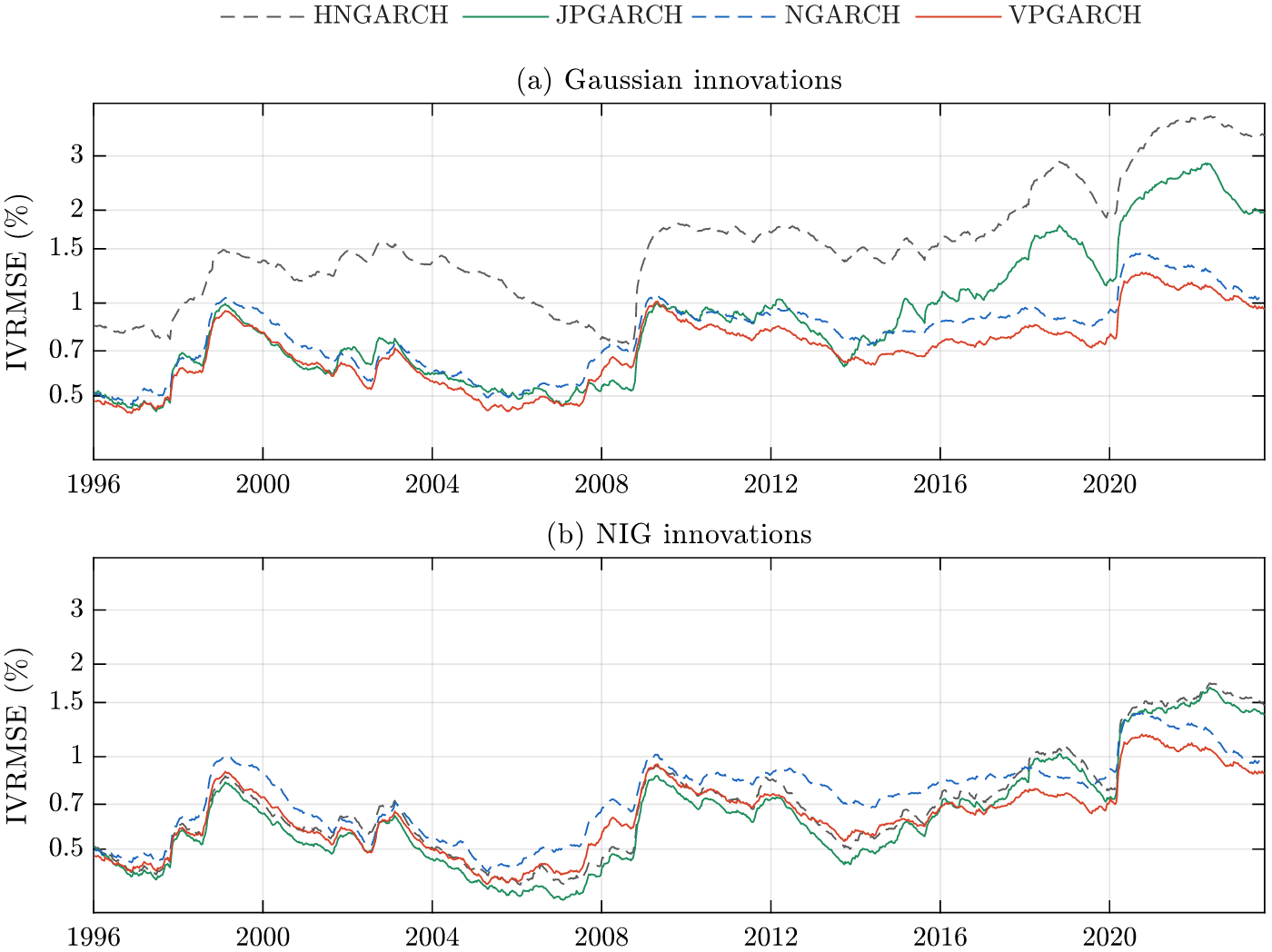
Polynomial-Preserving Stochastic Volatility Models

Discrete-time volatility models preserving polynomial moments reduce implied volatility root mean squared errors by 8–41% versus benchmarks across options spanning 1996–2023.

Fanfare 3Derivatives & VolatilityMaciej Augustyniak et al.PDF

Smoothed implied volatility RMSE over time comparing four models under Gaussian and NIG innovations.
Figure 2: Smoothed Weekly Implied Volatility Root Mean Squared Errors by Innovation Distribution Notes: Panels (a) and (b) show exponentially weighted moving averages (E…
18

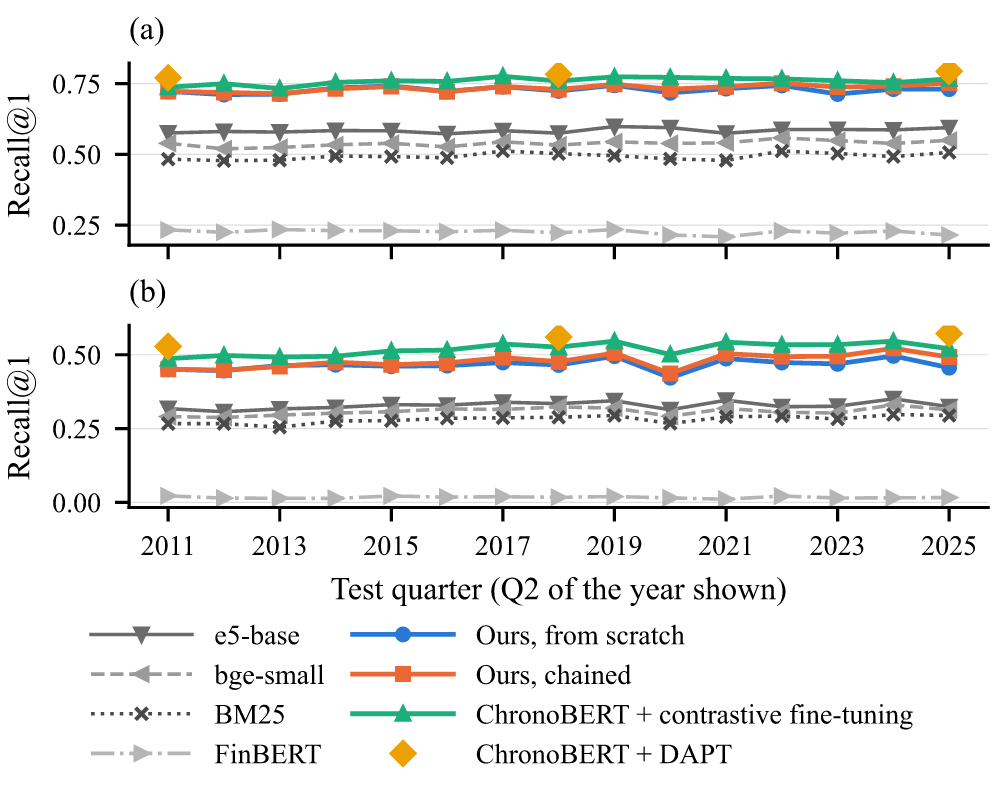
Point-in-Time Encoders For Earnings Calls

Encoders trained on earnings calls with yearly cutoffs raise rank correlation of return forecasts by about half and improve earnings-surprise prediction.

Fanfare 2LLMs & TextAlessio BriniPDF

Recall@1 on held-out calls by test quarter, for the vintage available at the time, so vintage Y is scored on the second
Fig. 2: Recall@1 on held-out calls by test quarter, for the vintage available at the time, so vintage Y is scored on the second quarter of year Y+1 . Each quarter has 3,…

SSRN

New working papers in finance, economics and ML

30 papers · 1 figures

ML & AI Methods3

01

Evidence Audit of 91 LLM Trading Papers

Pre-registers and audits 91 LLM trading papers, finding 51% ignore trading costs, median test window is 12 months, and 98% fail to control for look-ahead bias in model training.

Fanfare 4ML & AI MethodsHeng Zhang

09

AI Proxy Advice for Corporate Governance

An AI-based proxy advisor using firm context and text embeddings beats traditional advisors by 6 to 7 percentage points, earning 10.3% annualized alpha on contested board decisions.

Fanfare 4ML & AI MethodsSean S. Cao et al.

14

Agentic AI for Quant Research Deployment

A practitioner's guide proposes a reference architecture for deploying agentic AI systems in quantitative research, balancing flexibility and control through two reasoning components around a deterministic execution core.

Fanfare 3ML & AI MethodsAnna-Helena Mihov and Philip Treleaven

Econometrics & Forecasting2

02

Code-Paper Discrepancies in Finance Research

A systematic audit of 1,820 economics and finance papers finds 10% of claims show discrepancies between code and description, with 49% containing potentially serious errors affecting central results.

Fanfare 4Econometrics & ForecastingChristoph Huber et al.

30

Polymarket Calibration Across Horizons

A sample of 1,500 sports and politics prediction markets shows prices are well calibrated with no favourite-longshot bias, though calibration slightly worsens seven days before events.

Fanfare 2Econometrics & ForecastingJoseph Glasson

Derivatives & Volatility2

03

Pre-Registered Tests on QQQ Option Chains

Tests 15 pre-registered option strategies and published signals on Nasdaq-100 options with real execution costs, finding none produce tradable edges after correcting for multiple comparisons.

Fanfare 4Derivatives & VolatilityDharm Desai

29

Term Premia and Bond Convexity Trading

The paper derives term premia and convexity from rebalancing strategies rather than theory, showing that volatility smile materially affects convexity value and linking the result to empirical swap estimates.

Fanfare 2Derivatives & VolatilityVladimir Piterbarg and Wouter Van der Helm

Trading, Microstructure & Execution4

04

Frozen Protocol for Trading Strategy Validation

Describes a pre-registered protocol using sequentially adjusted significance levels to judge trading strategies, applied to two Euro Stoxx 50 futures strategies that both fail strict statistical tests.

Fanfare 4Trading, Microstructure & ExecutionDaniele Frongia and Fabio Crescenzi

15

Commodity Bubbles and Managed Money Trends

The study tracks commodity traders through explosive price episodes and finds managed money follows trends but stops buying as long-horizon trends strengthen, suggesting extrapolation does not amplify bubbles.

Fanfare 3Trading, Microstructure & ExecutionRafael Baptista Palazzi

16

Margin Requirements and Futures Market Liquidity

Using exogenous variation in maintenance margins across futures, the research finds higher margins reduce trading volume by 2.67%, cut liquidity by 7.51%, and raise volatility by 2.59%.

Fanfare 3Trading, Microstructure & ExecutionGabriel Bracons

18

Optimal Portfolio Market Making Theory

The research derives a closed-form lower bound on trading costs that depends only on return and order-flow covariances, showing that Kyle's lambda achieves optimality for multi-asset liquidity provision.

Fanfare 3Trading, Microstructure & ExecutionAndreas Park and Katya Malinova

Asset Pricing & Factors9

05

Agentic Search for Stochastic Discount Factors

Automates asset pricing research using agents to propose and test stochastic discount factors, finding one with out-of-sample Sharpe ratio of 3.38 and 0.86 rank correlation across periods.

Fanfare 4Asset Pricing & FactorsAlejandro Lopez-Lira et al.

06

Pricing Ability of Nontraded Factors

Robust econometric methods reduce the fraction of 102 nontraded factors classified as priced from 39% to 4%-13%, suggesting prior tests overstated their pricing ability.

Fanfare 4Asset Pricing & FactorsAmedeo Andriollo et al.

07

Sustainability Information and Returns

Machine learning finds no robust evidence that sustainability characteristics predict stock returns after multiple-testing corrections, contradicting prior research.

Fanfare 4Asset Pricing & FactorsEnrica Archetti et al.

08

Complex Capital Markets Hypothesis

Models a computational arms race where many weak signals drive return predictability and explain why uncertainty about signal coefficients sustains an equity premium.

Fanfare 4Asset Pricing & FactorsSergei Glebkin et al.

17

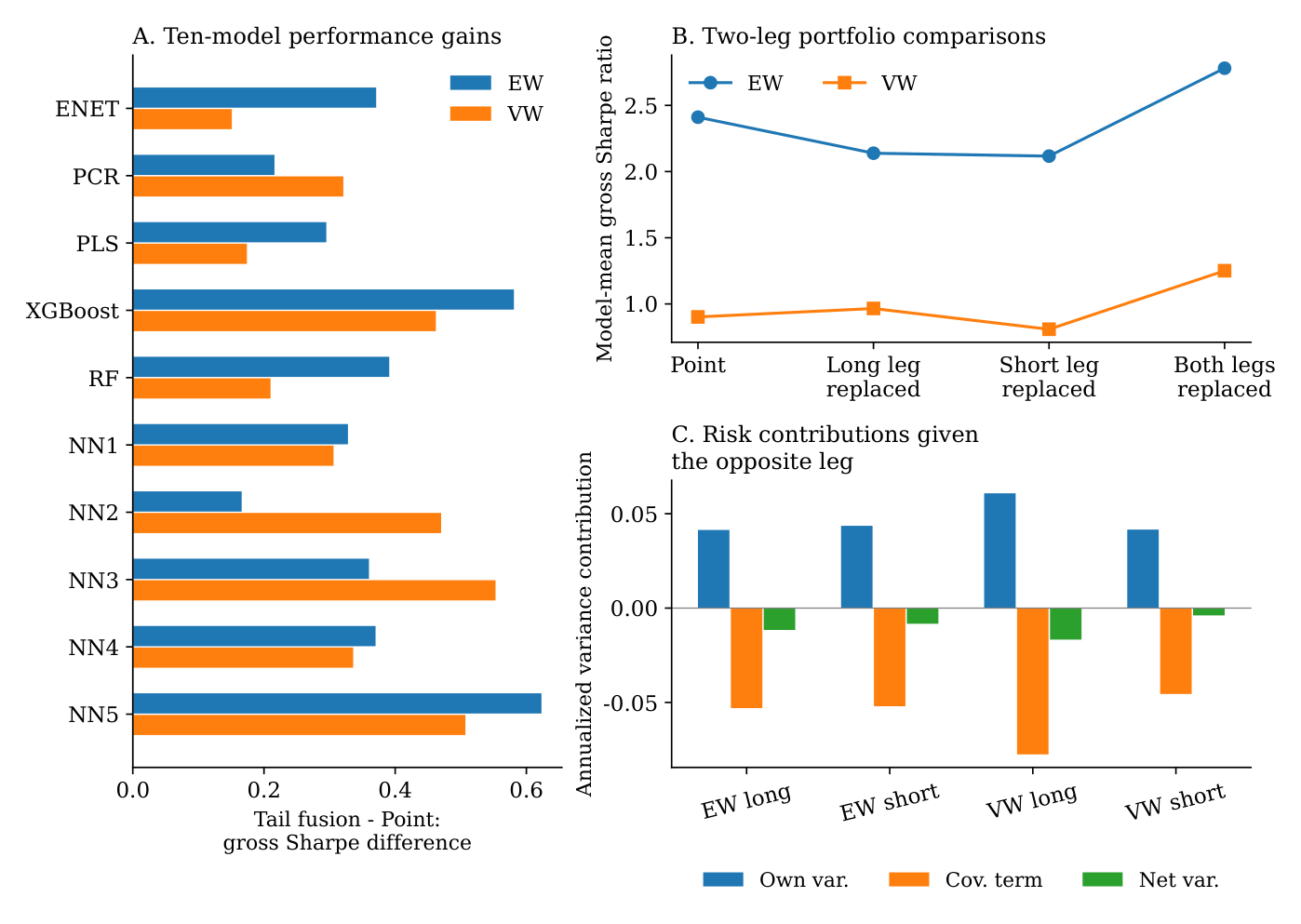
Tail Distributions Improve Portfolio Selection

Incorporating upper and lower tail information from machine learning models increases Sharpe ratios for long-short equity portfolios across ten prediction models from 1992 to 2024.

Fanfare 3Asset Pricing & FactorsYifei Wang

Performance and Joint Risk of Directional Tail-Based Stock Selection
Figure 1: Performance and Joint Risk of Directional Tail-Based Stock Selection
20

Risk Premium Neglect in Asset Forecasts

Professional forecasters systematically overestimate Treasury yields and stock returns when expecting monetary tightening, neglecting how policy changes alter the price of risk.

Fanfare 3Asset Pricing & FactorsPeter Vaporakis

21

Long-Run Rates and the Carry Trade

Research shows that sorting currencies on long-run interest-rate differentials yields a carry strategy with higher Sharpe ratios and significant alpha versus traditional carry.

Fanfare 3Asset Pricing & FactorsMohammed Mehdi Kaebi and Igor Ferreira Batista Martins

25

Factor Investing in Financial Institutions

Financial institutions excluded from factor studies show meaningful factor premiums; including them with adapted definitions improves risk-adjusted portfolio returns.

Fanfare 3Asset Pricing & FactorsGuido Baltussen et al.

26

Physical Climate Risk in U.S. Equities

A scenario-analysis framework reveals strong cross-state and cross-sector heterogeneity in climate risk, with portfolio-level valuations declining roughly 4.0% under current policy.

Fanfare 3Asset Pricing & FactorsVincent Bouchet and Nicolas Schneider

Risk, Credit & Banking2

10

AI Compute Finance Network Risk

The study maps the financial network supporting AI buildout, revealing concentrated debt exposures and network propagation risks that could cause losses reaching $16.87 trillion in a low-productivity state.

Fanfare 4Risk, Credit & BankingStijn Van Nieuwerburgh and Zijin Su

22

Non-Standard Errors in Risk Capital

The paper quantifies that reasonable modeling choices for Value-at-Risk and Expected Shortfall create capital gaps of a third between identical portfolios at different banks.

Fanfare 3Risk, Credit & BankingGregor N. F. Weiss

LLMs & Text3

11

ChatGPT Reduces Analyst Forecast Diversity

Following ChatGPT's release, analyst forecast divergence fell sharply and AI-assisted reports show stronger textual similarity, reducing information diversity in markets.

Fanfare 4LLMs & TextShawn X. Huang et al.

13

LLMs in Asset Pricing: A Literature Review

Surveys applications of large language models to return prediction, risk measurement, and investor beliefs from financial text, highlighting look-ahead bias and evaluation pitfalls in existing research.

Fanfare 3LLMs & TextMohammad Gheidi

27

Fund Differentiation Narrative vs. Portfolio

Narrative distinctiveness drives fees and flows while portfolio uniqueness predicts future alpha, suggesting fund prospectuses serve marketing while holdings signal performance ability.

Fanfare 3LLMs & TextGe Yu

Macro-Finance & Rates4

12

Quantitative Easing Effects on House and Stock Prices

A 10 basis point QE-type surprise raises real house prices 3% in the US and 1.6% in the euro area, lifts technology stocks, and shifts wealth toward the middle class without raising stock indices broadly.

Fanfare 4Macro-Finance & RatesNuoya Chen

19

Treasury Buybacks and Dealer Inventories

Data on Treasury buybacks reveal dealers reduce inventories in targeted maturity segments, with larger declines among specialists and balance-sheet-constrained dealers facing binding leverage constraints.

Fanfare 3Macro-Finance & RatesCourtney Wiegand et al.

24

Random-Walk Benchmark for Bond Returns

A yield-curve slope measure based on random-walk beliefs outperforms the expectations hypothesis in forecasting Treasury returns and economic value out of sample.

Fanfare 3Macro-Finance & RatesHoyong Choi

28

Tariff Announcement Dollar Depreciation

The dollar depreciated after U.S. tariff announcements not from treasury flight but from equity rotation from domestic to foreign stocks, revealed by fund flow analysis.

Fanfare 3Macro-Finance & RatesRashad Ahmed et al.

Also notable1

23

Model Portfolios and Fund Competition

Centralized model portfolios buffer fund flows but weaken incentives for active management, reducing performance persistence and dampening rewards for outperformance.

Fanfare 3Portfolio & AllocationPietro Lazzaretto

RePEc

Working papers curated by RePEc's NEP field reports

30 papers · 22 figures

Asset Pricing & Factors5

01

Asymmetric Idiosyncratic Return Reversal

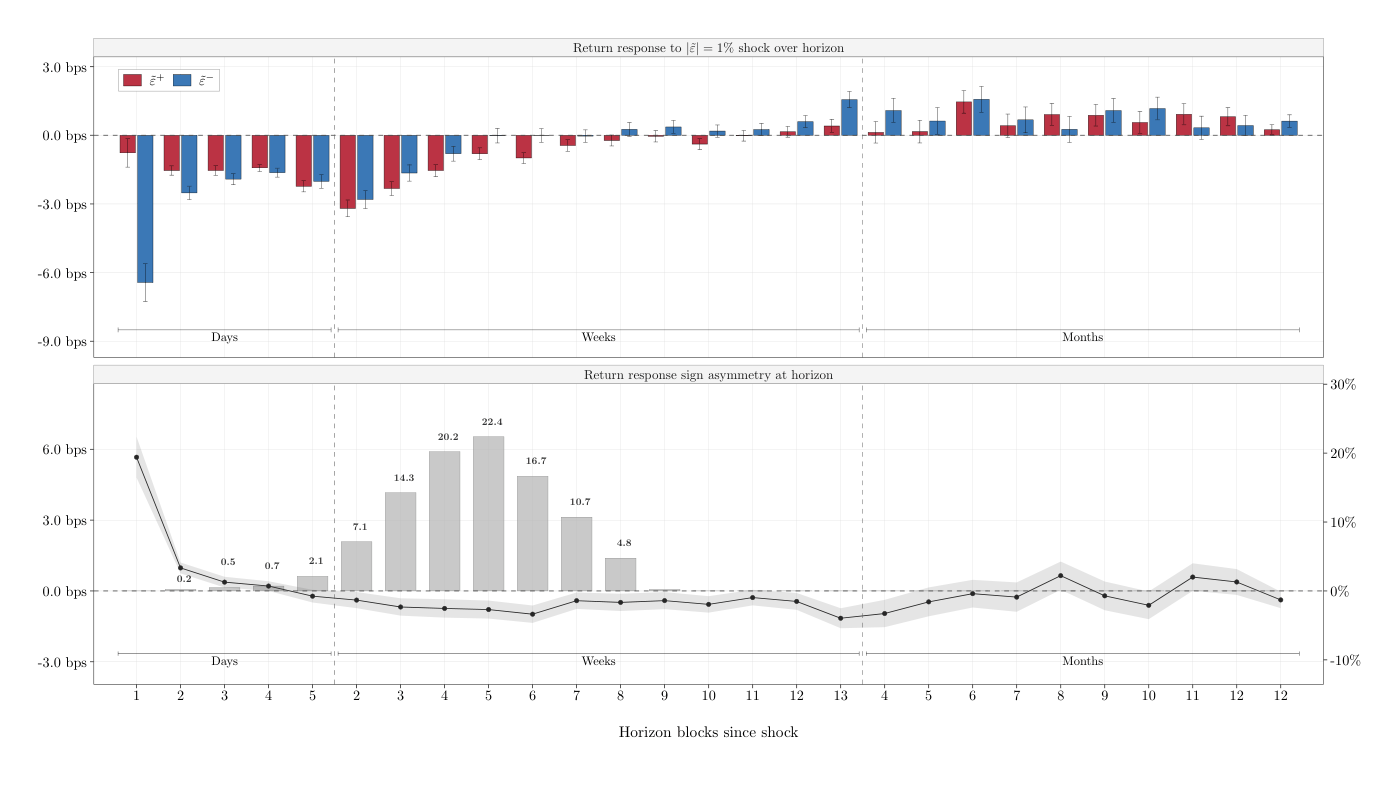
Positive residual stock shocks reverse slower than negative shocks, and this asymmetric reversal explains short-term predictability better than idiosyncratic volatility alone.

Fanfare 4Asset Pricing & FactorsFederico Baldi-Lanfranchi et al.PDF

Residual reversal timing and monthly aggregation weights
Figure 7: Residual reversal timing and monthly aggregation weights. This figure links spline-implied residual return responses from equation (22) to the monthly aggregat…
03

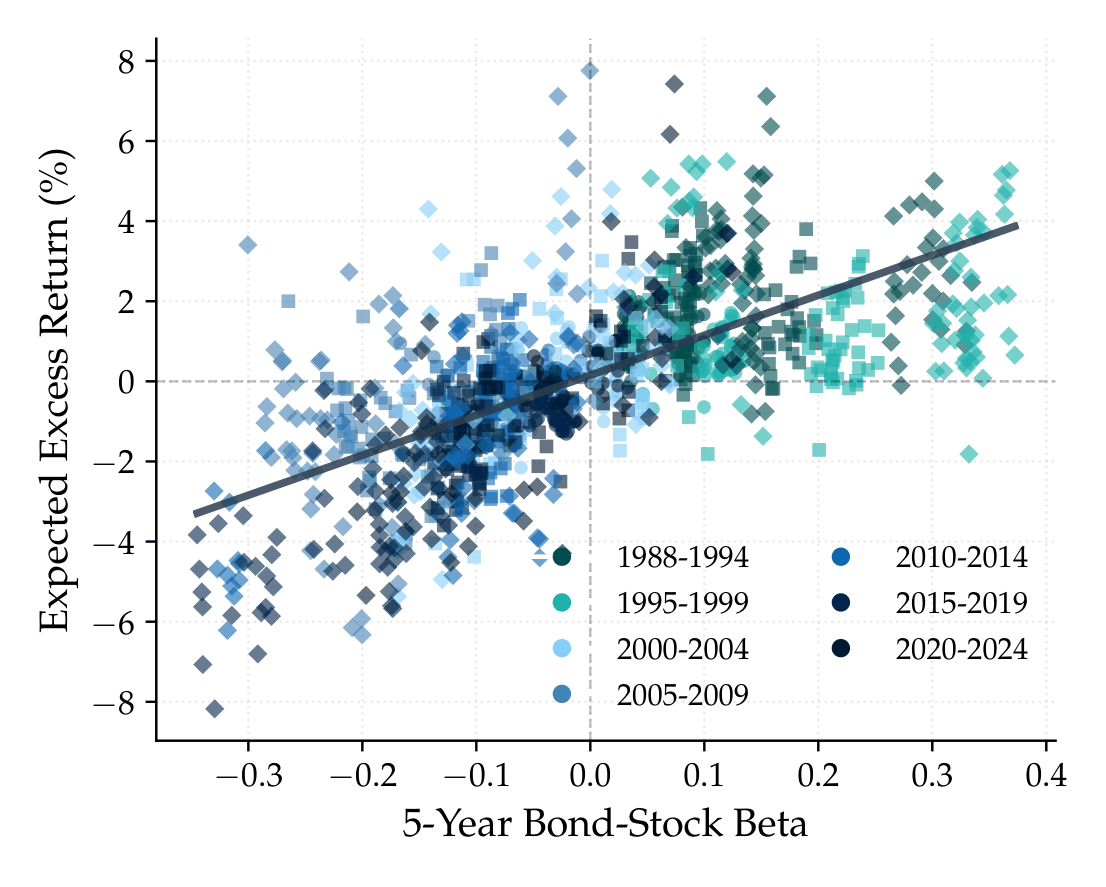
Government Bond Risk Return Correlation

Expected excess returns on government bonds correlate 67% with bond-stock betas and account for more than half of long-term yield moves since the mid-1980s.

Fanfare 3Asset Pricing & FactorsMatteo Leombroni et al.PDF

Scatter plot showing strong positive correlation between bond-stock betas and expected excess returns
Figure 2: Bond Expected Excess Returns and Bond–Stock Betas
09

AI Innovation and Stock Returns Globally

The study finds that AI patenting activity predicts higher stock market returns across 61 countries, with strongest effects in the EU, UK, and G7 economies.

Fanfare 3Asset Pricing & FactorsGuglielmo Maria Caporale et al.PDF

27

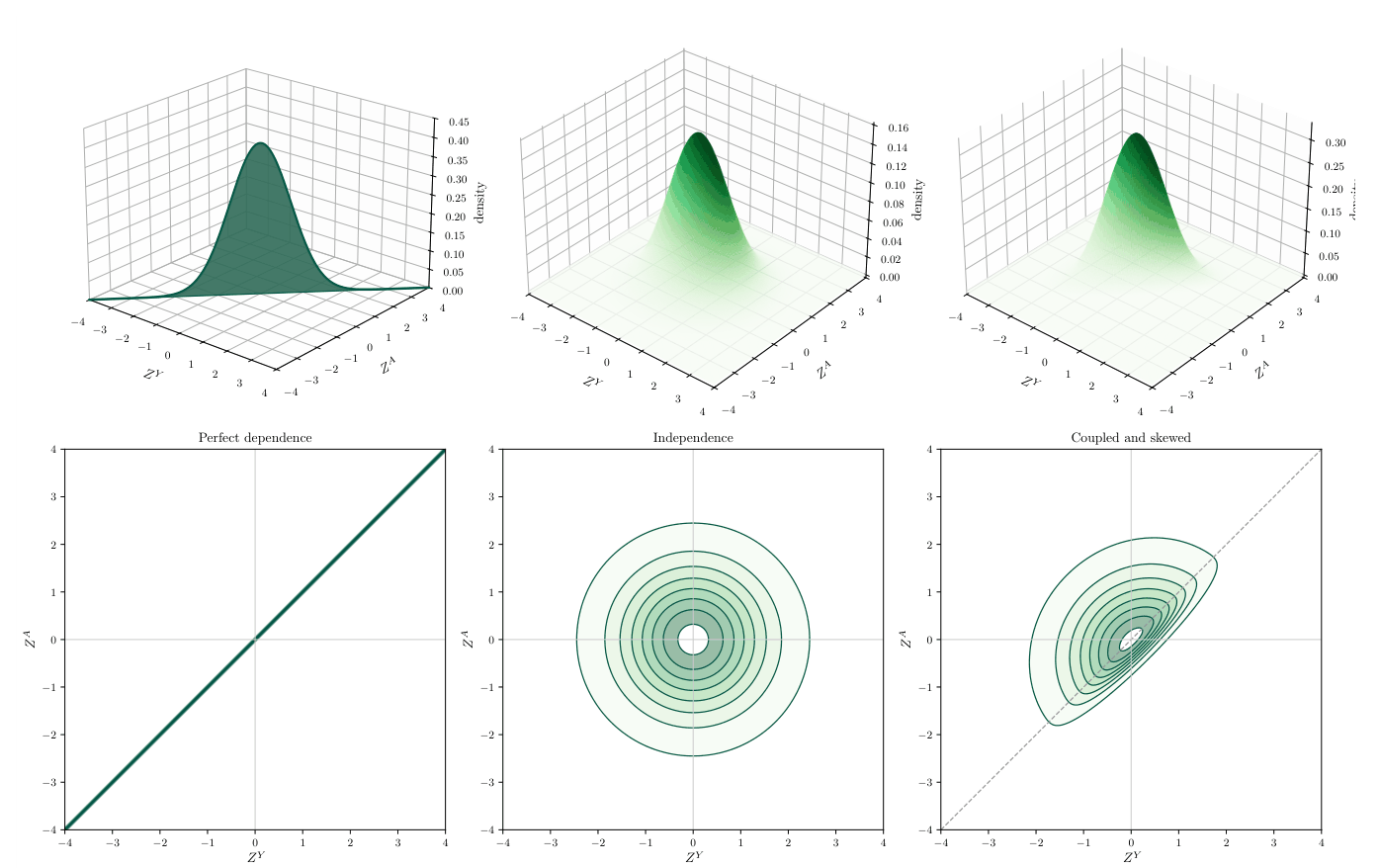
Dutch Housing Appraisals Track Prices

Analysis of Dutch residential appraisals shows they copy realized transaction prices rather than provide independent valuations, raising collateral risk for borrower and lender.

Fanfare 2Asset Pricing & FactorsRamon F. A. de Punder and Mathijs R. G. DijkstraPDF

Copula dependence structures
Figure 2: Copula dependence structures
28

Behavioral Finance at Forty

A retrospective reviews behavioral finance's progress over four decades, covering earnings beliefs, return beliefs, prospect theory, and emerging directions in cognitive foundations and AI.

Fanfare 2Asset Pricing & FactorsNicholas C. BarberisPDF

Macro-Finance & Rates5

02

Debt Maturity Term Premium Inflation

Lengthening government debt maturity raises term premia and affects inflation differently under monetary versus fiscal dominance, with lasting price-level consequences.

Fanfare 4Macro-Finance & RatesArtur Doshchyn et al.PDF

Nine-panel grid showing impulse responses to maturity shock under monetary dominance
Figure 1: Response to a positive maturity shock under monetary dominance
13

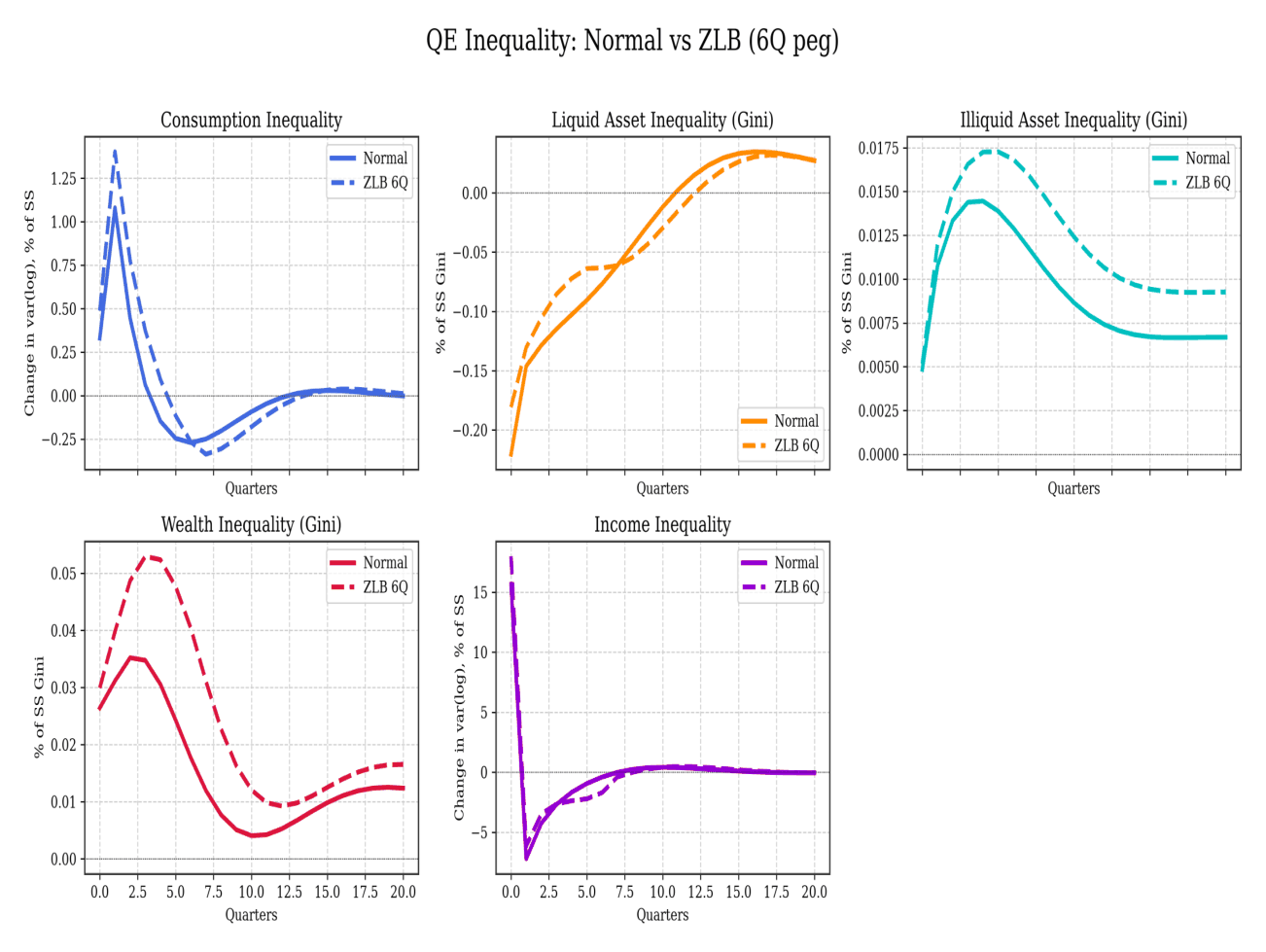
Unconventional Monetary Policies and Inequality

A heterogeneous-agent model shows quantitative easing and liquidity facilities outperform operation twist at the zero bound and increase wealth inequality most through portfolio shifts.

Fanfare 3Macro-Finance & RatesCharles de Beauffort and Ansgar RannenbergPDF

QE effects on consumption, asset inequality, and income inequality across quarters
Figure 3: QE: Gini coefficients of liquid, illiquid and total wealth, per cent change from steady state
17

Fixed-Floating Agency Debt Mispricing

Fixed-floating interest rate parity violations in agency debt are driven by money market fund demand for floating notes rather than arbitrageur constraints.

Fanfare 2Macro-Finance & RatesMatthias Fleckenstein et al.PDF

18

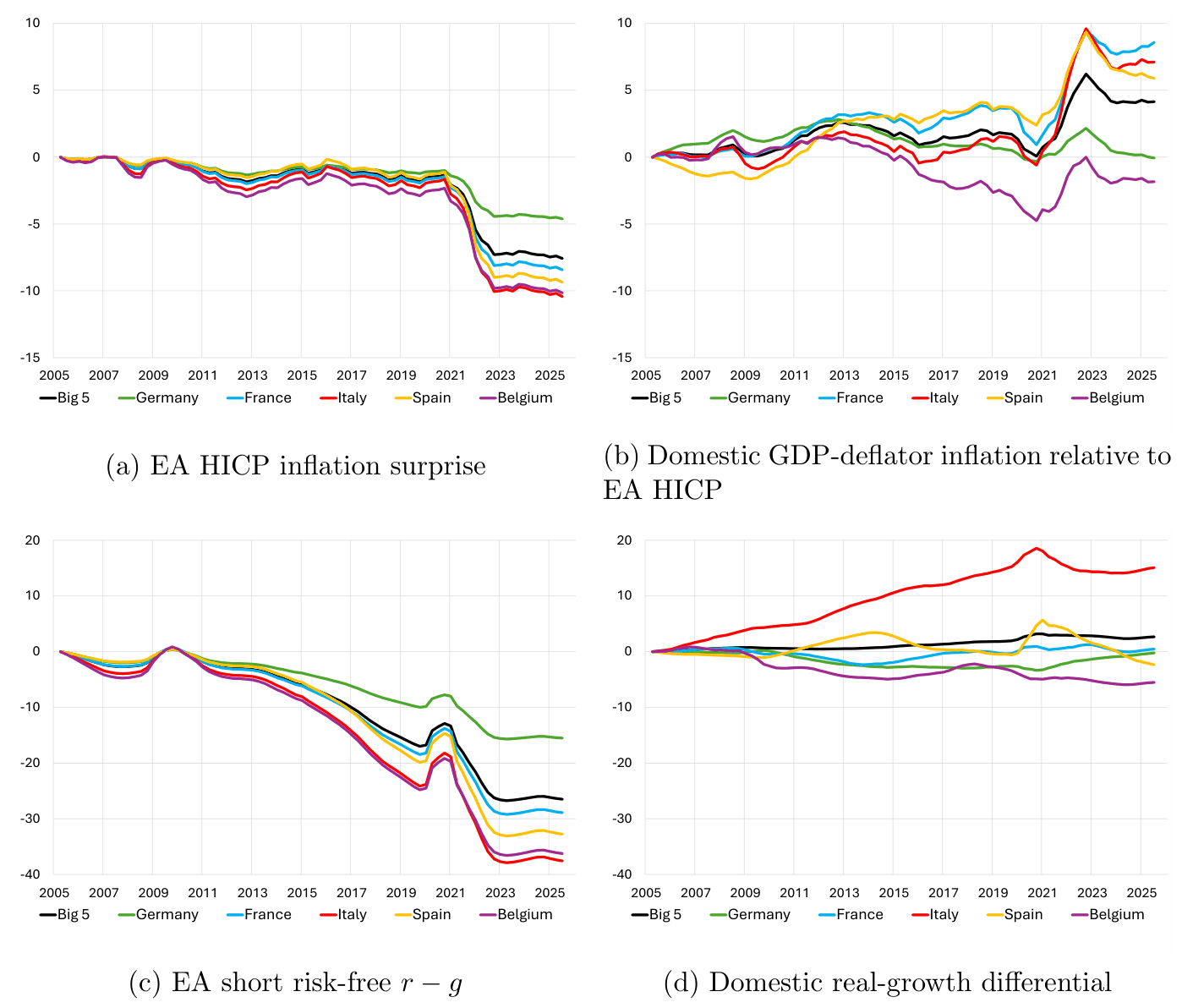
Euro-Area Public Debt Decomposition

Analyzing security-level data shows low real rates cut debt ratios substantially, while inflation surprises mattered little, and central-bank holdings initially reduced but later raised consolidated debt.

Fanfare 2Macro-Finance & RatesJef Boeckx et al.PDF

Four panels showing macroeconomic contributions to Euro-area debt dynamics across countries over time
Figure 3: The contribution of macroeconomic conditions to debt-ratio dynamics
26

Exchange Rate Depreciation and Macroeconomics

Currency depreciations relative to the dollar stimulate borrowing from abroad and economic growth for peggers, driven by lower uncovered interest parity deviations rather than expenditure switching.

Fanfare 2Macro-Finance & RatesMasao Fukui et al.PDF

Econometrics & Forecasting6

04

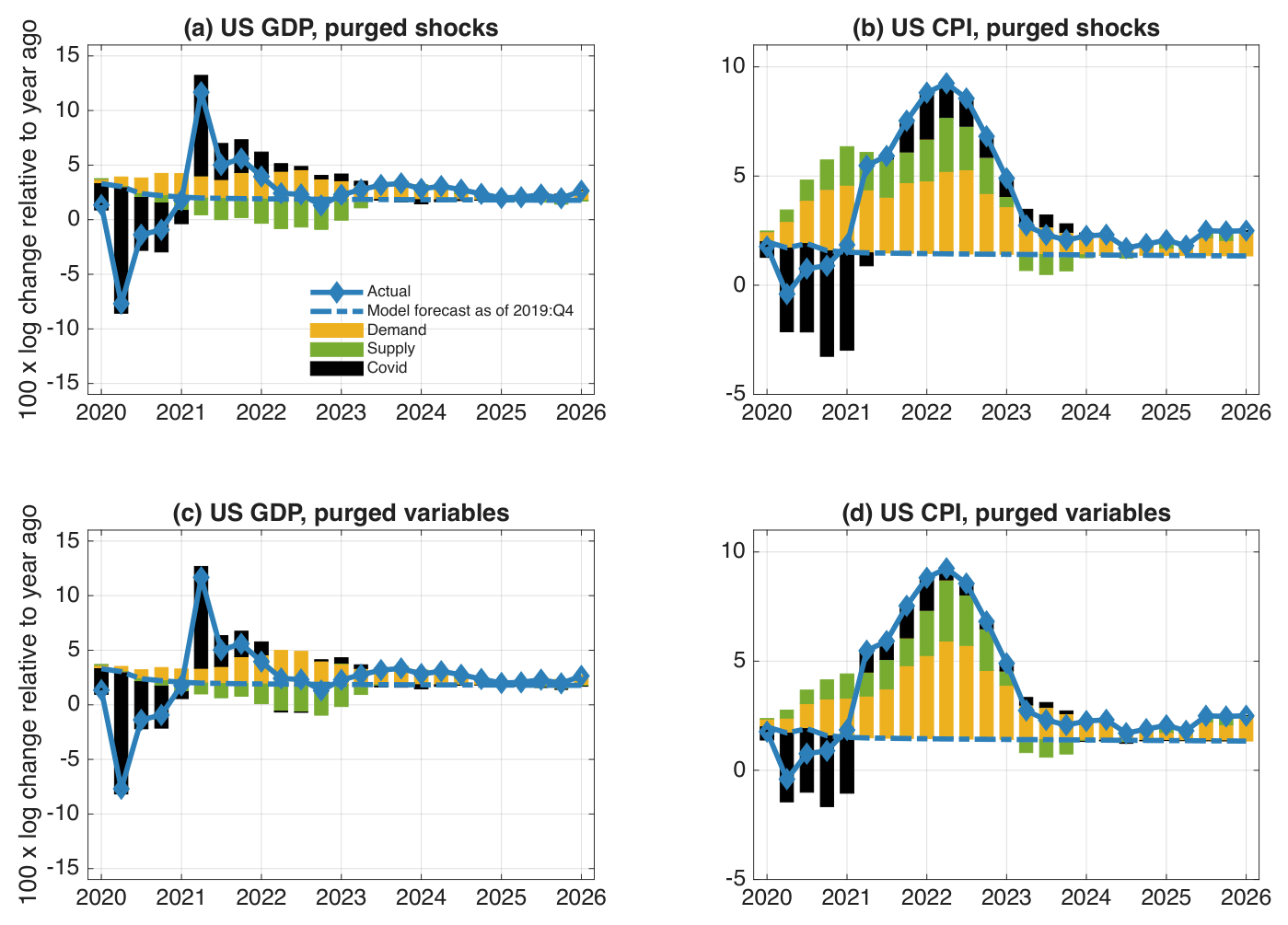
Post-Covid Inflation Driven by Demand

Structural VARs and a DSGE model establish that post-pandemic inflation in the US and Euro Area was predominantly driven by strong demand from fiscal expansion and accommodative policy.

Fanfare 3Econometrics & ForecastingDomenico Giannone and Giorgio PrimiceriPDF

Stacked area charts decomposing US GDP and CPI shocks into demand, supply, and other components.
Figure 3: Historical decomposition of GDP and inflation dynamics, after controlling for the covid factor of Stock and Watson (2025). Sources: data from the Bureau of Eco…
15

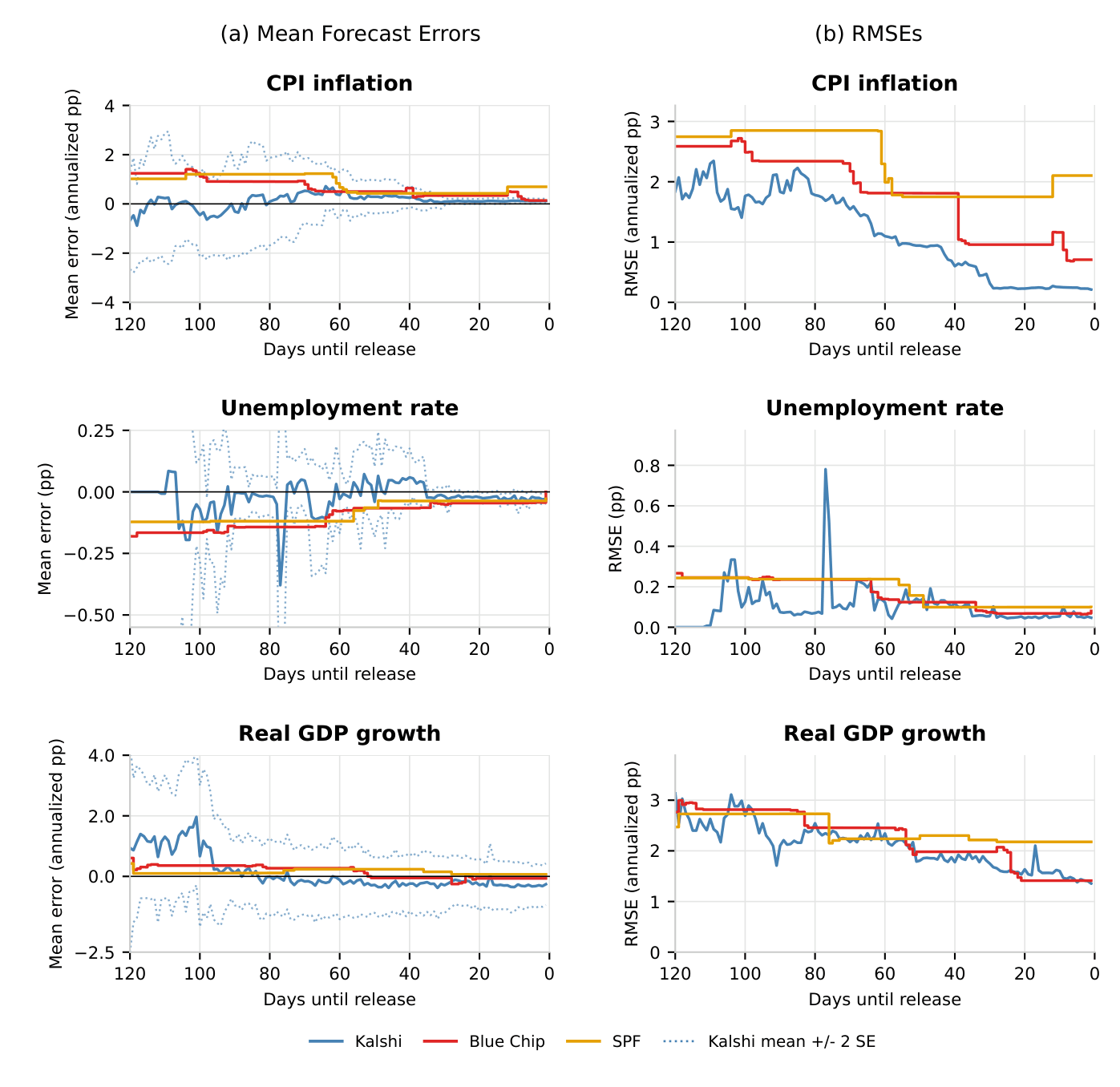
Fed Policy Prediction Markets Expectations

Prediction market data on macroeconomic outcomes show Fed rate hikes affect expectations through standard transmission channels, not through an information effect.

Fanfare 2Econometrics & ForecastingEric T. Swanson et al.PDF

Forecast Errors: Kalshi vs
Figure 4. Forecast Errors: Kalshi vs. Blue Chip and SPF
19

Household Sector Inflation Uncertainty

The study links price dispersion in food and gasoline to household uncertainty and shows contractionary policy compresses this uncertainty, suggesting optimal policy should vary by sector.

Fanfare 2Econometrics & ForecastingPhilip Schnattinger and Prachi SrivastavaPDF

20

Macroeconomic Tail Risk Forecasting

Incorporating professional forecasts into GARCH models improves predictions of joint tail risks for growth, inflation, and unemployment, enabling better scenario-based risk assessment.

Fanfare 2Econometrics & ForecastingManuel Schick and Anne OpschoorPDF

24

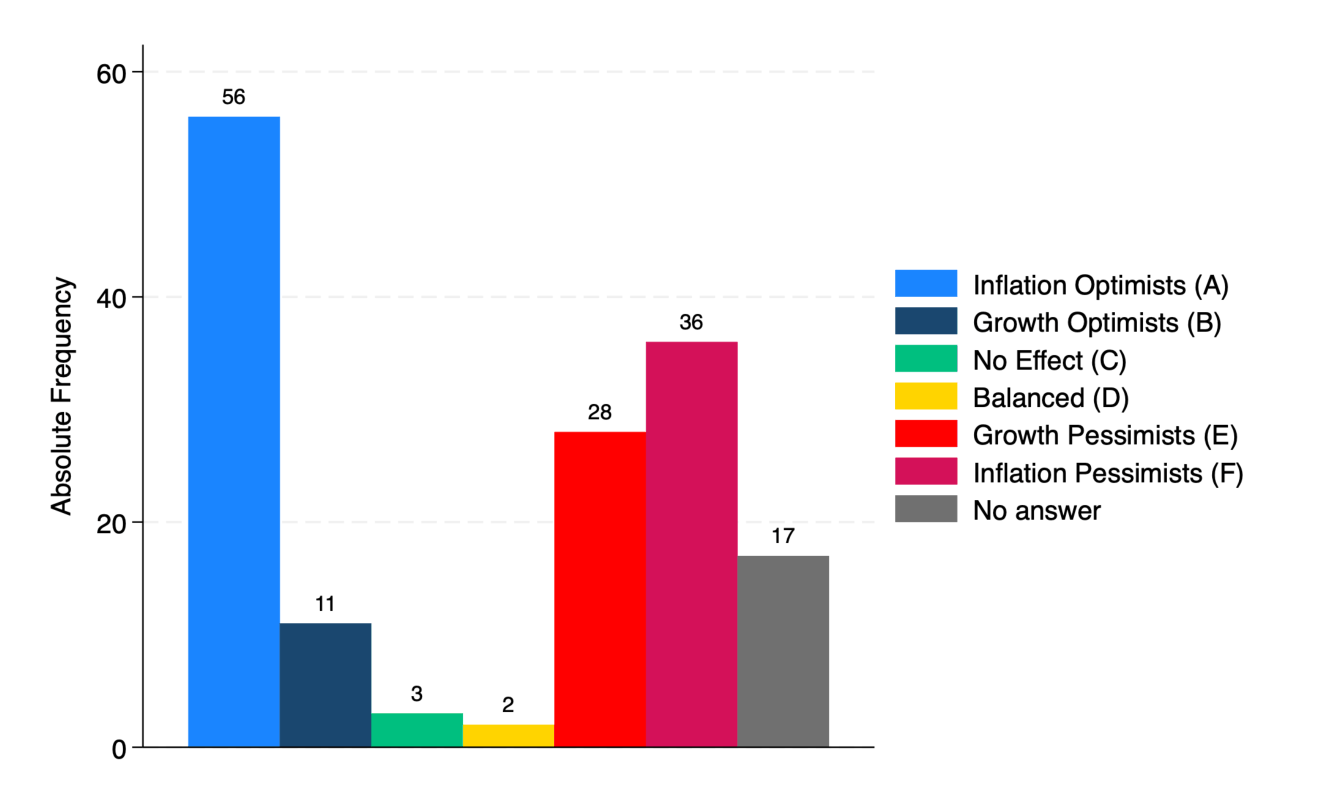
Forecasters' Narratives on Inflation and Stocks

Professional forecasters hold heterogeneous narratives about inflation's impact on stocks, causing disagreement in expectations and divergent portfolio choices despite common signals.

Fanfare 2Econometrics & ForecastingChristian Conrad et al.PDF

Distribution of the forecasters’ narratives relating inflation to DAX returns in the Decem- ber 2022 survey
Figure 2: Distribution of the forecasters’ narratives relating inflation to DAX returns in the Decem- ber 2022 survey. Among the 153 survey participants, 136 selected a…
29

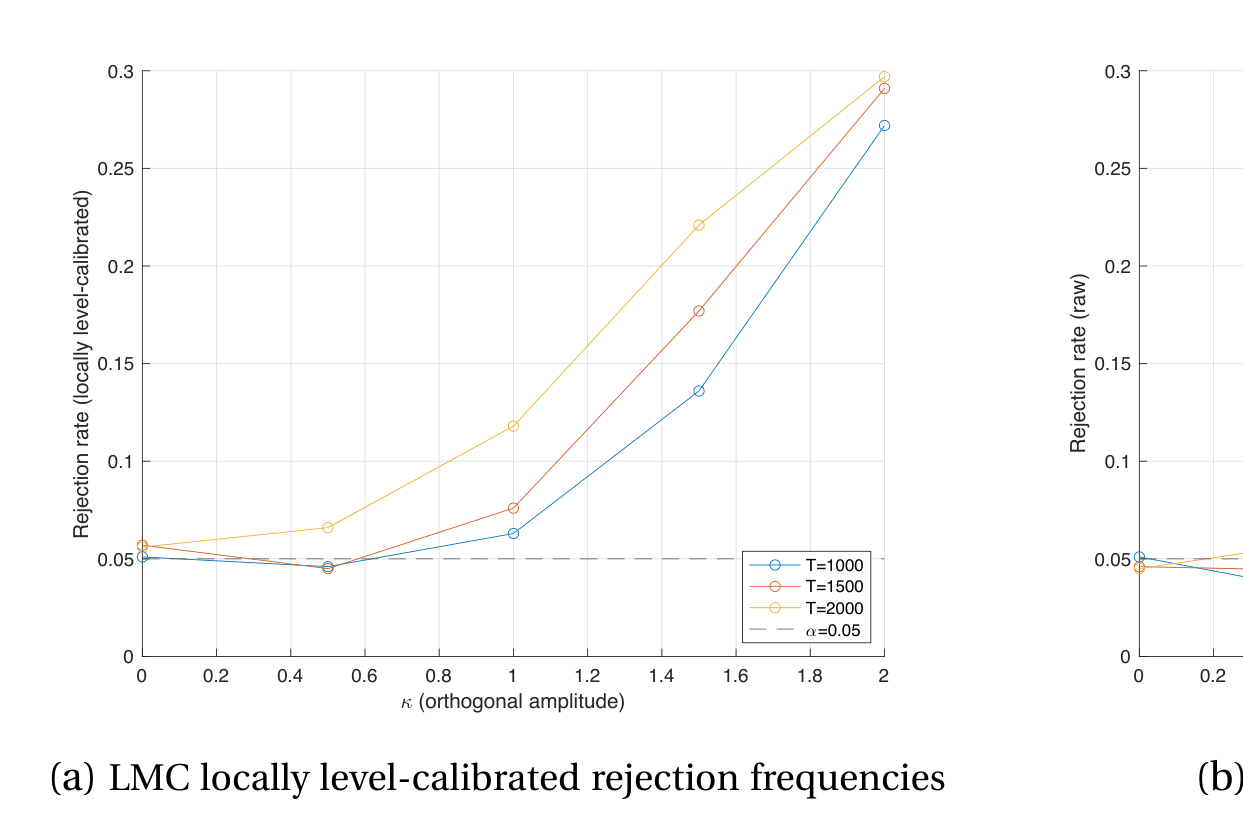
High-Dimensional Multivariate Stochastic Volatility Estimation

Proposes computationally efficient estimators for multivariate stochastic volatility models using moment equations and shrinkage methods, avoiding numerical optimization while maintaining reliability.

Fanfare 1Econometrics & ForecastingMD Nazmul Ahsan and Jean-Marie DufourPDF

Rejection-frequency curves for the common C-space test under monotone deviations indexed by κ
Figure 1 Rejection-frequency curves for the common C-space test under monotone deviations indexed by κ

Risk, Credit & Banking4

05

Monetary Transmission Through Banks and Non-Banks

A DSGE model reveals that interest-rate policy transmission to output remains robust as non-bank finance grows, but quantitative easing effectiveness depends critically on non-bank sector composition.

Fanfare 3Risk, Credit & BankingNicolò Bandera et al.PDF

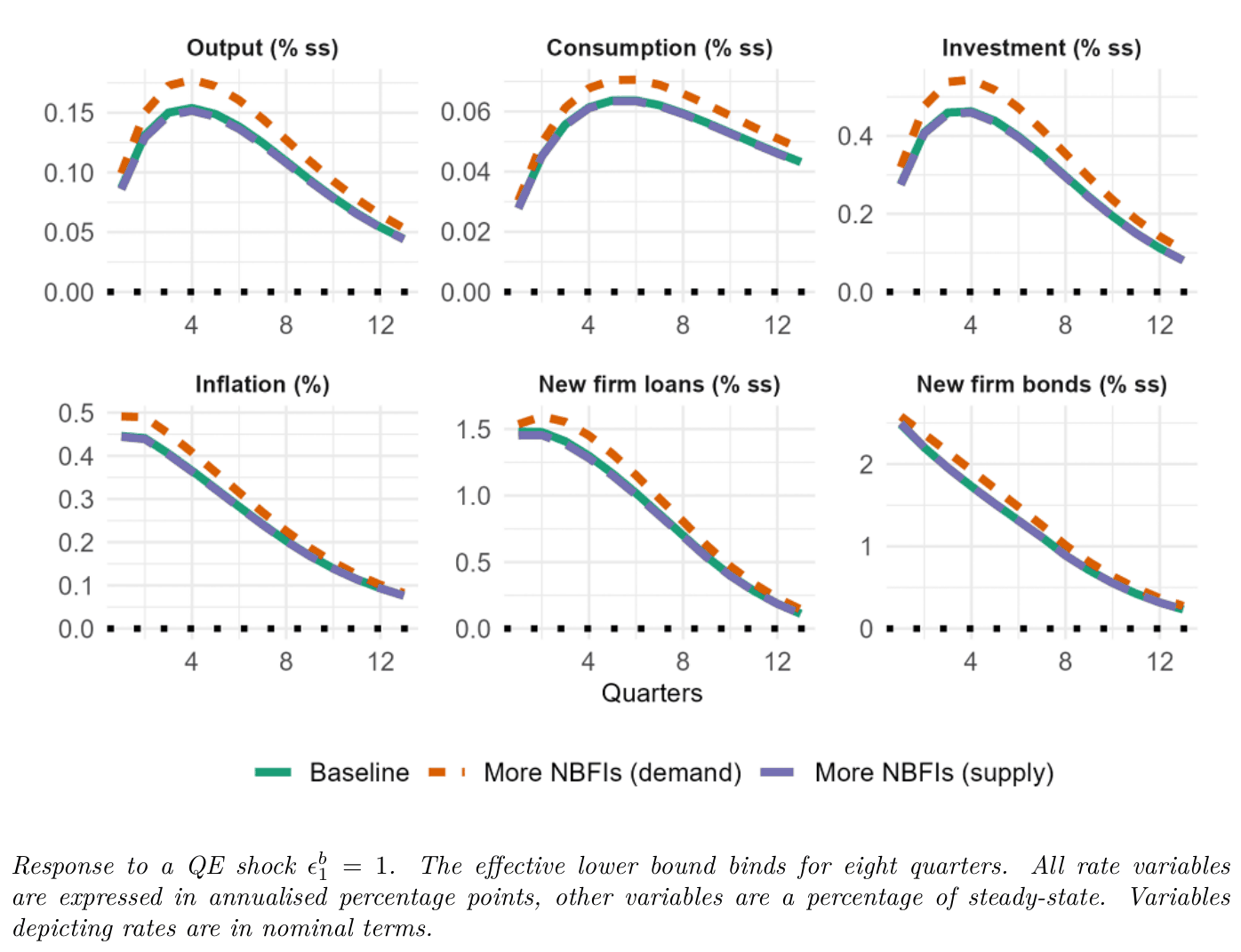
Macroeconomic responses to QE showing output, consumption, investment, inflation, and credit effects across scenarios.
Figure 8: QE at the Lower Bound: Macroeconomy
12

SBA Disaster Loans and Employment

A regression discontinuity design shows that SBA disaster lending preserved 9.8% of jobs in affected counties, operating primarily through reduced firm exit rather than new hiring.

Fanfare 2Risk, Credit & BankingFederico Esposito and Saverio SimonelliPDF

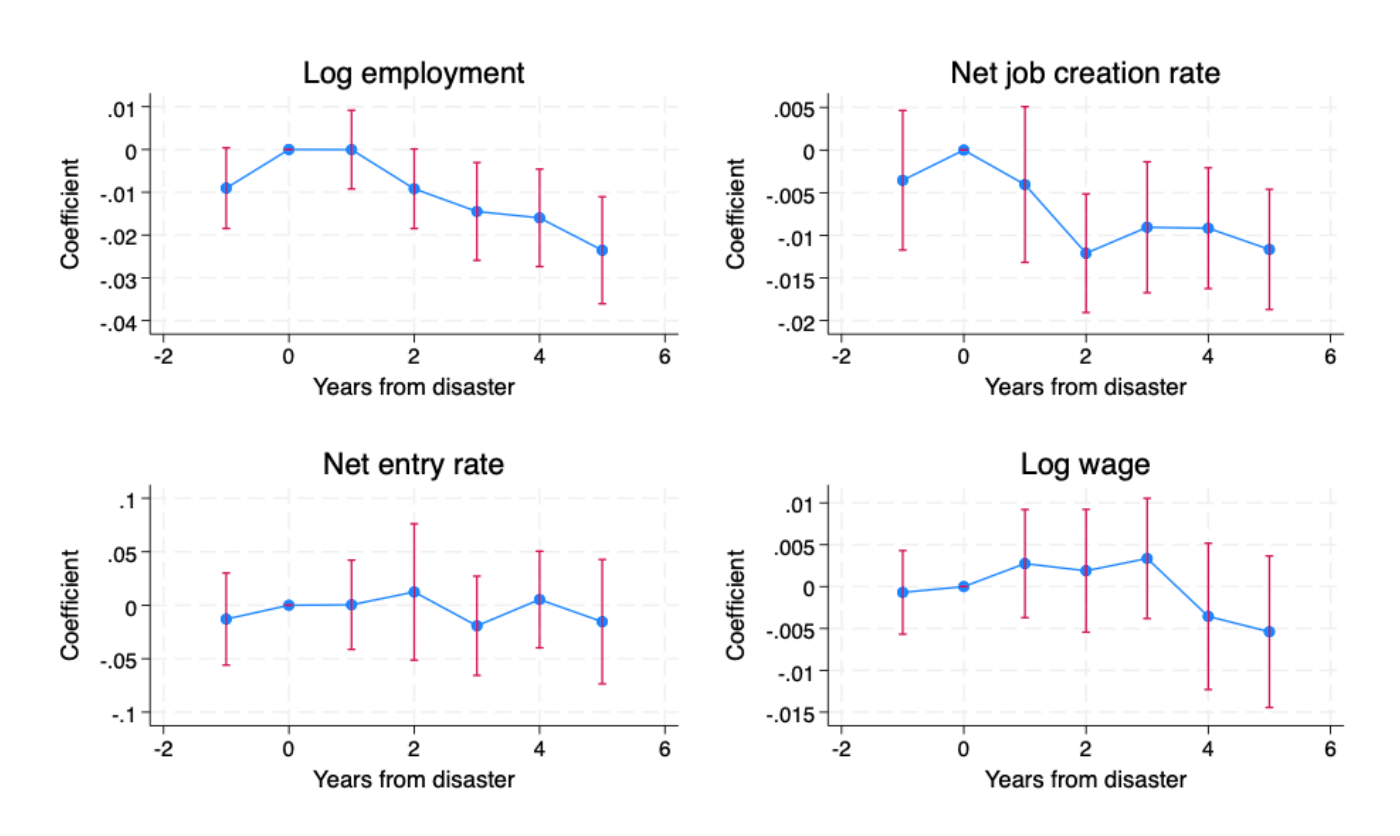
County-level efects of natural disasters
Figure 2: County-level efects of natural disasters.
21

Sovereign-Bank Nexus in Post-Crisis Europe

The link between sovereign and bank risk remains economically meaningful for less-capitalized banks with large sovereign holdings, especially during market stress and in fiscally constrained countries.

Fanfare 2Risk, Credit & BankingCharlotte Hoopes et al.PDF

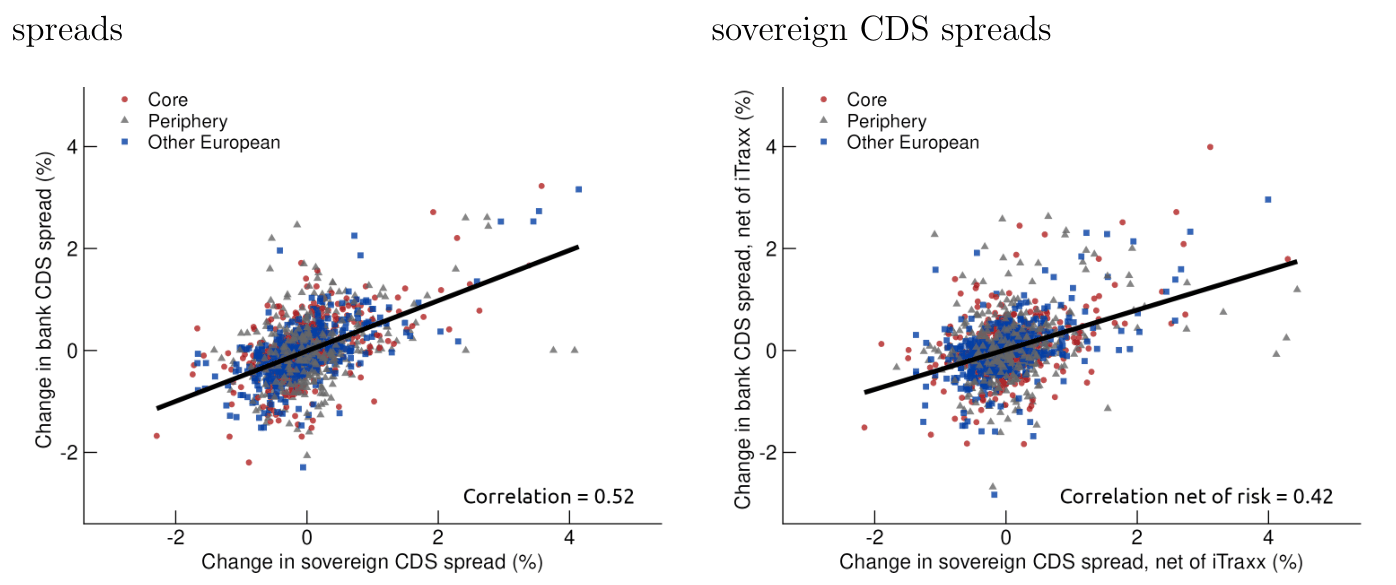
Sovereign and bank risk remain closely linked in Europe
Figure 2. Sovereign and bank risk remain closely linked in Europe
25

Digital Finance and Bank Performance in Africa

Digital financial inclusion boosts bank profitability across Sub-Saharan Africa but shows weaker effects on stability, with impact concentrated in high-rate, low-inflation environments.

Fanfare 2Risk, Credit & BankingEric Kofi Boadi et al.PDF

Portfolio & Allocation3

06

Team Versus Solo Fund Managers

Teams outperform solo managers by 11.5 basis points during outflows through threat-rigidity cohesion, but underperform by 36 basis points during inflows due to social loafing.

Fanfare 3Portfolio & AllocationCristhian Rodriguez-Revilla et al.PDF

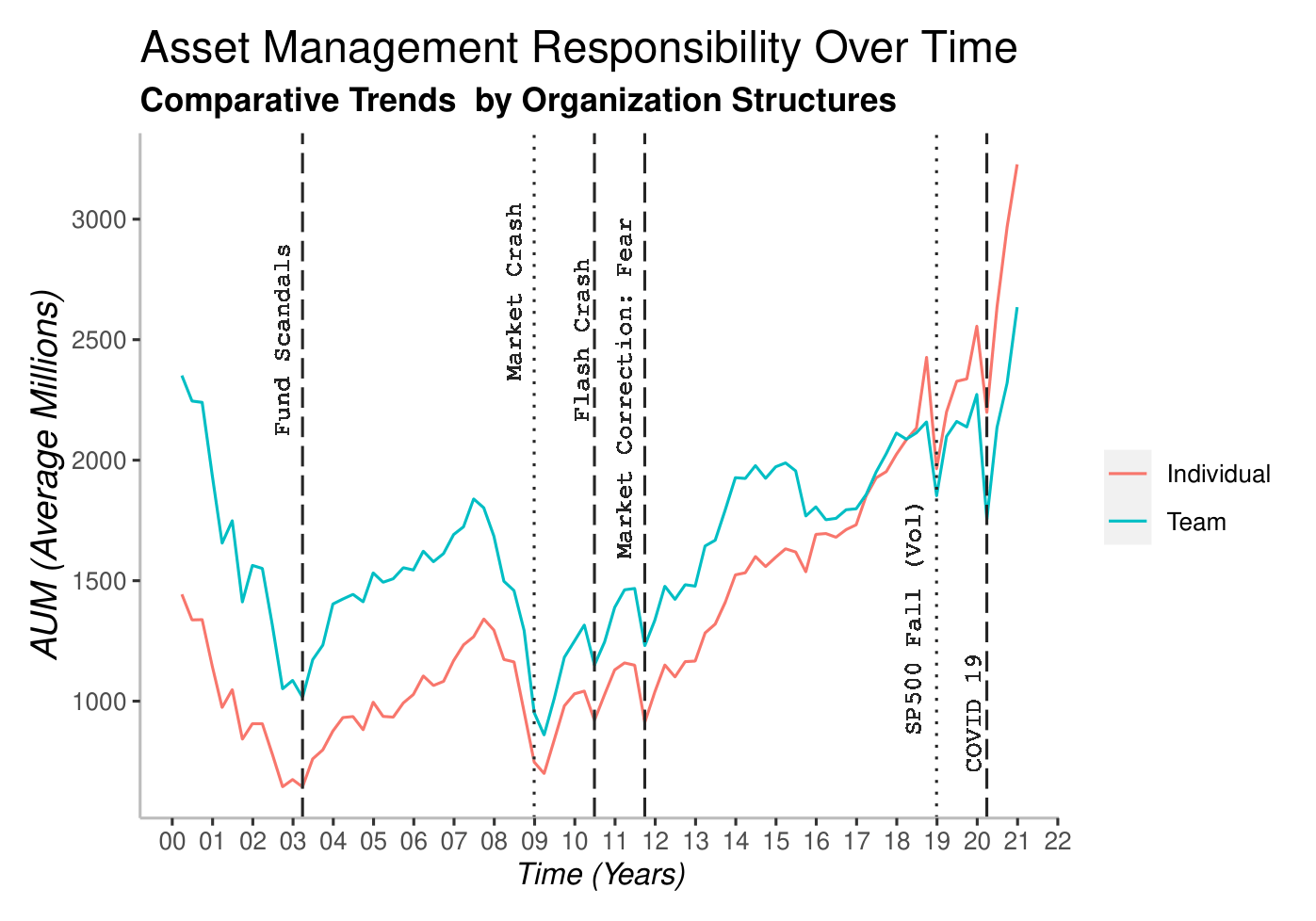
Team versus individual fund manager AUM over time, showing divergent performance trends.
07

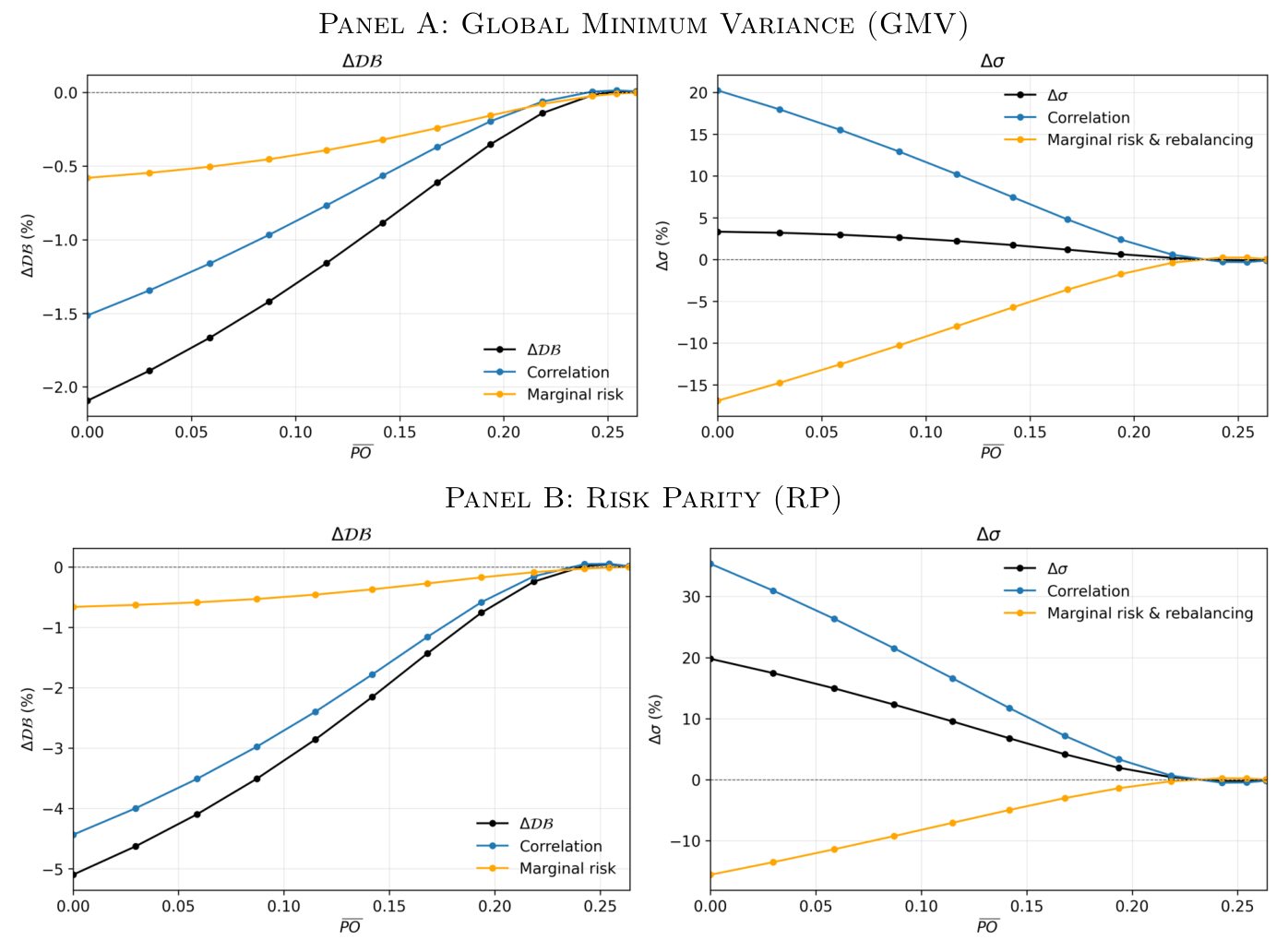
Passive Investing Diversification Risk

Passive ownership raises return correlations and reduces achievable portfolio diversification by 2.1%, shifting risk from firm-specific to market-wide components.

Fanfare 3Portfolio & AllocationI. GuflerPDF

Decomposition of diversification benefits and risk parity across passive ownership levels, showing correlation and marginal…
Figure 5: Decomposition of ∆DB and ∆σ
08

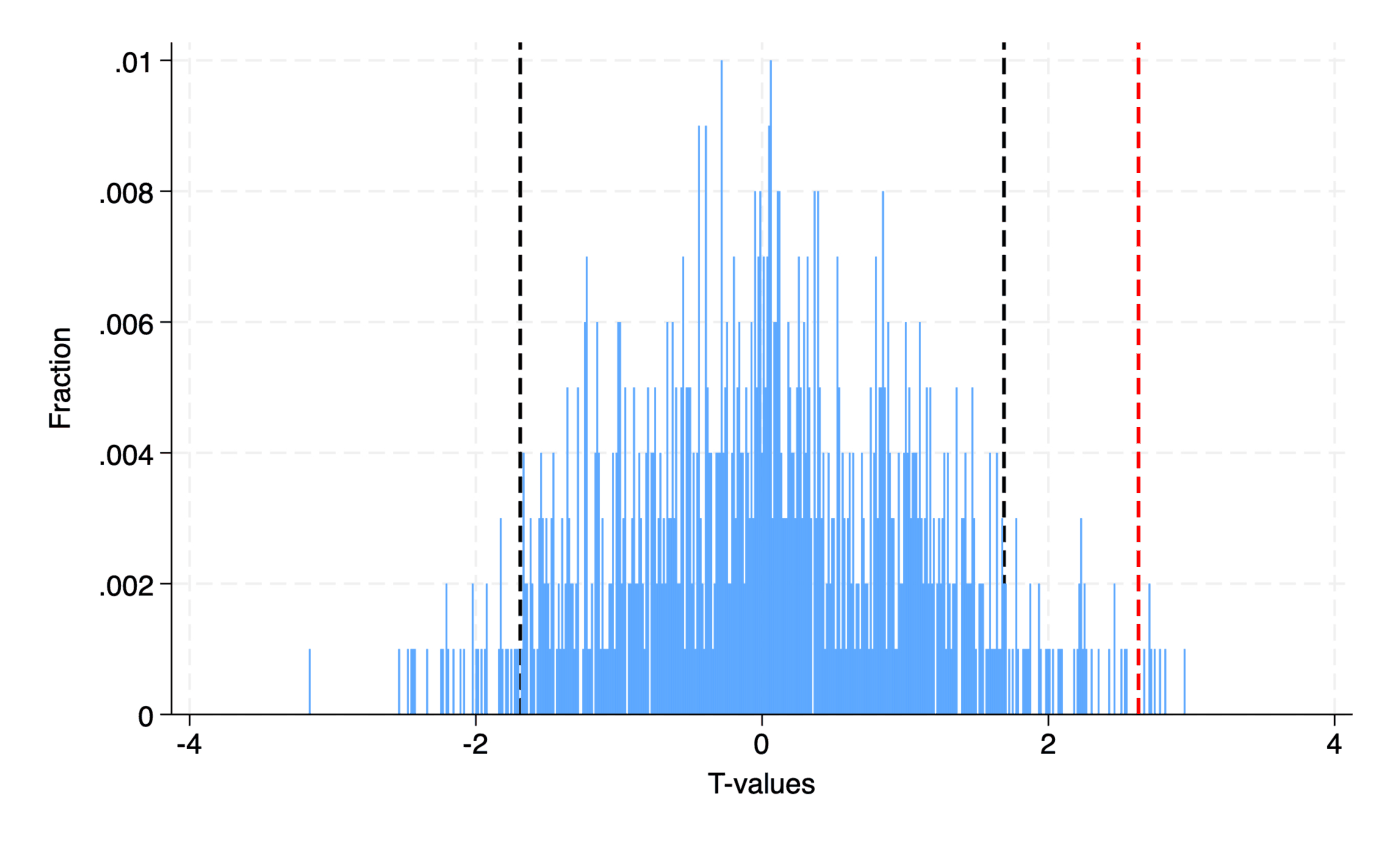
Investment Funds Geopolitical Risk

Investment funds buy depressed stocks of geopolitically exposed firms seeking yield, stabilizing valuations during shocks while raising portfolio concentration.

Fanfare 3Portfolio & AllocationDaniel Marcel te Kaat et al.PDF

Distribution of t-values for randomizing the exposure variable
Figure 3: Distribution of t-values for randomizing the exposure variable

Trading, Microstructure & Execution2

10

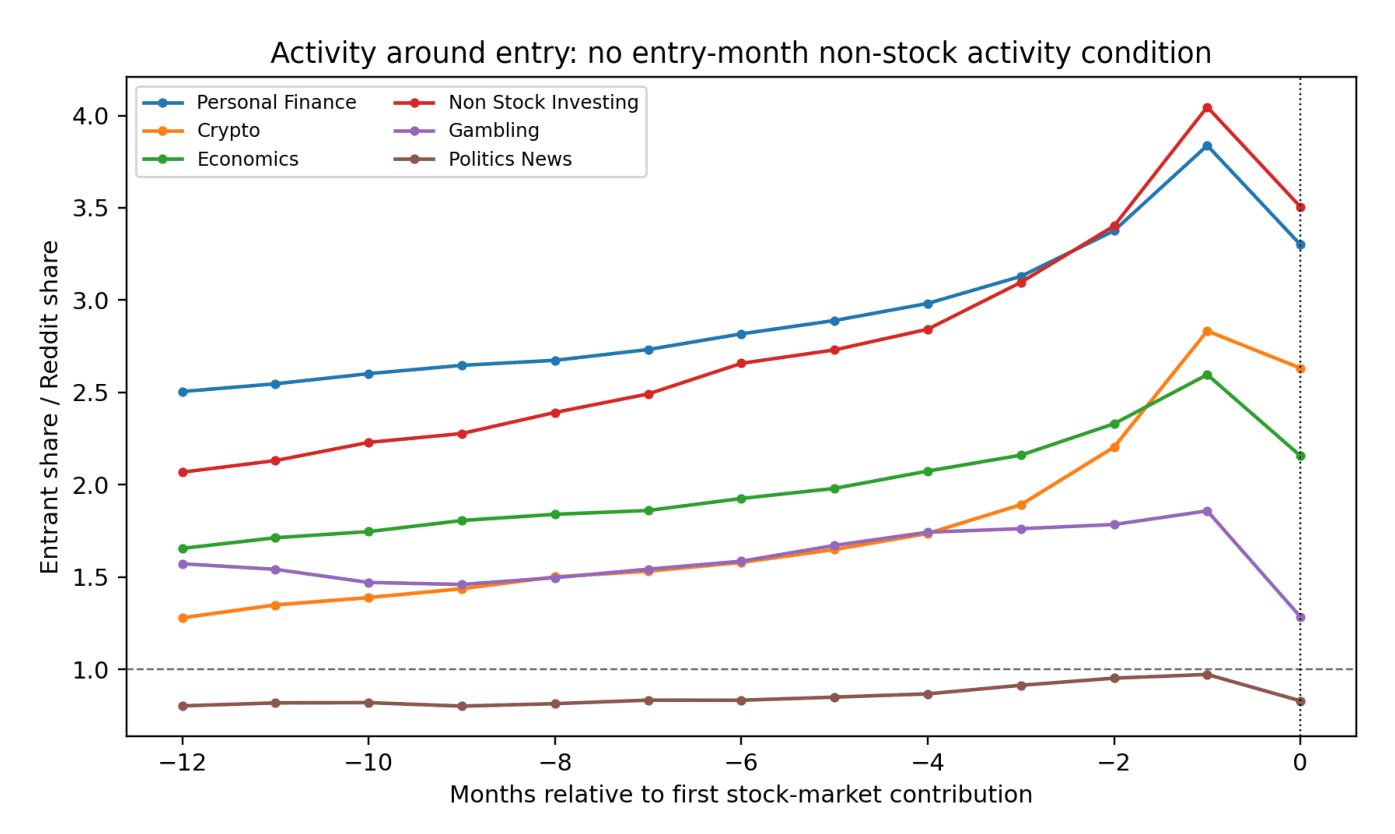
Reddit Pathways to Stock Market Entry

Tracking 6.8 million Reddit users reveals distinct entry routes to stock investing from budgeting, crypto, or gambling forums, with composition predicting market price and volume reactions.

Fanfare 2Trading, Microstructure & ExecutionOlga Balakina and Jonathan SeimPDF

Entry activity by user type showing relative share over months around market entry
Figure 1: Activity Around Stock-Market Entry
16

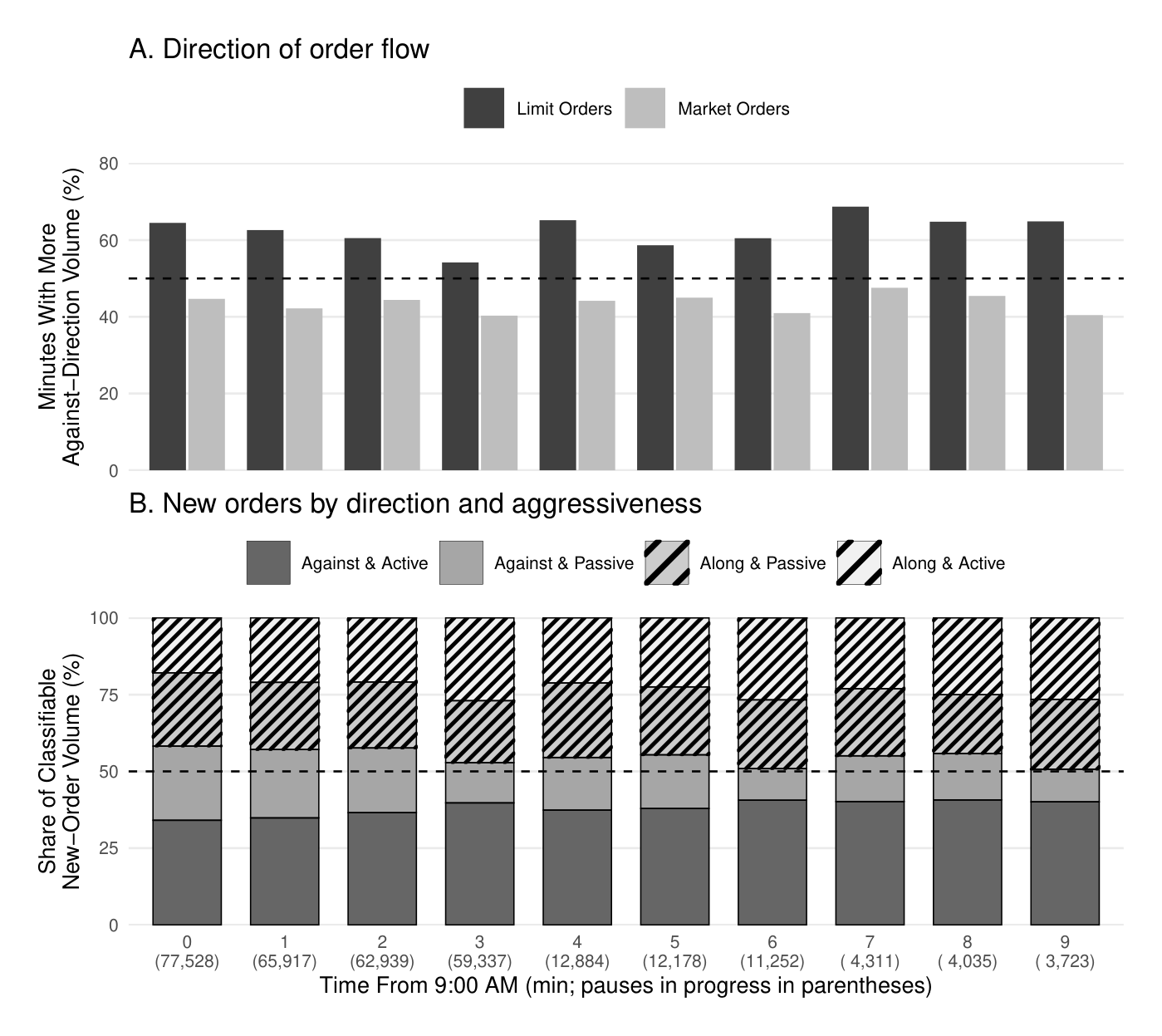
Trading Pauses Market Quality TSE

Single-stock trading pauses on the Tokyo Stock Exchange reduce subsequent volatility by roughly a quarter by allowing aggressive limit orders to offset initial imbalances.

Fanfare 2Trading, Microstructure & ExecutionAkitada Kasahara and Masahiro YamadaPDF

Order flow composition during trading pauses showing limit orders offset aggressive market orders.
Figure 11: Order Flow During Morning-Open Pauses

ML & AI Methods2

11

Competition in Generative AI Markets

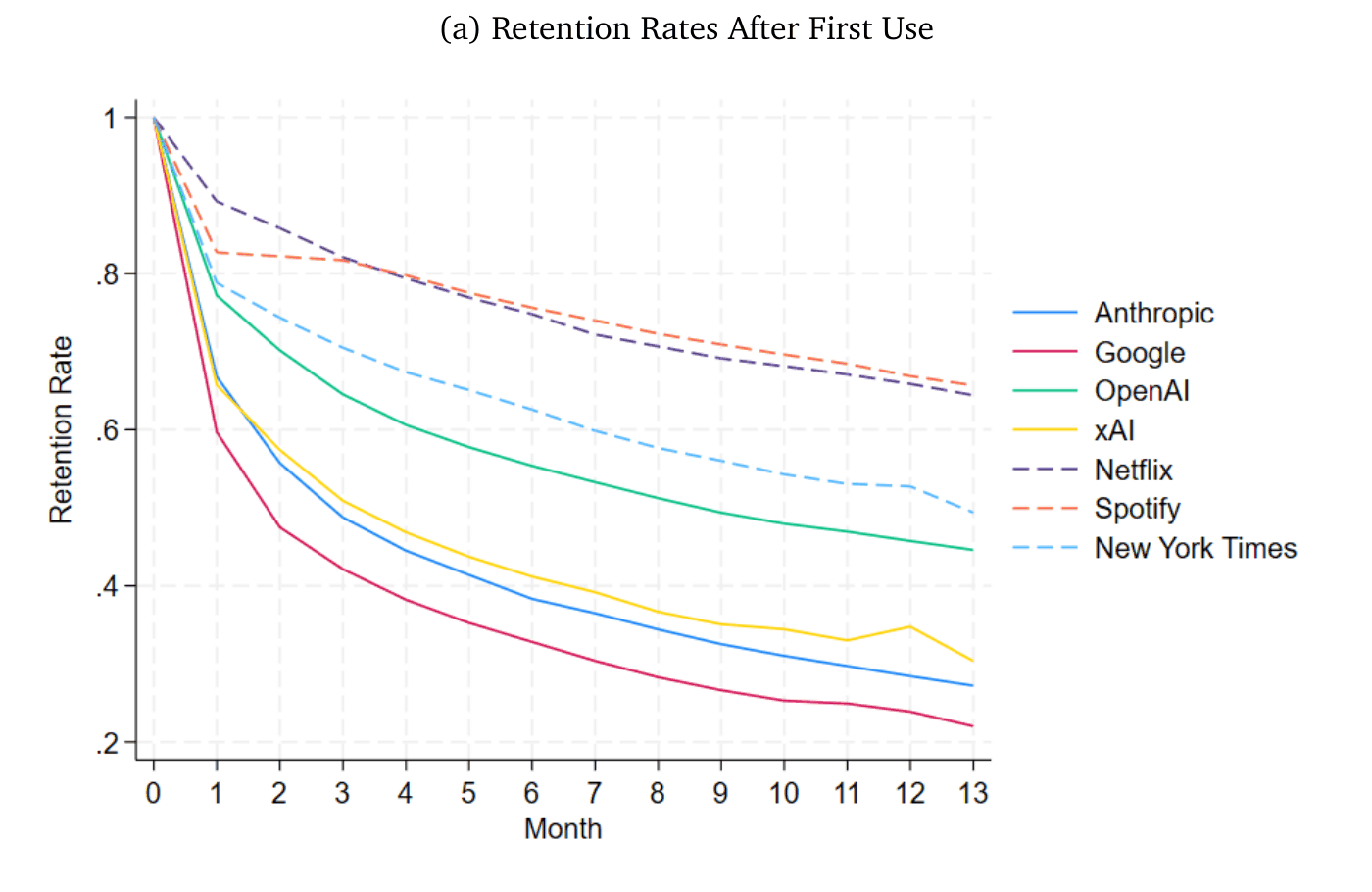
Analysis of 114 billion consumer transactions finds only 2.9% of Americans pay for AI, with low switching costs and retention rates of 20-45%, suggesting strong competitive pressure ahead.

Fanfare 2ML & AI MethodsMark L. Egan et al.PDF

AI subscription retention rates declining over 13 months, comparing multiple platforms and services.
Figure 5: Retention of AI Subscriptions
22

Multi-Factor Equity Strategy with AI

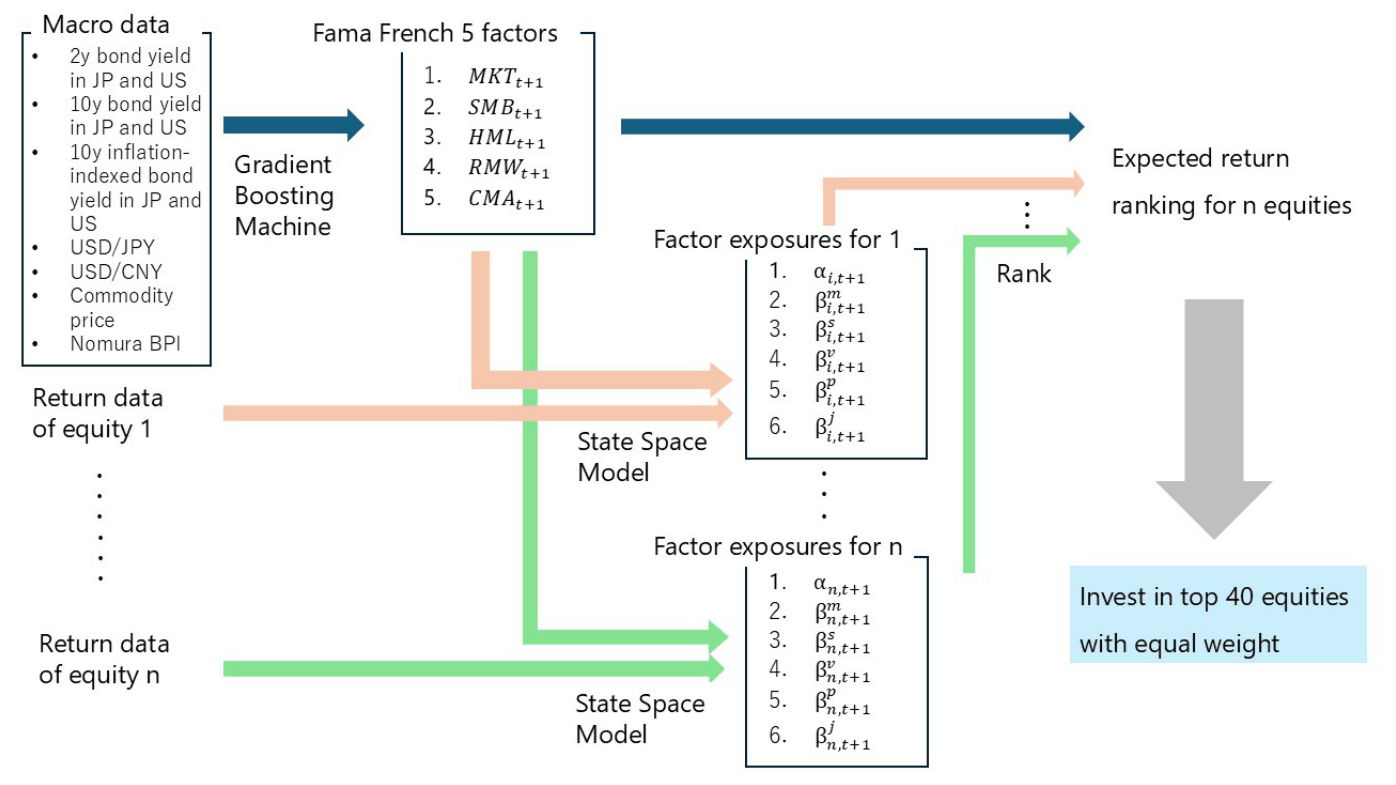
Combining a five-factor model with gradient boosting and technical indicators for hedging, the strategy outperforms index buy-and-hold on Japanese stocks while maintaining interpretability.

Fanfare 2ML & AI MethodsDaiya Mita and Akihiko TakahashiPDF

Architecture diagram showing five-factor model inputs through gradient boosting to expected returns and portfolio ranking.
Fig. 2 Architecture of equity long model

Derivatives & Volatility2

14

Arbitrage-Aware Volatility Surface Generation

A latent flow-matching framework generates implied volatility surfaces enforcing no-arbitrage constraints and closely reproduces empirical distributions with 90.8% surface validity.

Fanfare 2Derivatives & VolatilityDusica Bajalica et al.PDF

30

Bank Runs Drive Gold Price Volatility

Accounting for bank runs in GARCH models improves in-sample and out-of-sample performance for modeling gold price returns and volatility using annual data since 1694.

Fanfare 2Derivatives & VolatilityRuipeng Liu et al.PDF

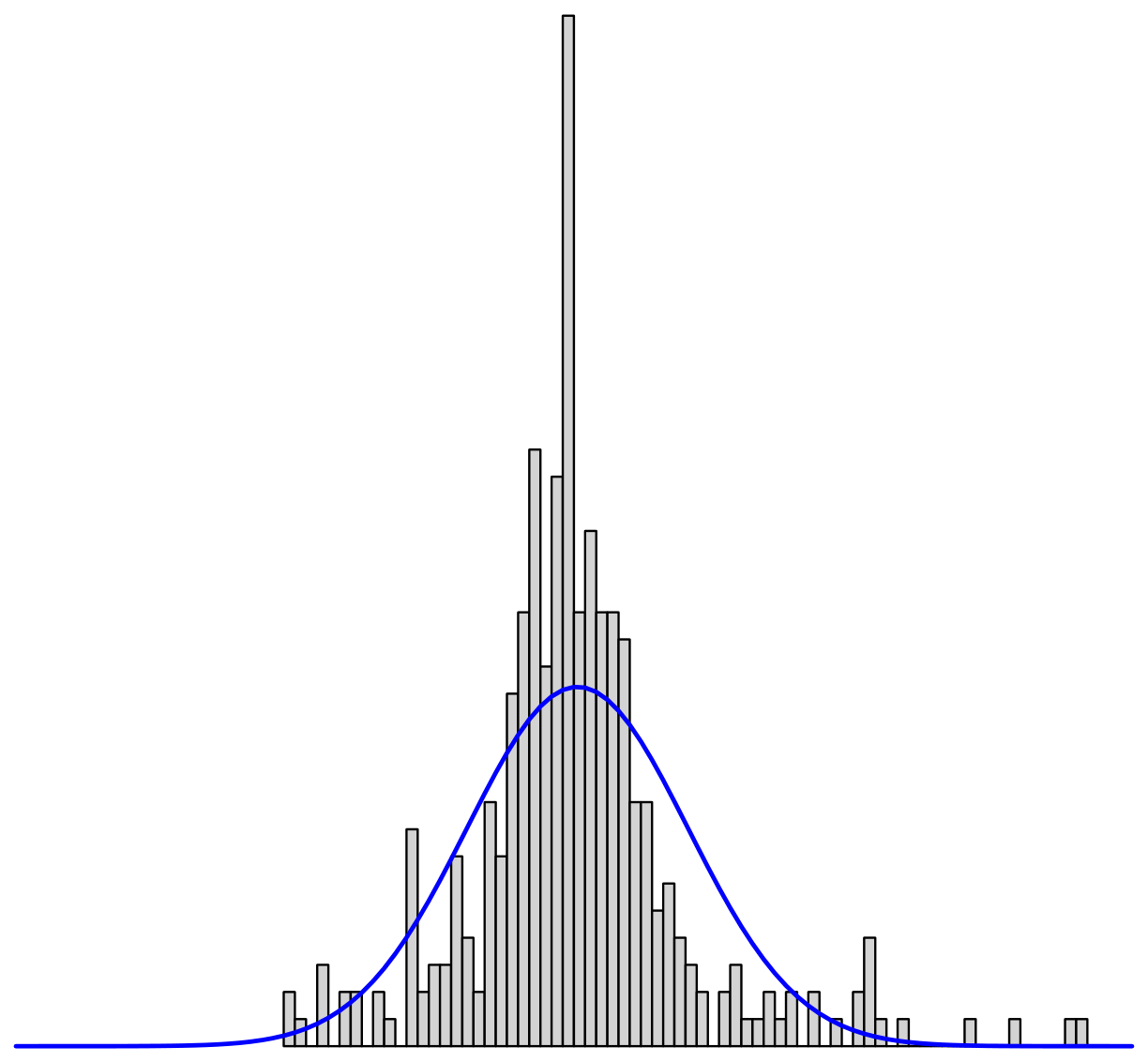
Histogram of real gold returns
Fig. 2: Histogram of real gold returns

Also notable1

23

ECB Sentiment on Non-Bank Finance

A fine-tuned language model reveals the ECB holds predominantly negative views of non-banks since the financial crisis, driven by stability and regulatory concerns.

Fanfare 2LLMs & TextAnisa Tiza Mimun and Ami DalloulPDF

Clusters of Positive and Negative Topics Discussed in ECB-NBFI Per- ception Index over Time
Figure 5: Clusters of Positive and Negative Topics Discussed in ECB-NBFI Per- ception Index over Time

Read the paperOpen full-size image

    Type to search. Try rough volatility, LLM agents or FinGPT.

    ↑↓ move↵ openesc closeFull search page