arXivML & AI Methods
FinCutBench: A Continually Updated Benchmark for Measuring the Temporal Boundaries of LLM Financial Knowledge
Introduces FinCutBench, a monthly updated benchmark measuring parametric knowledge boundaries in financial LLMs, tracking 9,000 questions from 2023 to 2026 to detect look-ahead bias.
Featured in No. 139 on 13 Nov 2026 · 3 days after release
- Released
- 10 Nov 2026
- First featured
- No. 139 · 13 Nov 2026
- Published in
- Not yet, as far as Semantic Scholar knows
- Fanfare
- 3 of 5
- Identifier
- arXiv:2611.11588
- Authors
- Siyuan Li et al.
Abstract
From arXiv (CC0).
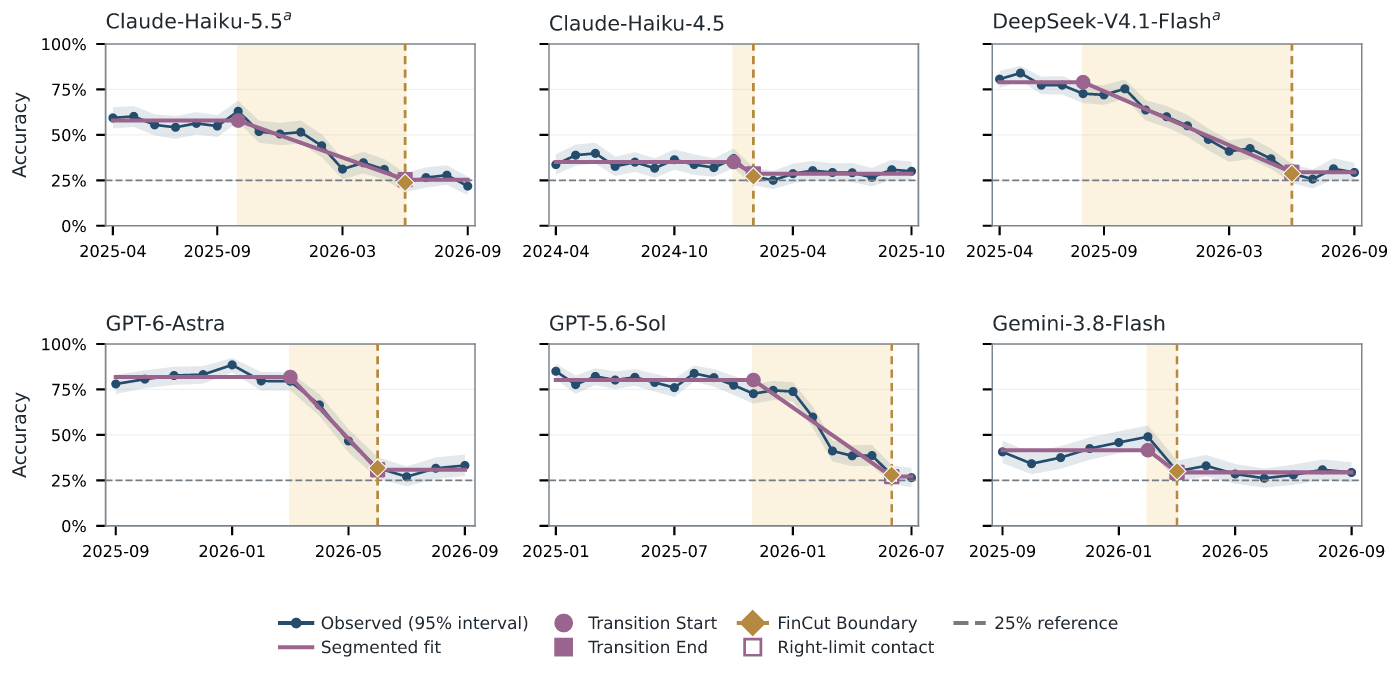
In financial backtesting and other point-in-time tasks, external inputs can be restricted by date, but model parameters may retain financial facts disclosed later, introducing parametric look-ahead bias. We introduce FinCutBench, a continually updated monthly financial knowledge benchmark for measuring how far a fixed model's financial knowledge extends over calendar time. The current dataset contains 9,000 Chinese and English four-option multiple-choice questions from January 2023 to September 2026, covering Chinese and U.S. markets and four categories of financial information. We construct monthly knowledge profiles using the approximate months in which the tested facts became public. After a profile passes the decline test and knot checks, we define the FinCut Boundary as the first month when the fitted profile reaches its lower level, and report the stability of the estimated date under resampling. Boundary dates and localization precision vary across models. Using the independently measured Transition Start and Boundary as fixed references for downstream sample grouping, we find significant relative declines in U.S. asset-ranking performance and in earnings recall for Sol and Luna. Downstream effects vary across markets and tasks. The FinCut Boundary thus provides an empirical reference for the temporal scope of parametric knowledge in point-in-time financial evaluation, supporting evaluation-window selection and result interpretation.
Citations and venue from Semantic Scholar (ODC-BY), refreshed weekly. Summary: Quant Letter (CC BY 4.0).