arXivML & AI Methods
Can AI Make Money in Crypto? Measuring the Gap from Backtests to Real Markets
A benchmark compares machine learning, reinforcement learning, and large language model trading methods across historical backtests, paper trading, and live markets to measure the gap.
Featured in No. 133 on 2 Oct 2026 · 3 days after release
- Released
- 29 Sep 2026
- First featured
- No. 133 · 2 Oct 2026
- Published in
- Not yet, as far as Semantic Scholar knows
- Fanfare
- 4 of 5
- Identifier
- arXiv:2609.34510
- Authors
- Xingtong Yu et al.
Abstract
From arXiv (CC0).
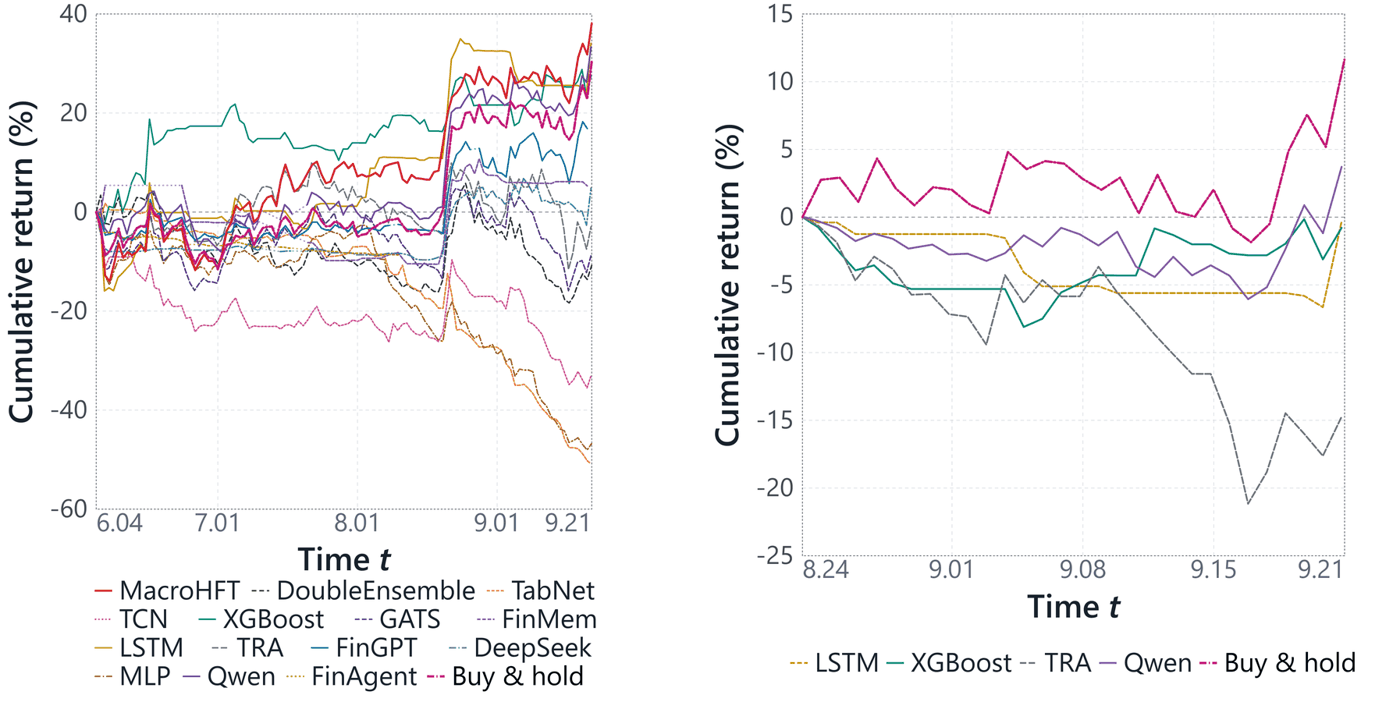
AI-based trading methods have rapidly evolved from machine learning and reinforcement learning to large language models (LLMs) and trading agents, yet their performance is still predominantly assessed through historical backtesting. Such evaluations provide limited evidence of whether a method can generalize to unseen future markets or whether its backtested performance can be sustained in realistic trading frictions (e.g., latency, slippage, liquidity constraints, and market impact). We present a unified benchmark that evaluates representative machine learning, reinforcement learning, LLM-based, and agent-based trading methods in cryptocurrency markets through three progressively more realistic stages: historical backtesting, prospective exchange-based paper trading, and real-money live trading. These stages jointly increase temporal realism by moving from historical to unseen future markets, and execution realism by moving from offline simulation toward live trading. This protocol enables us to quantify the backtest-to-realization gap, identify when performance begins to deteriorate, and compare how this gap differs across major classes of AI trading methods. We further provide a unified open-source system supporting all three evaluation stages, together with a public platform that continuously updates benchmark results. Code is available at https://github.com/Starlien95/Awesome-TradingAI.
Citations and venue from Semantic Scholar (ODC-BY), refreshed weekly. Summary: Quant Letter (CC BY 4.0).