arXivML & AI Methods
Trading Strategy Optimization via Textual Gradient
Proposes an LLM-guided framework for trading strategy refinement using accumulated experience and cross-period robustness, achieving 27.99% annualized return on Chinese equities with 1.63 Sharpe ratio.
Featured in No. 134 on 9 Oct 2026 · 4 days after release
- Released
- 5 Oct 2026
- First featured
- No. 134 · 9 Oct 2026
- Published in
- Not yet, as far as Semantic Scholar knows
- Fanfare
- 3 of 5
- Identifier
- arXiv:2610.03128
- Authors
- Chaoqun Yang et al.
Abstract
From arXiv (CC0).
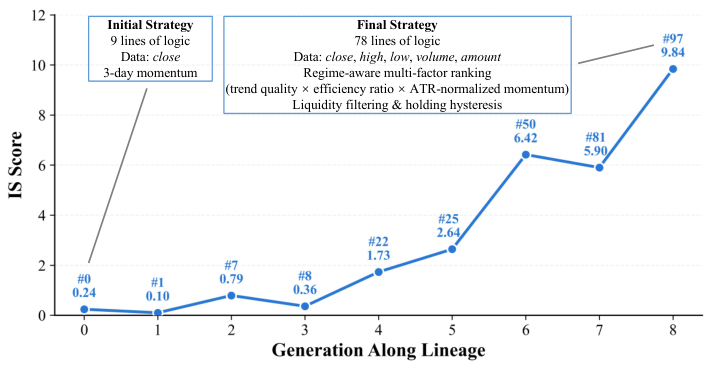
Quantitative trading strategy design aims to discover trading programs from historical data that remain effective in future markets, which can be viewed as a black-box program optimization problem. LLM-based textual gradients offer a promising approach by providing explicit optimization directions for iterative strategy refinement. However, directly applying textual gradients faces two challenges: (1) optimization is myopic, underutilizing experience from previous evaluations; and (2) aggregate backtest feedback overlooks temporal robustness, potentially favoring strategies that perform well only in specific market periods. To address these challenges, we propose TradeGrad, an experience-guided textual-gradient framework for robust trading strategy optimization. TradeGrad leverages accumulated optimization experience to estimate textual gradients and employs multi-scale revisions for both strategy exploration and refinement. It further introduces the Cross-Period Robust Objective (CPRO), which emphasizes performance in unfavorable historical periods to promote temporal robustness. Experiments on cross-sectional and time-series strategy design in Chinese A-share and U.S. equity markets show that TradeGrad achieves the best in-sample and out-of-sample performance across all four settings. Notably, its Chinese cross-sectional strategy achieves 27.99% annualized return, 12.19% maximum drawdown, and a Sharpe ratio of 1.63, approximately 68% higher than the CSI 300 benchmark. Further analyses validate the proposed components and show consistent improvements in both in-sample and out-of-sample performance throughout optimization. The code is available at https://github.com/transcend-0/TradeGrad.
Citations and venue from Semantic Scholar (ODC-BY), refreshed weekly. Summary: Quant Letter (CC BY 4.0).