arXivTrading, Microstructure & Execution
Does a Trading Policy Need to Know What It Trades? Microstructure Invariance and Zero-Shot Transfer of Execution Policies
An execution policy trained once on 954 stocks in normalized units generalizes to unseen assets, exchanges, and crypto with minimal performance loss.
Featured in No. 139 on 13 Nov 2026 · 4 days after release
- Released
- 9 Nov 2026
- First featured
- No. 139 · 13 Nov 2026
- Published in
- Not yet, as far as Semantic Scholar knows
- Fanfare
- 4 of 5
- Identifier
- arXiv:2611.08701
- Authors
- Hieu Tran and Hong Yu
Abstract
From arXiv (CC0).
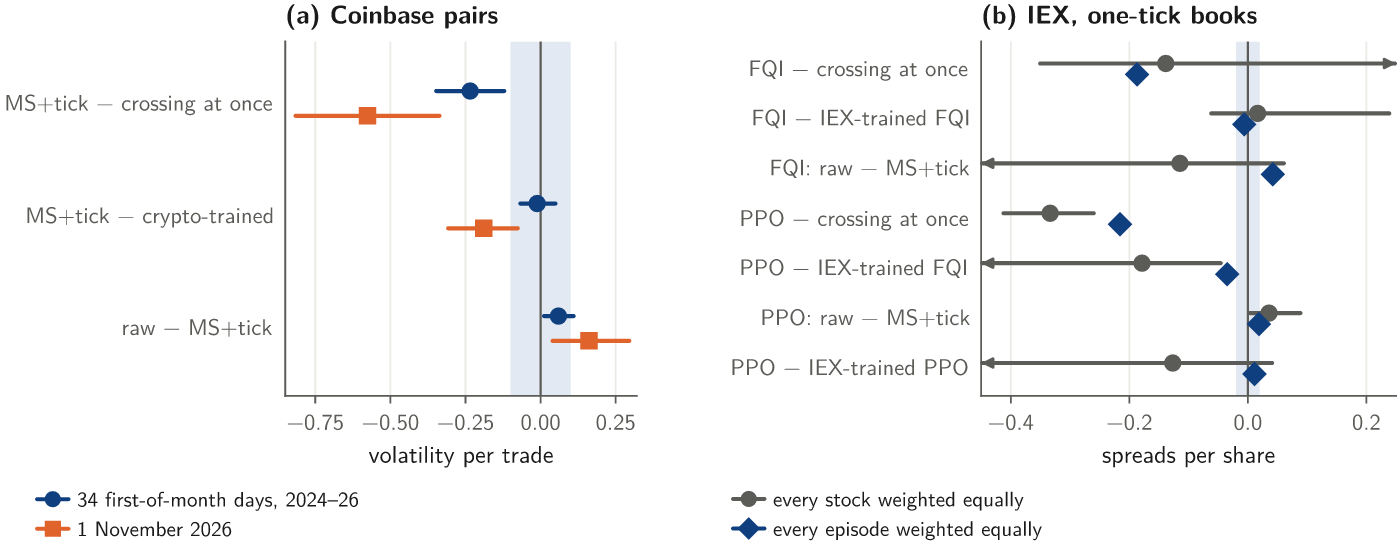
Execution algorithms are calibrated asset by asset, because the queues, trade rates and bid-ask spreads they face differ by orders of magnitude across assets. For reinforcement learning this is zero-shot generalisation across contexts of very different scales, and microstructure invariance proposes a normalisation fixed by theory: measured in each asset's own units of time, size and price, markets look alike. In an exact order-by-order replay of public Nasdaq data, we train policies once, on 954 stocks in 2019, to choose between waiting in the queue and crossing the spread, and evaluate them unchanged on 1,964 unseen stocks in 2020-21, 2,629 stocks in 2025-26, crypto pairs and a second exchange. First, a policy that sees a stock only through its recent trade rate, trade size, spread and price increment (tick) costs within 0.015 spreads per share (a fifth of what learning saves) of a policy whose training data included the stock, and the stock's own history does not help it; it comes within a similar margin of policies trained on the second exchange when every episode counts equally, and within a wider one on crypto. Second, in mean cost before fees, invariant units beat raw units, z-scores and asset descriptors, but by under a basis point: most of their advantage is information and a common cost scale that a learner can also take as plain inputs, and none of the representations tested extrapolates to unseen spread regimes. Third, a near-zero transfer gap to a pooled comparator is weak evidence that a representation is right: we show that such a comparator detects only a small share of what a poor representation loses, and confirm it in synthetic markets and on pendulums.
Citations and venue from Semantic Scholar (ODC-BY), refreshed weekly. Summary: Quant Letter (CC BY 4.0).