arXivTrading, Microstructure & Execution
A game-theoretic analysis of the market microstructure in decentralized exchanges with concentrated liquidity
The research models liquidity provision on decentralized exchanges as a mean-field game and derives closed-form solutions linking critical volatility to market microstructure parameters, validated on Ethereum data.
Featured in No. 136 on 23 Oct 2026 · 1 day after release
- Released
- 22 Oct 2026
- First featured
- No. 136 · 23 Oct 2026
- Published in
- Not yet, as far as Semantic Scholar knows
- Fanfare
- 3 of 5
- Identifier
- arXiv:2610.28863
- Authors
- Mikhail Belokon and Rostislav Berezovskiy
Abstract
From arXiv (CC0).
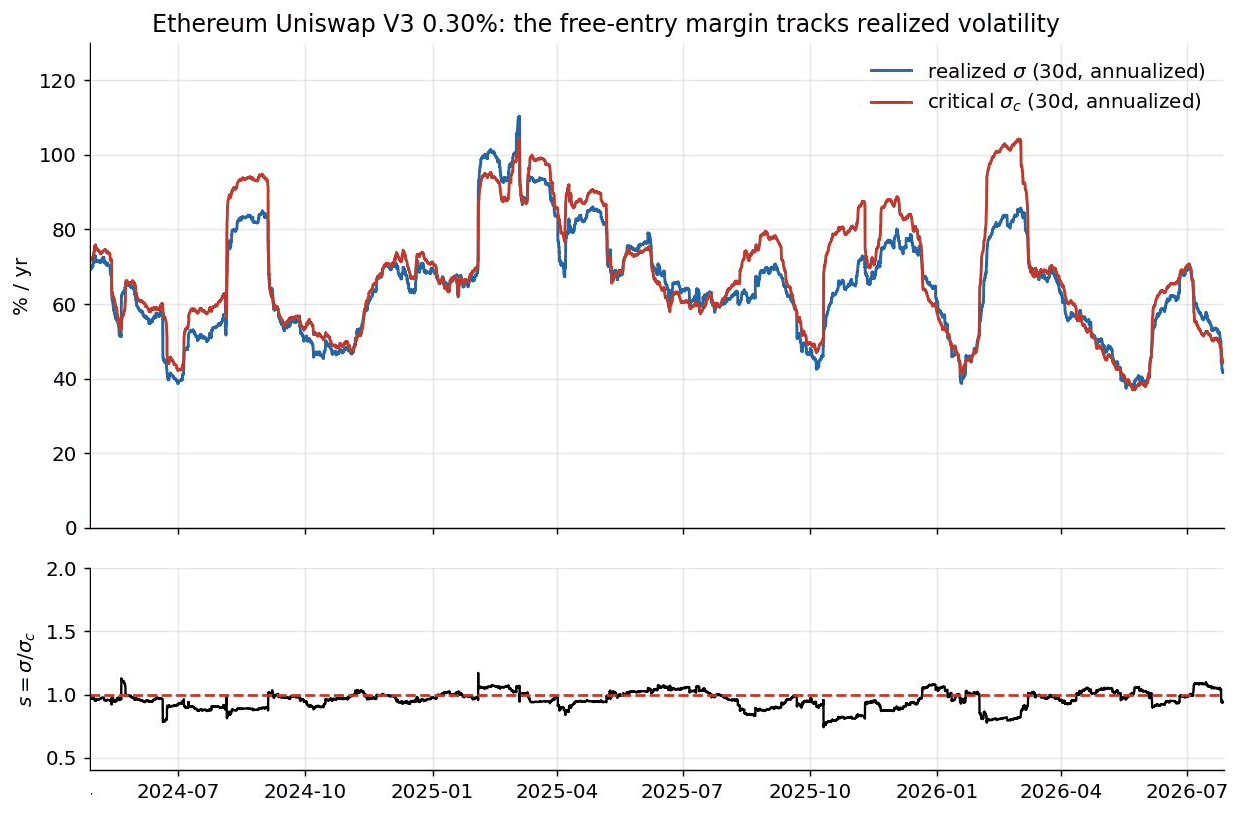
We study strategic liquidity provision in decentralized exchanges with concentrated liquidity as a mean-field game. Liquidity providers choose the width of their price range and when to rebalance it, pay a transaction cost at each rebalancing, and share the fees collected at each tick in proportion to their liquidity, so that each provider's income depends on the state of the population. We formulate the problem as a controlled continuous-time Markov chain on a finite state space. In an averaged version of the game, in which a rebalanced position is re-centered at a draw from the long-run law of the price, a mean-field equilibrium exists. Because each provider's share of the fees falls as competing liquidity is added, the equilibrium liquidity profile is unique. For the exact dynamics, with rebalancing at the range boundary and fast execution, we obtain closed forms for the optimal width, the value function and the stationary law of a position, together with a critical volatility above which provision does not pay. Free entry holds a pool strictly below this threshold, at a margin set by the rebalancing cost. The critical volatility is computed from the fee tier, traded volume, active-tick liquidity and price alone, with no fitted parameter. On two and a half years of hourly data from five WETH/USDC pools on Ethereum and Base, it tracks realized volatility. On the Ethereum $0.3\%$ pool the ratio of realized to critical volatility is less than one, and optimal value $w^*$ exists. On the standard Uniswap fee tiers the critical volatility coincides with the on-chain implied volatility of the pool.
Citations and venue from Semantic Scholar (ODC-BY), refreshed weekly. Summary: Quant Letter (CC BY 4.0).