Nonparametric GARCH: An Iterated Neural Estimator
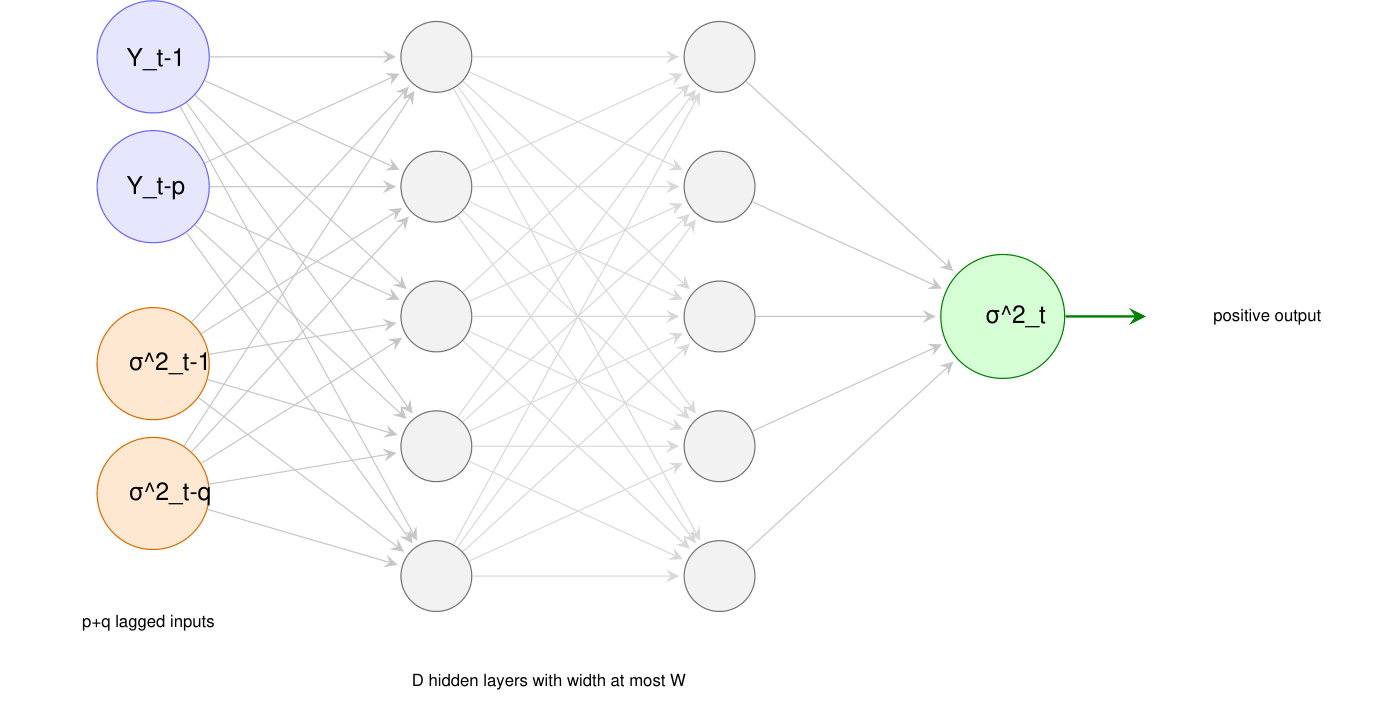
An iterated neural estimator for GARCH processes alternates between learning the recursion and updating conditional variances, achieving minimax-optimal rates for in-sample and forecasting tasks.
Featured in No. 138 on 6 Nov 2026 · 2 days after release
- Released
- 4 Nov 2026
- First featured
- No. 138 · 6 Nov 2026
- Published in
- Not yet, as far as Semantic Scholar knows
- Fanfare
- 2 of 5
- Identifier
- arXiv:2611.04157
- Authors
- Ruizhi Deng et al.
Abstract
From arXiv (CC0).
We study nonparametric estimation and forecasting for GARCH-type processes and propose an iterated neural estimator that alternates between estimating the recursion map and updating the unobserved conditional variances. Under mild conditions, we establish finite-sample bounds for the time-averaged in-sample variance-path error and show that the estimator is minimax rate-optimal up to logarithmic factors. Under stationarity and mixing conditions, we establish the same rate for recursion-map estimation and derive finite-sample bounds for out-of-sample variance forecasts and expected excess Gaussian quasi-likelihood (QLIKE) loss. The convergence rates depend on the true lag orders and remain unchanged when the fitted orders are overspecified. Simulation studies illustrate the effectiveness of our estimators under nonlinear and time-varying volatility dynamics. Real-data applications suggest that our neural methods perform competitively and can incorporate option-price and high-frequency information.
Citations and venue from Semantic Scholar (ODC-BY), refreshed weekly. Summary: Quant Letter (CC BY 4.0).