Deep catastrophic-risk-aware reinforcement learning
The study applies extreme value theory to train neural hedging policies on tail risk, achieving lower losses under extreme scenarios when relevant observations are scarce.
Featured in No. 136 on 23 Oct 2026 · 2 days after release
- Released
- 21 Oct 2026
- First featured
- No. 136 · 23 Oct 2026
- Published in
- Not yet, as far as Semantic Scholar knows
- Fanfare
- 2 of 5
- Identifier
- arXiv:2610.27214
- Authors
- Carlos Pérez Octavio Mendoza and Frédéric Godin
Abstract
From arXiv (CC0).
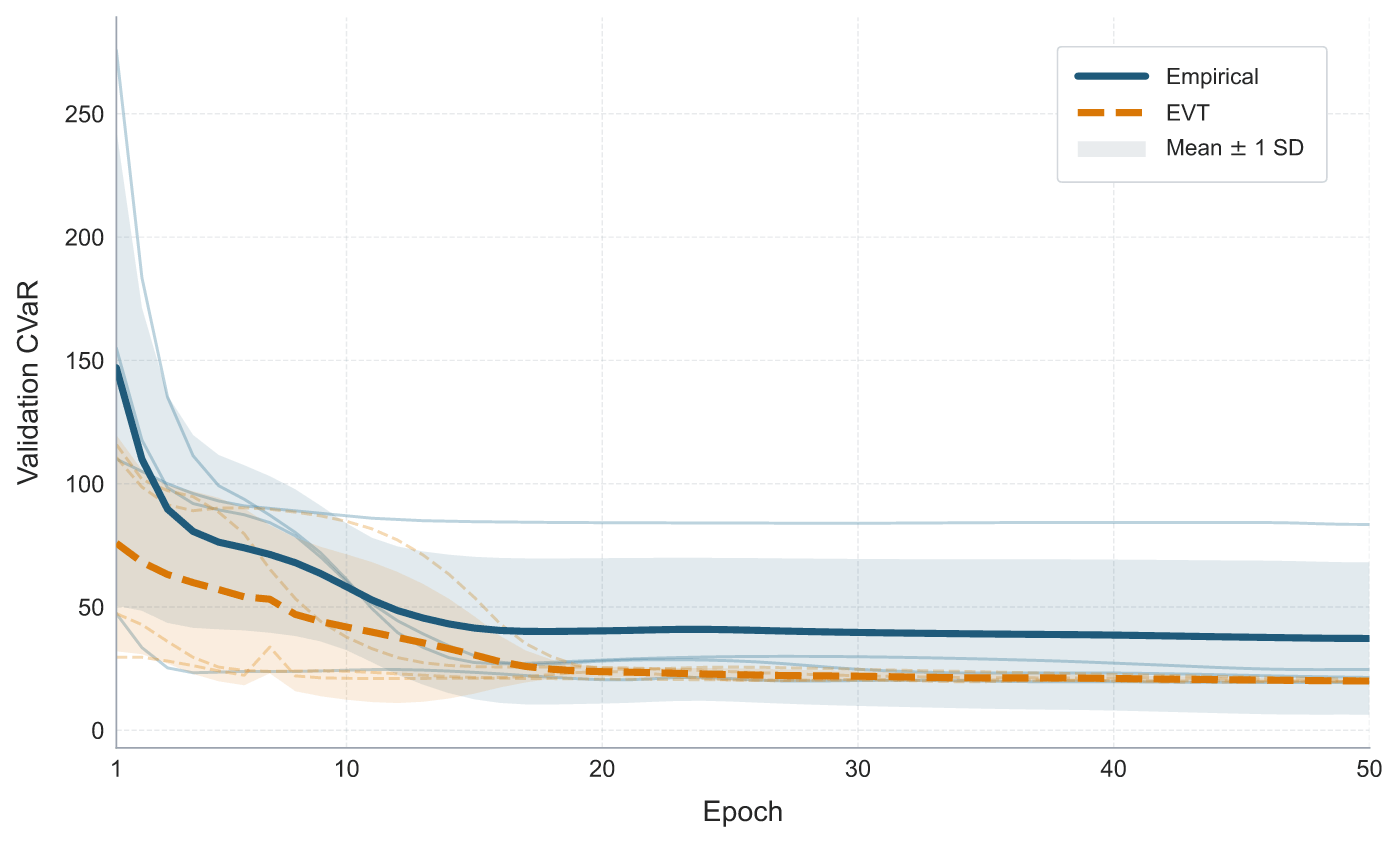
Estimating extreme risk in reinforcement learning becomes increasingly difficult as the confidence level increases, since only a small number of observations contribute to empirical estimates of Conditional Value-at-Risk (CVaR). In this paper, we extend an Extreme Value Theory (EVT) approach for CVaR optimization to high-dimensional neural-network policies. Using a peaks-over-threshold representation and method-of-moments estimation, we obtain a differentiable tail-risk objective and show that, conditional on the selected threshold, its finite-sample gradient can be computed directly through automatic differentiation. We first validate the approach in a controlled experiment with a known optimal solution and then investigate its performance in a deep-hedging problem with rare extreme market movements. Our results show similar hedging behavior for EVT- and empirical-CVaR-trained policies under normal conditions, while EVT-trained policies exhibit lower hedging losses under the extreme-scenario evaluation across the training sample sizes considered. These results suggest that EVT can provide a practical alternative for training neural policies when the observations relevant to extreme risk are scarce.
Citations and venue from Semantic Scholar (ODC-BY), refreshed weekly. Summary: Quant Letter (CC BY 4.0).