Conditional value-at-risk under reward-penalty mechanism with applications to robust portfolio management
Derives a closed-form expression for worst-case conditional value-at-risk under reward-penalty mechanisms and distribution uncertainty, enabling optimal portfolio allocations that balance losses with downside risk.
Featured in No. 134 on 9 Oct 2026 · 1 day after release
- Released
- 8 Oct 2026
- First featured
- No. 134 · 9 Oct 2026
- Published in
- Not yet, as far as Semantic Scholar knows
- Fanfare
- 2 of 5
- Identifier
- arXiv:2610.09246
- Authors
- Jun Cai et al.
Abstract
From arXiv (CC0).
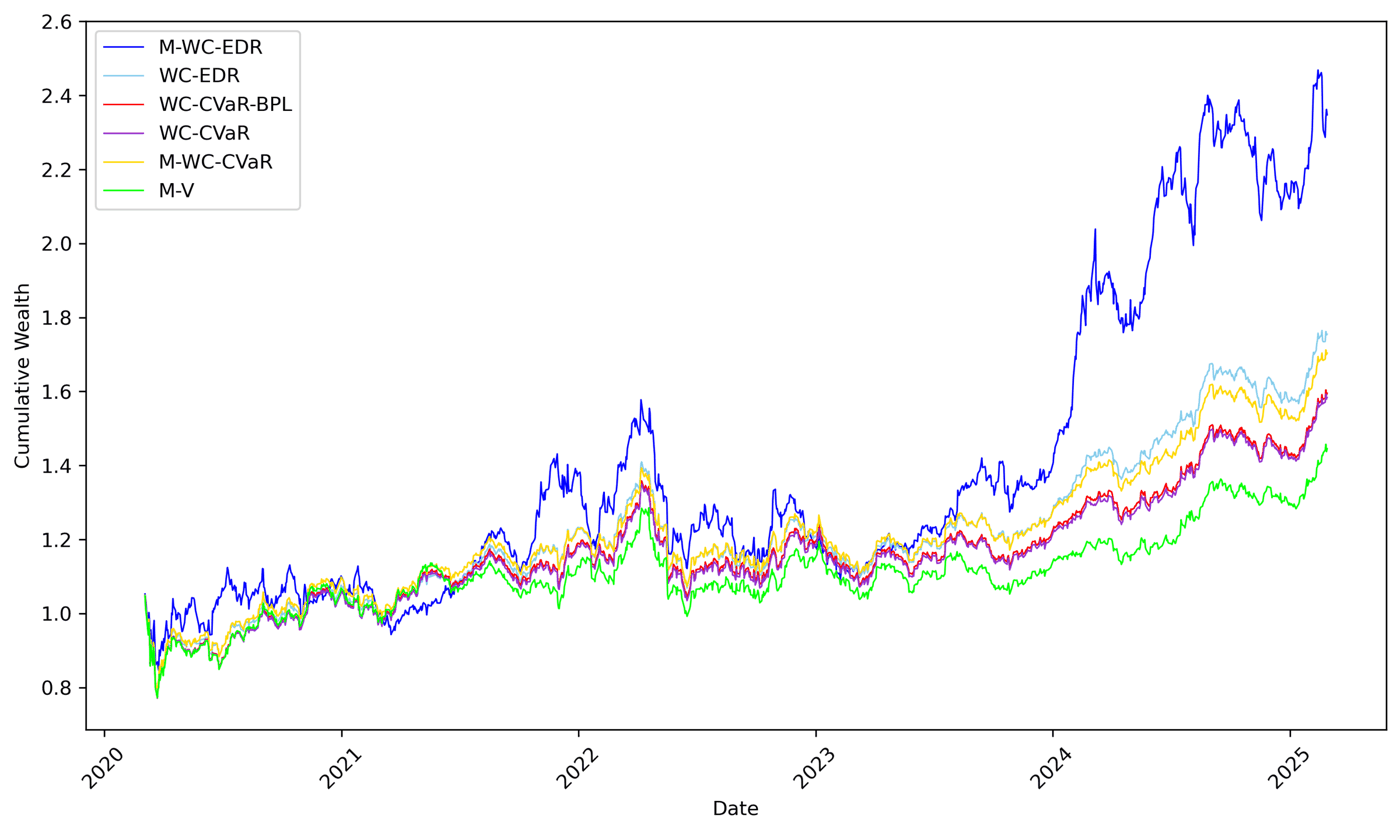
In this paper, we present robust portfolio selection models by incorporating a reward and penalty mechanism into portfolio management. We assume that the joint distribution of the losses of the underlying risky assets in a portfolio is uncertain but lies within a multivariate distribution set. Our goal is to identify optimal portfolio allocations by minimizing the worst-case conditional value-at-risk (CVaR) of portfolio loss under the reward and penalty mechanism and distribution uncertainty. Our models can also be used to investigate the problem of how to balance portfolio losses with their associated downside risk in portfolio management. We first derive an explicit closed-form expression for the worst-case CVaR under the reward-penalty mechanism, which generalizes several existing models and results regarding the worst-case CVaR, such as those studied in Jagannathan (1977), Chen et al. (2011), and Cai et al. (2024). We then apply this expression to obtain optimal portfolio allocations that minimize the worst-case CVaR under both a classical mean-covariance-based multivariate distribution set and a generalized mean-covariance-based multivariate distribution set introduced in Kang et al. (2019). Additionally, we utilize real market data to illustrate the application of the proposed models and the corresponding optimal portfolio allocations in portfolio management. Our empirical experiments show that portfolios based on the proposed models have the potential to outperform those based on several existing related models. Furthermore, the results demonstrate that incorporating downside risk into portfolio loss helps better manage risk and can achieve higher investment returns than considering either downside risk or portfolio loss alone. Moreover, our experiments reveal the trade-off between improving expected portfolio return and controlling the worst-case portfolio CVaR.
Citations and venue from Semantic Scholar (ODC-BY), refreshed weekly. Summary: Quant Letter (CC BY 4.0).