Data-Driven Dynamic Portfolio Selection with Vine Copula Simulation and Reinforcement Learning
A data-driven approach combines vine-copula simulation with reinforcement learning to optimize dynamic portfolio selection across equities and gold with CVaR penalties.
Featured in No. 135 on 16 Oct 2026 · 1 day after release
- Released
- 15 Oct 2026
- First featured
- No. 135 · 16 Oct 2026
- Published in
- Not yet, as far as Semantic Scholar knows
- Fanfare
- 2 of 5
- Identifier
- arXiv:2610.20037
- Authors
- Gabriël M. J. Gelissen and Fengyi Yuan
Abstract
From arXiv (CC0).
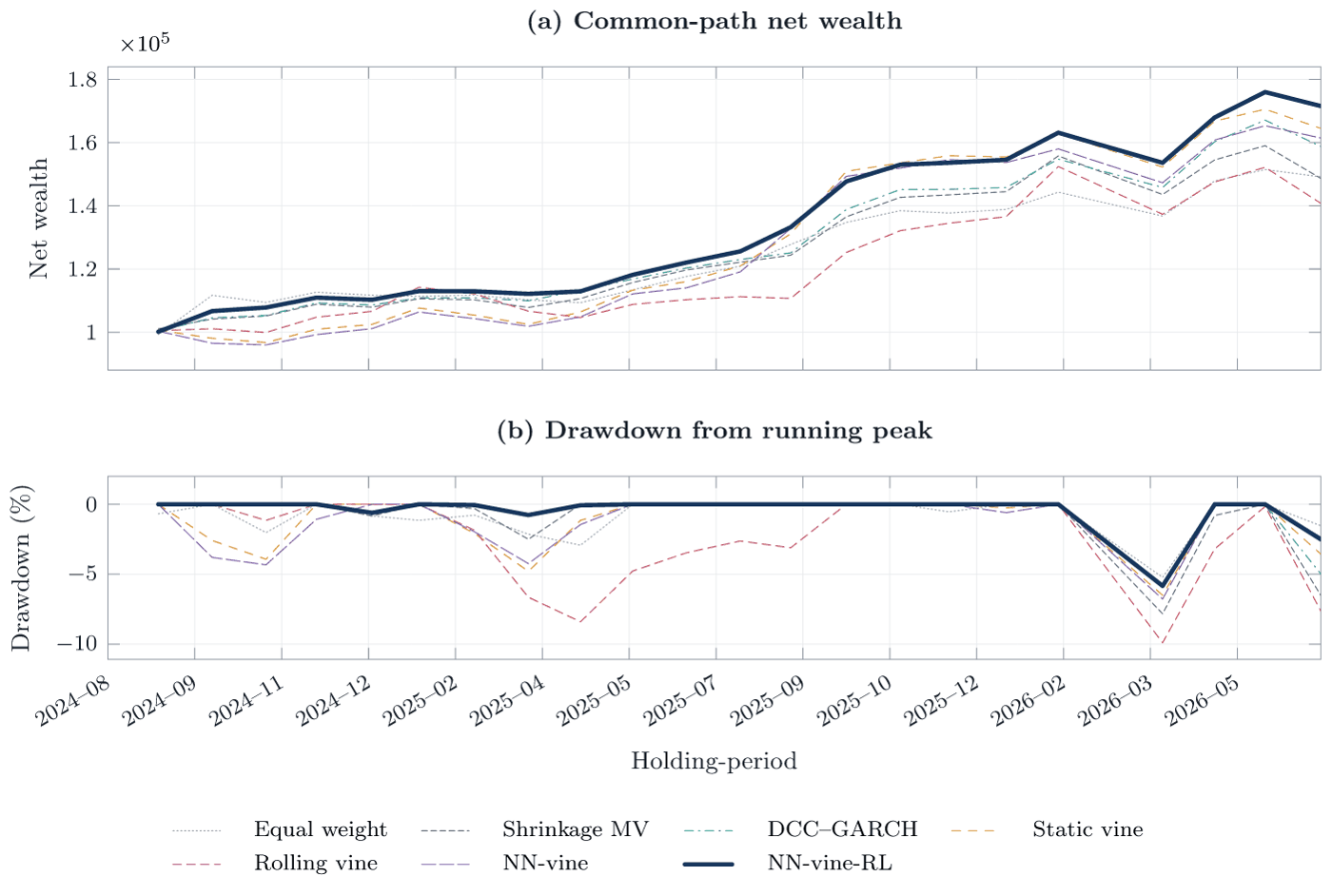
We develop a data-driven approach to dynamic portfolio selection that combines vine-copula simulation with reinforcement learning. The investor has constant relative risk aversion and maximises expected terminal utility with a running penalty on the conditional value-at-risk (CVaR) of one-period losses. We estimate a conditional vine model from historical returns and use it to generate joint scenarios for CVaR evaluation and conditional paths for training a recurrent portfolio policy. Under uniform local derivative bounds, we propagate edgewise pair-copula parameter errors through the conditional transforms to obtain power-law stability bounds in Hellinger distance and total variation. In a finite-horizon investment model, we combine these estimates with a marginal and structural approximation budget to bound policy values, optimal values and the true-market loss of policies selected under a fitted model, with separate simulation and numerical optimisation terms. On a seven-asset panel comprising US and Chinese equities and gold, the selected ensemble of ten trained policies achieves a compound annual growth rate of 34.13% and a Sharpe ratio of 2.31 over 22 complete monthly holding periods, exceeding the corresponding values of six classical and vine-based benchmarks. Combining simulated and historical training data reduces monthly target-to-target turnover by 41.5% relative to training on historical data alone, while maintaining comparable growth.
Citations and venue from Semantic Scholar (ODC-BY), refreshed weekly. Summary: Quant Letter (CC BY 4.0).