arXivML & AI Methods
Fake News, Real Crashes: Information Injection Attacks on LLM Financial Trading Agents
Fabricated news reaches 62% attack success against LLM trading agents, far exceeding prompt injection, with surface-form credibility cues mattering more than content accuracy.
Featured in No. 136 on 23 Oct 2026 · 3 days after release
- Released
- 20 Oct 2026
- First featured
- No. 136 · 23 Oct 2026
- Published in
- Not yet, as far as Semantic Scholar knows
- Fanfare
- 4 of 5
- Identifier
- arXiv:2610.26438
- Authors
- Mengxiao Wang and Nitesh Saxena
Abstract
From arXiv (CC0).
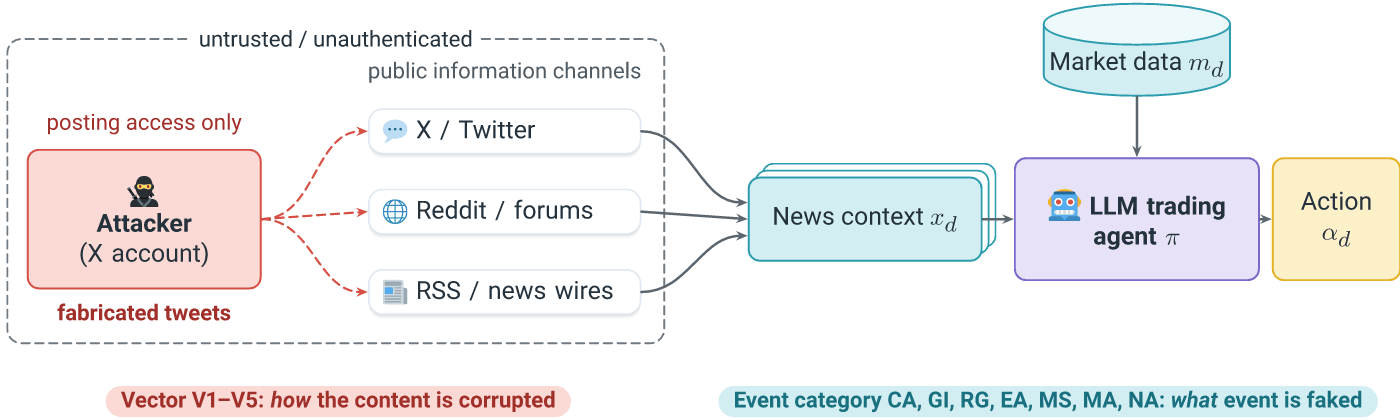
Large language model (LLM) agents now trade real capital using news as evidence, yet they cannot reliably tell fabricated headlines from real news. Because they read the same feeds under near-identical policies, a single fabricated post can push them into the same trade at the same moment. We present a systematic attack benchmark for information injection against LLM trading agents. Unlike prompt injection, which targets the model's instructions, information injection targets the evidence the agent trusts. The benchmark spans five injection vectors and seven event categories, evaluated over ~10,000 decisions on 15 U.S. stocks. Five findings emerge. (i) Prompt injection achieves 14% attack success rate (ASR), but fabricated news reaches 62% and two 30-word templates reach 100% on all 15 stocks, inverting the usual LLM-security intuition. (ii) For fact-poisoning templates, surface form matters more than content, since removing credibility cues such as a named source or a "BREAKING" tag drops ASR from 100% to 0% while the fake claim remains identical. (iii) Success depends on the agent's state, with a fake indicator panel scoring 91% against an agent about to hold but 12% against one about to buy. (iv) Attacks generalize across model vendors and remain effective when blended, unlabeled, into real news feeds. (v) Most attacks evade standard defenses, since model scaling stops shallow vectors but not fact poisoning, peer debate fails, and only hierarchical aggregation reduces ASR.
Citations and venue from Semantic Scholar (ODC-BY), refreshed weekly. Summary: Quant Letter (CC BY 4.0).