Optimal Trading Filters and the Value of Predictive Signals
Wiener-Hopf factorization yields optimal trading filters for return forecasts under transient price impact, showing fractional filters and the value of mean-reversion timing for signals.
Featured in No. 136 on 23 Oct 2026 · 3 days after release
- Released
- 20 Oct 2026
- First featured
- No. 136 · 23 Oct 2026
- Published in
- Not yet, as far as Semantic Scholar knows
- Fanfare
- 2 of 5
- Identifier
- arXiv:2610.24558
- Authors
- Matteo Smerlak
Abstract
From arXiv (CC0).
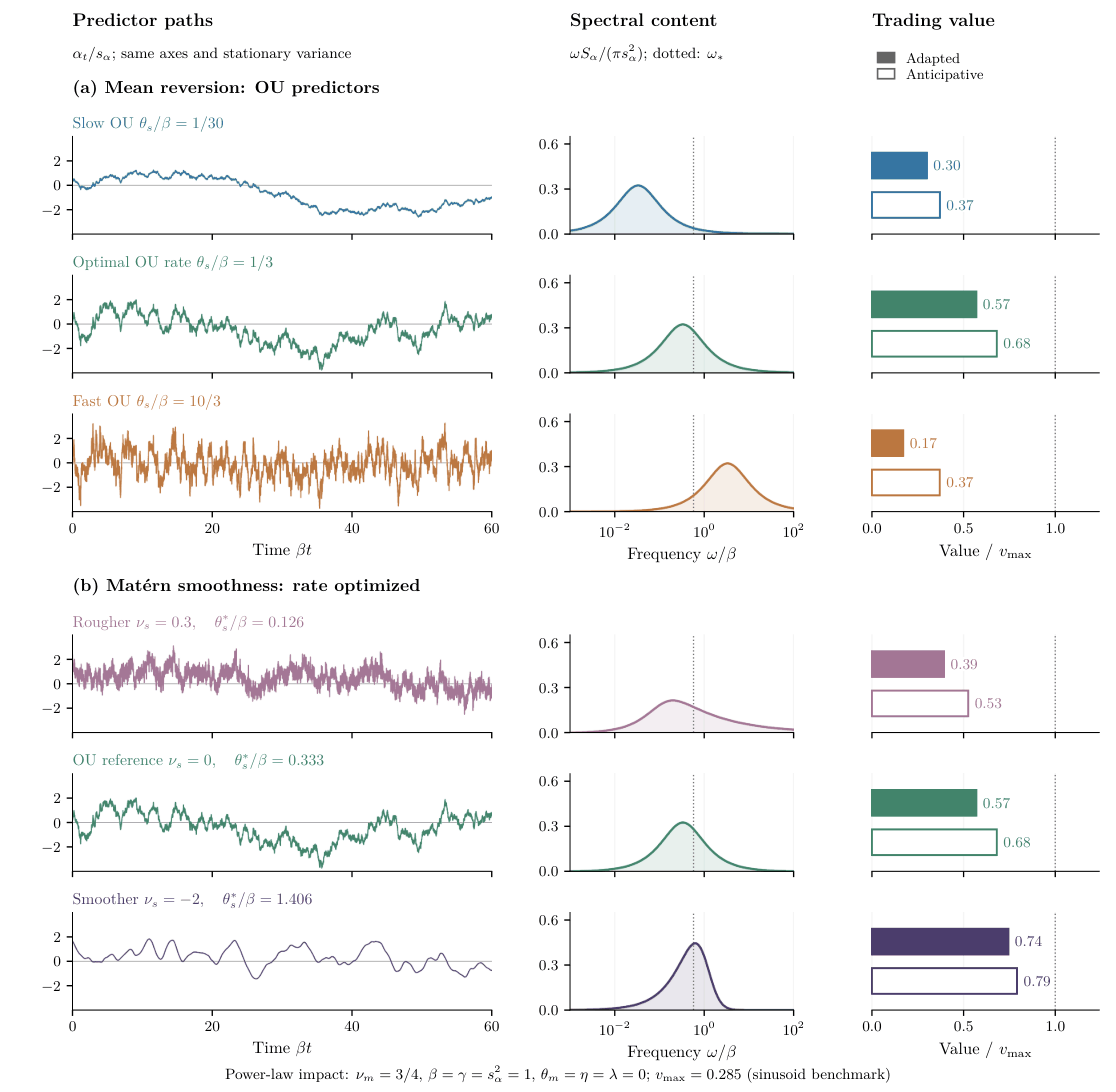
The value of a forecast depends on its accuracy, but also on its actionability. In trading, an investor must translate return forecasts into positions while accounting for trading costs and the lingering impact of earlier trades. We solve the stationary quadratic trading problem with transient price impact using tools from prediction theory: Wiener-Hopf factorization gives the optimal policy as the composition of a conditional forecast and an explicit causal linear filter. We recover the Gârleanu-Pedersen aim-portfolio under exponential resilience and derive fractional trading filters under power-law impact decay, requiring memory beyond finite-dimensional LQR control. At fixed positive risk penalty, signals of equal instantaneous predictive strength have equal frictionless Markowitz value. With trading costs, net attainable value is determined by the mean square of the friction-weighted conditional forecast. Under power-law impact with exposure bleeding, we find an intermediate optimal mean-reversion rate for Ornstein-Uhlenbeck signals.
Citations and venue from Semantic Scholar (ODC-BY), refreshed weekly. Summary: Quant Letter (CC BY 4.0).