Multiperiod bond portfolio optimization with transaction costs using a Markov Decision process
The study develops a Markov decision process framework for dynamic bond portfolio management that balances yield and interest-rate risk subject to transaction costs.
Featured in No. 133 on 2 Oct 2026 · 1 day after release
- Released
- 1 Oct 2026
- First featured
- No. 133 · 2 Oct 2026
- Published in
- Not yet, as far as Semantic Scholar knows
- Fanfare
- 2 of 5
- Identifier
- arXiv:2609.38765
- Authors
- Balaji Ramachandran et al.
Abstract
From arXiv (CC0).
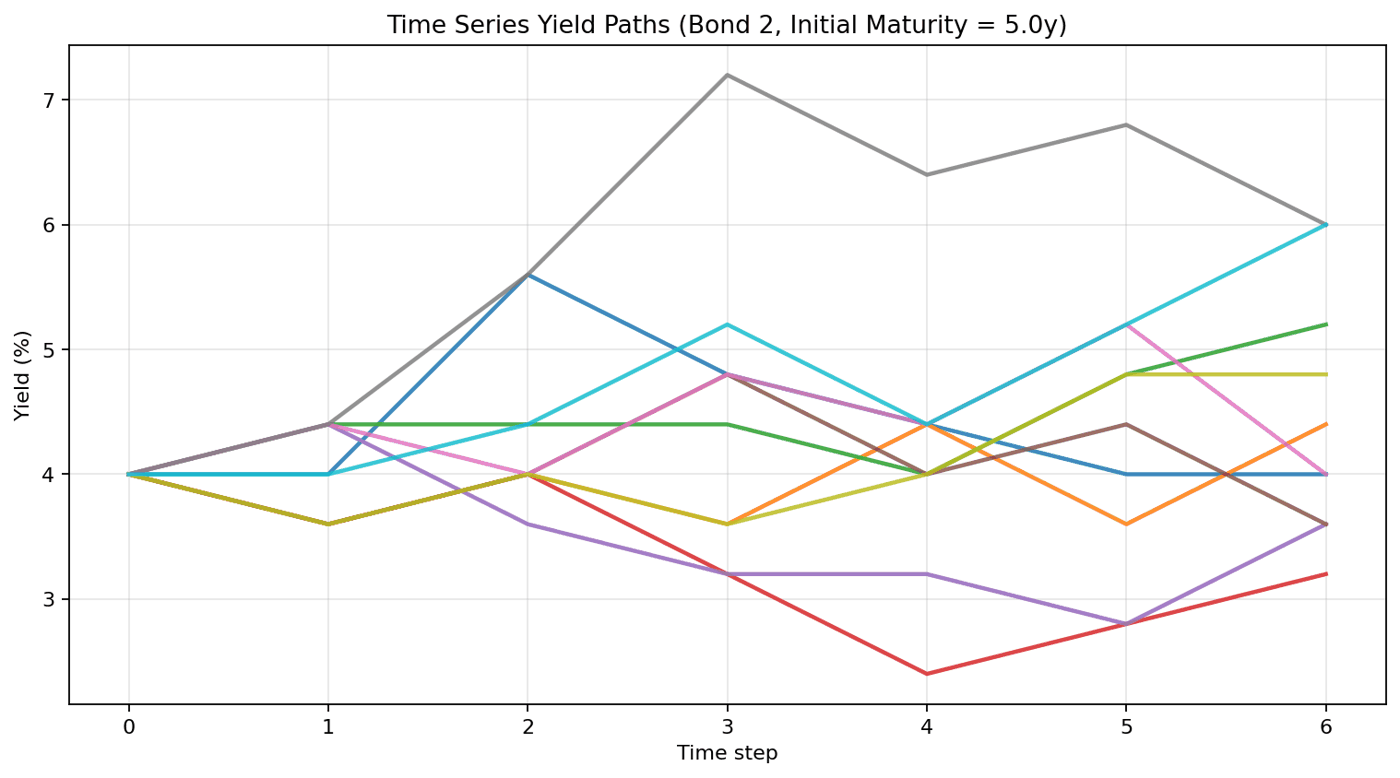
Bank treasury portfolios must balance yield, liquidity, and interest-rate risk across bonds of different maturities. Static allocation rules are ill-suited to this task: portfolios concentrated in long-duration securities with no dynamic adjust- ment mechanism can accumulate large mark-to-market losses and liquidity stress under rising interest rates, as illustrated by the failure of Silicon Valley Bank in 2023. We develop a tractable simulation-based framework for multi-period bond port- folio optimization under interest-rate risk and proportional transaction costs. Yield-curve dynamics are modeled using the Dynamic Nelson-Siegel parameter- ization with Vector Autoregressive factor dynamics, from which we construct a time-inhomogeneous discrete-state Markov chain approximating the joint yield process across bond maturities. This chain forms the state space of a finite- horizon Markov Decision Process in which the investor maximizes expected terminal wealth subject to proportional rebalancing costs. The optimal portfolio policy is obtained by backward induction. We also quantify the approximation error introduced by truncating the transition kernel, and show that it leaves mean terminal wealth almost unchanged while substantially distorting drawdown and tail statistics.
Citations and venue from Semantic Scholar (ODC-BY), refreshed weekly. Summary: Quant Letter (CC BY 4.0).