arXivML & AI Methods
Agentic AI in Automated Markets
Deep reinforcement learning simulates three agent archetypes in automated markets, finding herd-followers generate frequent short stress episodes while manipulators create persistent volatility.
Featured in No. 136 on 23 Oct 2026 · 4 days after release
- Released
- 19 Oct 2026
- First featured
- No. 136 · 23 Oct 2026
- Published in
- Not yet, as far as Semantic Scholar knows
- Fanfare
- 2 of 5
- Identifier
- arXiv:2610.22522
- Authors
- Irene Aldridge et al.
Abstract
From arXiv (CC0).
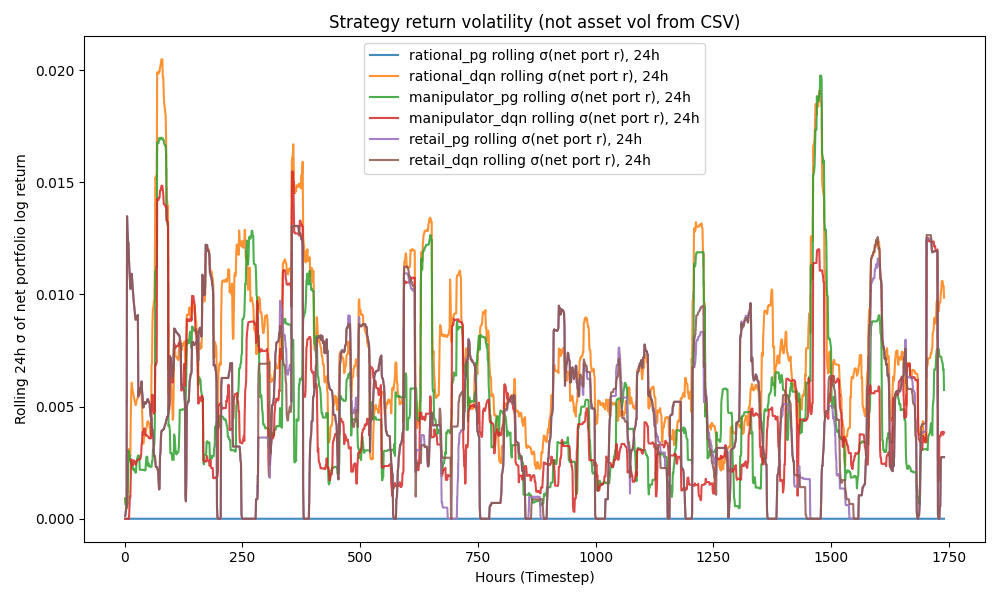
Automated markets increasingly host autonomous, learning trading agents and are powered by formulaic automated market makers (AMMs). We study how heterogeneous agent behavior shapes stress, risk-adjusted performance, liquidity, and volatility in these types of markets. Three behavioral archetypes are modeled as agentic reinforcement learning (RL) systems: a rational arbitrageur, a manipulator, and a retail herd-follower. Each archetype is defined by its reward function within a common, asset-agnostic exposure-control environment, and each is trained with a value-based Deep Q-Network (DQN) and with REINFORCE using a learned baseline. A pilot on hourly cryptocurrency data (AAVE, ETC, SUI) motivates the hypotheses. Herd-followers produce the most frequent but shortest stress episodes, manipulators the fewest but most persistent, and rational agents the most stable rolling Sharpe ratios despite higher return volatility. SHAP attributions tie these patterns to drawdown and cross-asset signals, short-term volatility and position state, and momentum, respectively. The results motivate behavior-specific regulation rather than uniform limits on volatility or turnover.
Citations and venue from Semantic Scholar (ODC-BY), refreshed weekly. Summary: Quant Letter (CC BY 4.0).