Three options are roughly enough - Variance-optimal semi-static hedging in the rough Heston model
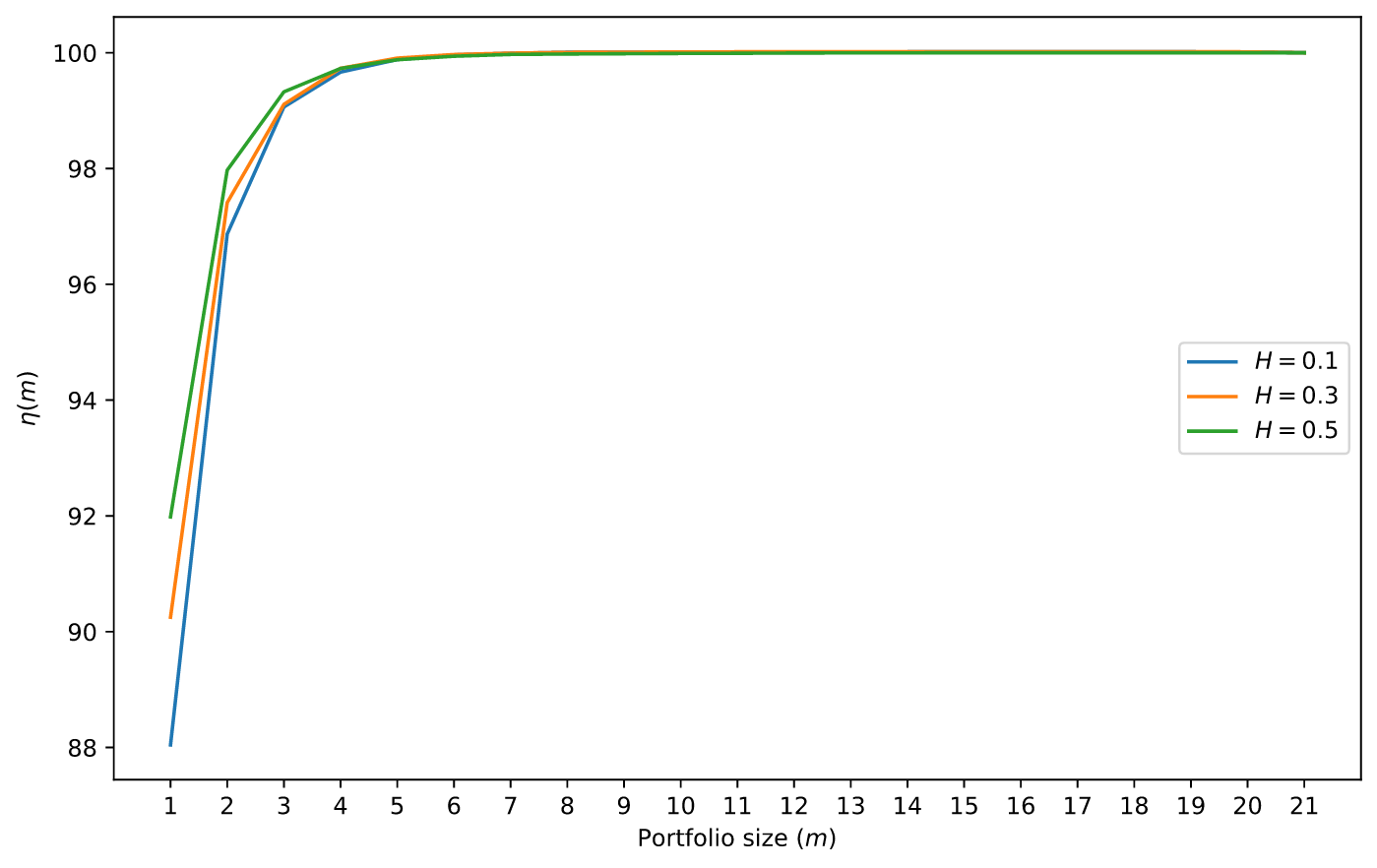
The paper shows that combining dynamic trading in the underlying with static positions in three vanilla options reduces variance-swap hedging error by more than 95% across different market roughness regimes.
Featured in No. 135 on 16 Oct 2026 · 4 days after release
- Released
- 12 Oct 2026
- First featured
- No. 135 · 16 Oct 2026
- Published in
- Not yet, as far as Semantic Scholar knows
- Fanfare
- 3 of 5
- Identifier
- arXiv:2610.13543
- Authors
- Paolo Di Tella et al.
Abstract
From arXiv (CC0).
This paper studies semi-static variance-optimal hedging of variance swaps in the rough Heston model under a risk-neutral measure. We combine dynamic trading in the underlying asset with static positions in a finite basket of European options, with the aim of minimizing the variance of the residual hedging error. Exploiting the Markovian lift provided by the forward variance curve, the Fourier representations of the claims and the Laplace transform characterization of the log-price, we derive semi-explicit formulas for the optimal strategies and the hedging error. We then study the optimal claim selection problem, investigating numerically how the choice of static instruments depends on the Hurst index. Under standard parametrization, we discover that "three options are roughly enough", i.e. adding three static vanilla options reduces the hedging error by more than 95% relative to the purely dynamic hedge for all considered roughness regimes H= 0.1, 0.3, 0.5.
Citations and venue from Semantic Scholar (ODC-BY), refreshed weekly. Summary: Quant Letter (CC BY 4.0).