Auto-Alpha: A Framework for Autonomous Factor Research
A framework connects economic reports to self-directed research via backtest feedback, retaining 62 factors from initial development and 32 from reports.
Featured in No. 140 on 20 Nov 2026 · on release day
- Released
- 20 Nov 2026
- First featured
- No. 140 · 20 Nov 2026
- Published in
- Not yet, as far as Semantic Scholar knows
- Fanfare
- 3 of 5
- Identifier
- arXiv:2611.25732
- Authors
- Hui Cai et al.
Abstract
From arXiv (CC0).
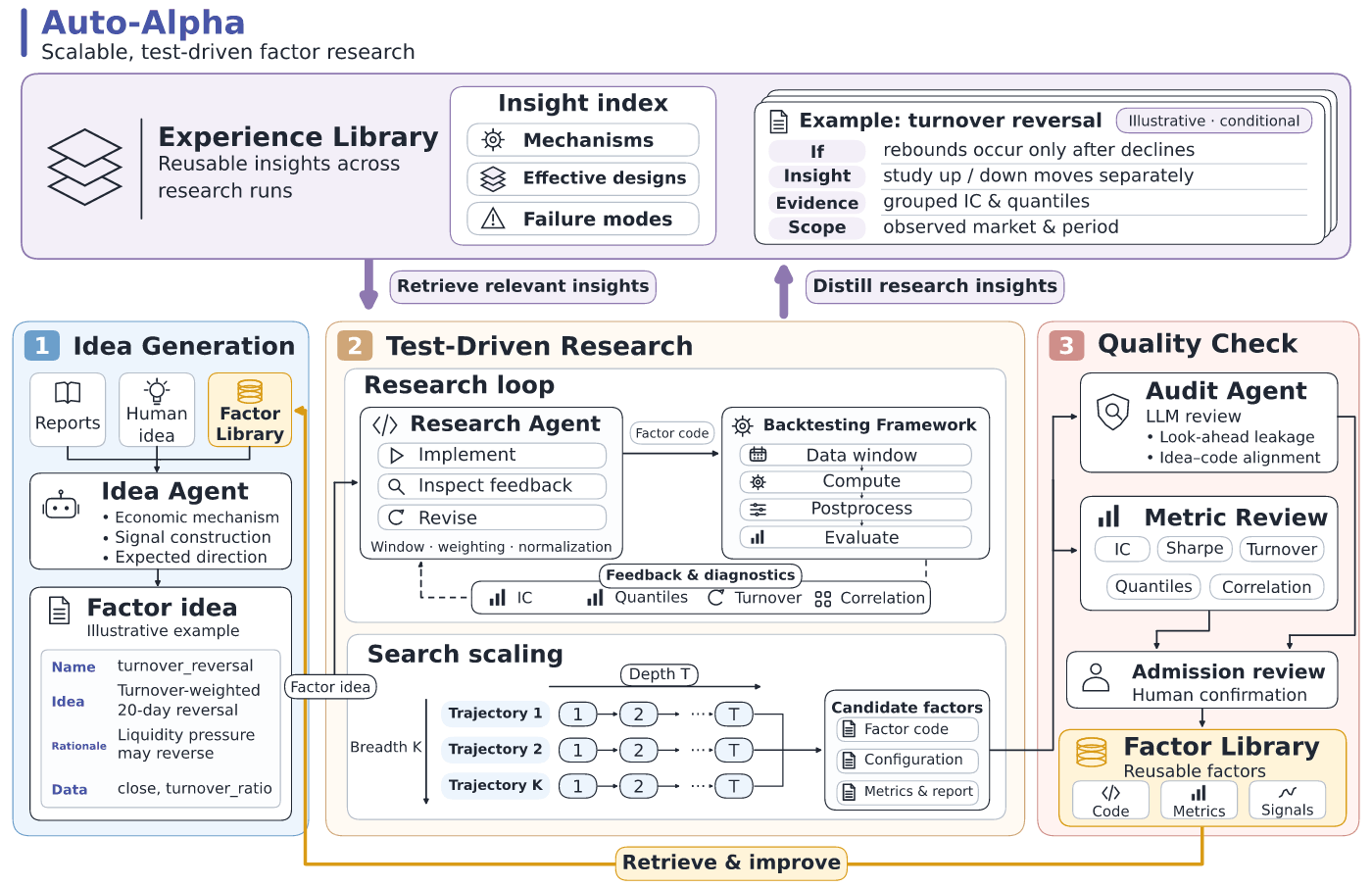
Autonomous factor research requires generating economic hypotheses as well as implementing and testing them. We present Auto-Alpha, a framework that connects report-guided initialization to self-directed research through a test-driven implementation loop. An idea agent proposes economic mechanisms and signal constructions; a research agent develops them with backtest feedback. Semantic audit, quantitative review, and human admission select factors for a persistent library, while an Experience Library retains research insights. Starting from 120 research reports, Auto-Alpha builds an initial library of 32 factors. It then generates new ideas and refines existing candidates, producing 420 implementations and retaining 62 additional factors. We evaluate factor quality and portfolio performance using a fixed library snapshot of 105 factors. The median 1-day Rank IC is 0.0301, and a weekly Top-300 portfolio returns 16.81% annualized after stated costs over 2020-2026, versus 1.71% for the CSI 1000 price index. These retrospective results document an operating research process and its artifacts; controlled evaluation is needed to isolate the contribution of its components.
Citations and venue from Semantic Scholar (ODC-BY), refreshed weekly. Summary: Quant Letter (CC BY 4.0).