arXivEconometrics & Forecasting
Structural Fine-Tuning under Economic Restrictions
A framework adapts pretrained predictors to new economic environments by imposing constraints based on economic knowledge, lowering prediction error by 28-39% in a credit-limit scenario.
Featured in No. 140 on 20 Nov 2026 · on release day
- Released
- 20 Nov 2026
- First featured
- No. 140 · 20 Nov 2026
- Published in
- Not yet, as far as Semantic Scholar knows
- Fanfare
- 2 of 5
- Identifier
- arXiv:2611.25420
- Authors
- Yi Niu et al.
Abstract
From arXiv (CC0).
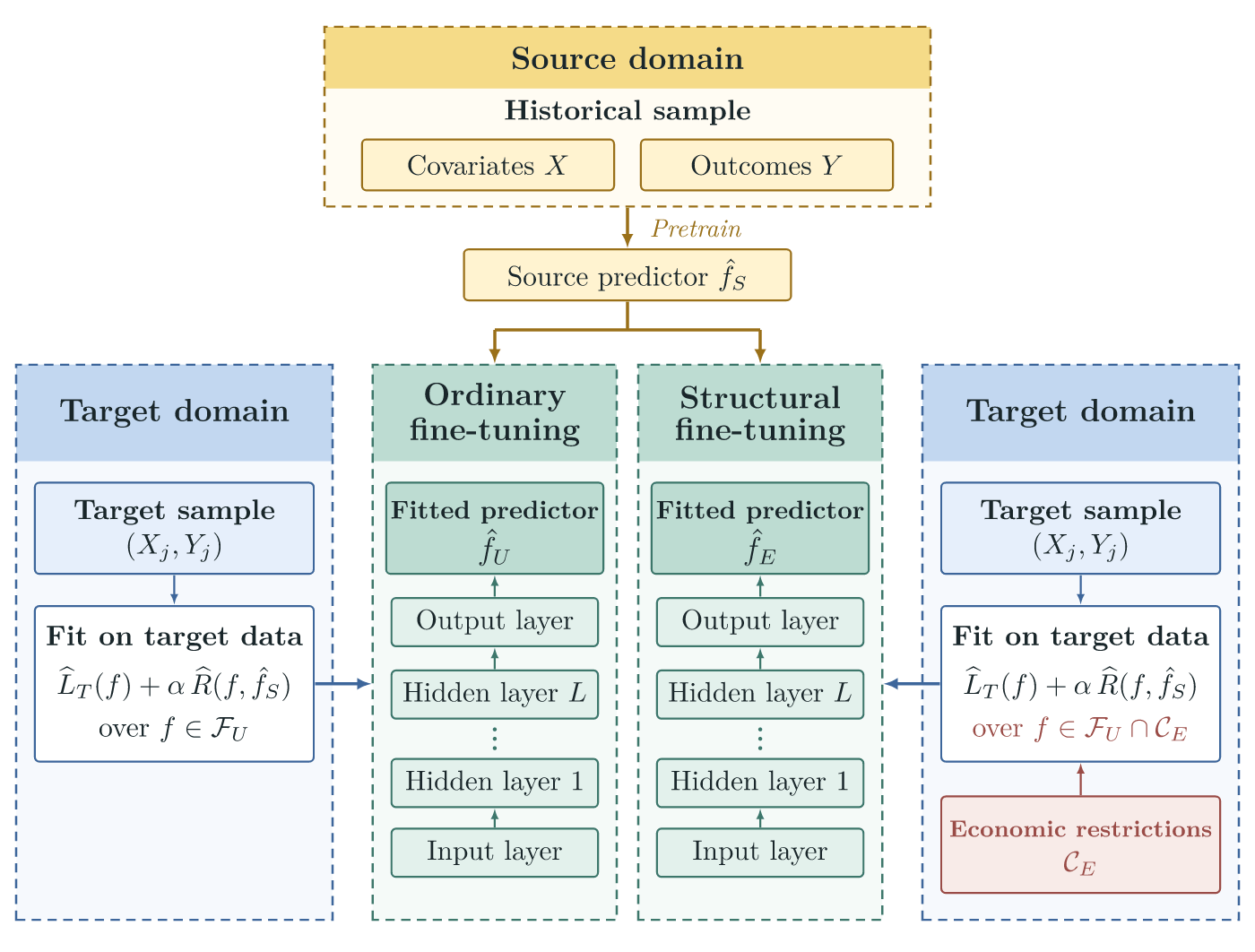
How should a predictor trained on historical data be adapted to a new economic environment or task when few target observations are available? We propose structural fine-tuning, a framework that introduces economic restrictions to guide the adaptation of pretrained predictors. The framework does not require a complete structural model; instead, it utilizes constraints based on economic knowledge, ranging from simple, ubiquitous assumptions to particular workhorse models. Theoretically, we characterize conditions when economic restrictions improve prediction over the original model and ordinary fine-tuning. Then, we illustrate the framework through a simulation exercise of a credit issuer's credit-limit decision following a Medicaid-style expansion in medical payments. Imposing restrictions based on eligibility, outstanding medical bills, cash flows, and group-level risk bounds, our framework lowers the root mean squared error of predicted risk by 28 to 39 percent and the issuer's policy regret by 3 to 10 percent relative to ordinary neuron gating, LoRA, and full fine-tuning.
Citations and venue from Semantic Scholar (ODC-BY), refreshed weekly. Summary: Quant Letter (CC BY 4.0).