arXivEconometrics & Forecasting
Tabular Foundation Models in Financial Predictions
A tabular foundation model pretrained on synthetic data outperforms tree-based and language models at predicting next-year earnings changes.
Featured in No. 139 on 13 Nov 2026 · 2 days after release
- Released
- 11 Nov 2026
- First featured
- No. 139 · 13 Nov 2026
- Published in
- Not yet, as far as Semantic Scholar knows
- Fanfare
- 3 of 5
- Identifier
- arXiv:2611.13550
- Authors
- Ed deHaan and Allen H. Huang
Abstract
From arXiv (CC0).
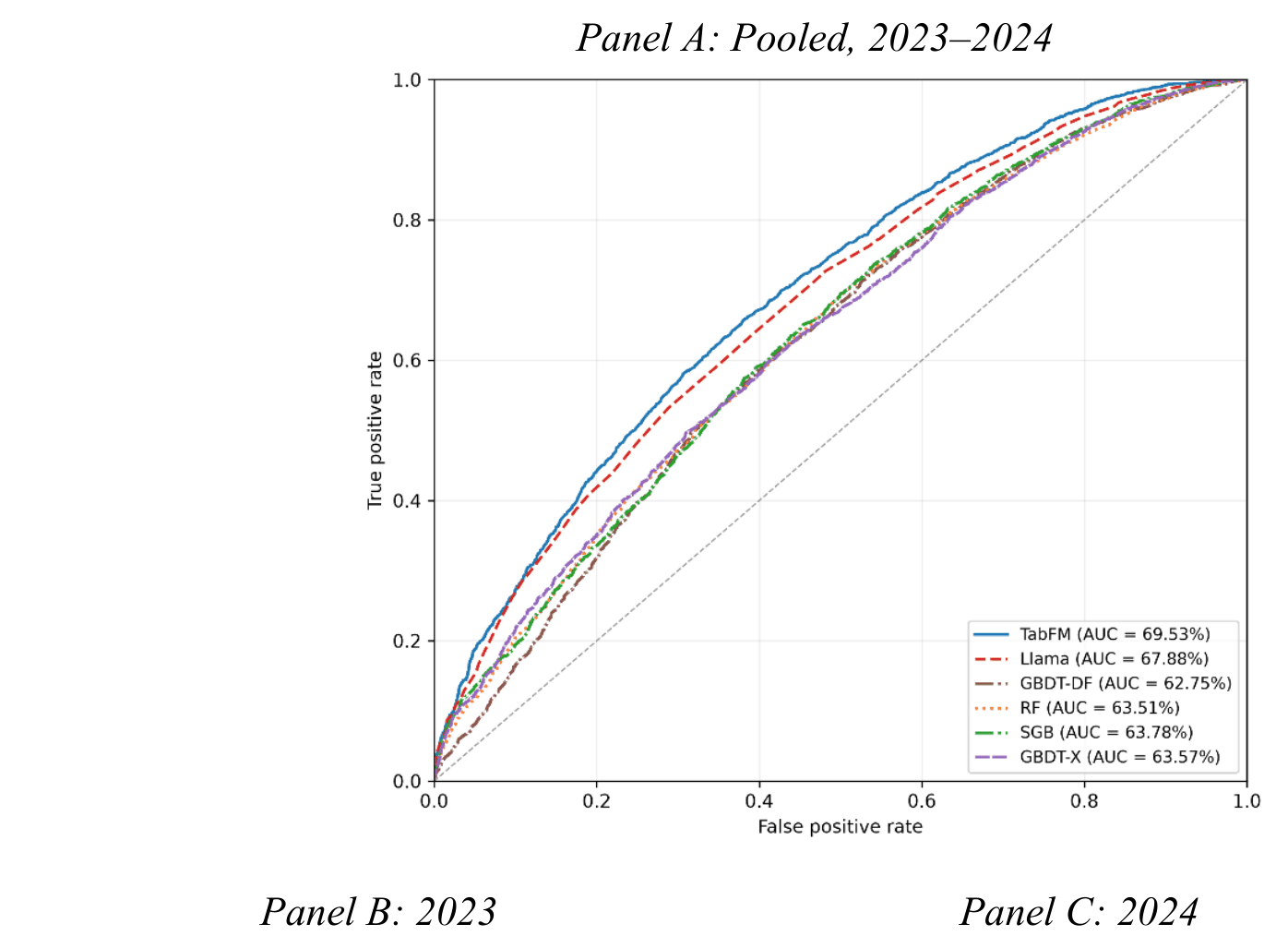
This technical note introduces tabular foundation models (TFMs) to accounting research and evaluates their performance in one common benchmark task: predicting firms' next-year earnings changes. TFMs produce numeric predictions and learn in context, without post-release training or tuning, making them natural and easy to use for forecasting. The TFMs we study are pretrained on synthetic tabular data, so they avoid look-ahead bias from memorizing firms' outcomes. We compare Google Research's TabFM with a fine-tuned open-weight large language model developed in recent accounting research and with several tree-based models. TabFM is more accurate than all comparison models. It is also faster and less computationally intensive than the large language model. Several tree-based specifications produce predictions more quickly than TabFM, so choosing between them involves a trade-off between accuracy and speed. We conclude that TFMs have promise as a new tool for forecasting in accounting and finance. However, our evaluation is based on a single benchmark task, and no class of models is likely to dominate in all settings.
Citations and venue from Semantic Scholar (ODC-BY), refreshed weekly. Summary: Quant Letter (CC BY 4.0).