arXivTrading, Microstructure & Execution
Algorithmic Market Making Can Lead to Rough Volatility Through the Order Book
The research shows that stochastic gradient descent by asynchronous market makers with power-law memory in order flow generates rough volatility, confirmed on simulated agents and Binance data.
Featured in No. 140 on 20 Nov 2026 · 1 day after release
- Released
- 19 Nov 2026
- First featured
- No. 140 · 20 Nov 2026
- Published in
- Not yet, as far as Semantic Scholar knows
- Fanfare
- 3 of 5
- Identifier
- arXiv:2611.24028
- Authors
- Sai Niranjan Ramachandran
Abstract
From arXiv (CC0).
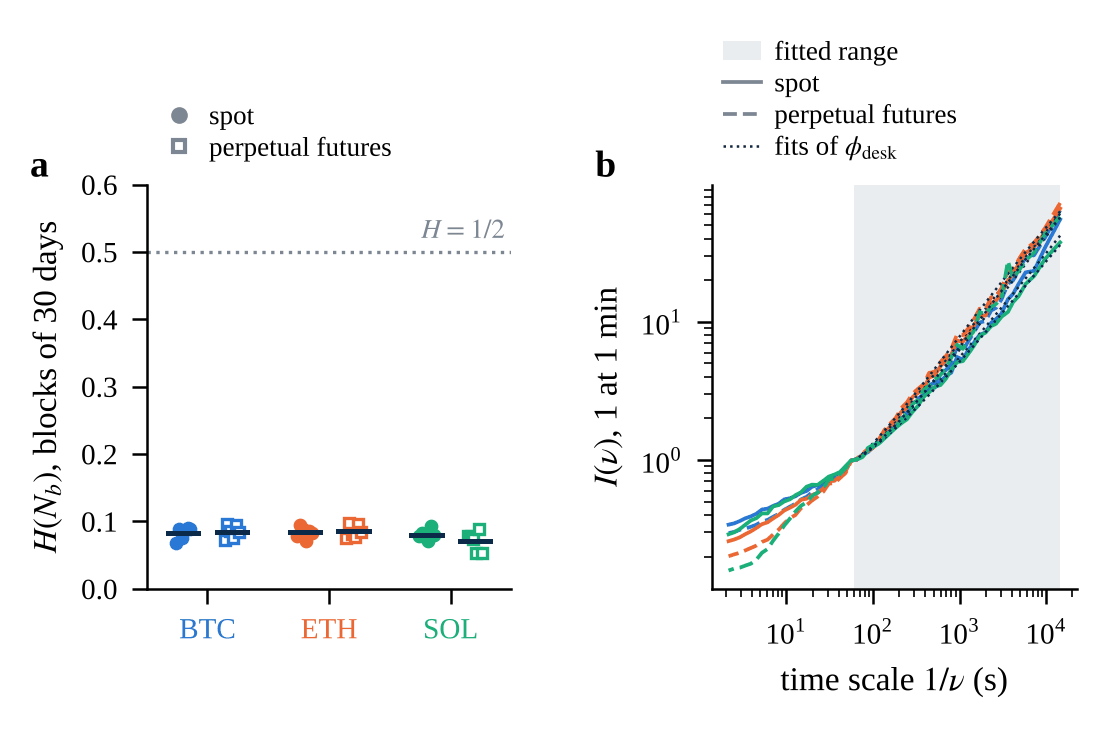
Existing work suggests that markets can show volatility with paths rougher than those of Brownian motion. In theory this can happen when the order flow is close to instability with memory that decays as a power law. However, it is not fully clear how such order flow could arise from the predominantly algorithmic market making that characterizes order book dynamics. We show one such consistent mechanism. We treat each market maker as a desk that uses a first-order gradient rule to move the distances of its orders from the mid price toward target distances provided by an unknown oracle. We assume that distinct desks do not act synchronously in time but act whenever new information relevant to their respective oracles arrives, which each desk samples over its own characteristic lookback horizon. Across all desks the rule therefore takes the form of stochastic gradient descent (SGD) with information-driven (mini-batch) noise. In the continuum limit this update rule makes the volume of the order book follow a conservative stochastic partial differential equation (the Dean--Kawasaki equation) whose fluctuations drive the order flow. The distinct horizons of the desks further induce a persistent memory in the order flow that decays as a power law. Standard scaling arguments then lead to rough volatility. We confirm the key predictions of the model on simulated agents and on six months of Binance data with about 790 million orders. In liquid markets governed mainly by market makers, such as the perpetual futures of Binance, the order books are consistent with how our desks change the book.
Citations and venue from Semantic Scholar (ODC-BY), refreshed weekly. Summary: Quant Letter (CC BY 4.0).