arXivTrading, Microstructure & Execution
Evolution of Market Microstructure in the Age of AI
A survey traces how market design has evolved from floor trading through electronic exchanges to AI agents, examining whether markets can allocate goods efficiently without full revelation.
Featured in No. 133 on 2 Oct 2026 · 3 days after release
- Released
- 29 Sep 2026
- First featured
- No. 133 · 2 Oct 2026
- Published in
- Not yet, as far as Semantic Scholar knows
- Fanfare
- 3 of 5
- Identifier
- arXiv:2609.33058
- Authors
- Irene Aldridge
Abstract
From arXiv (CC0).
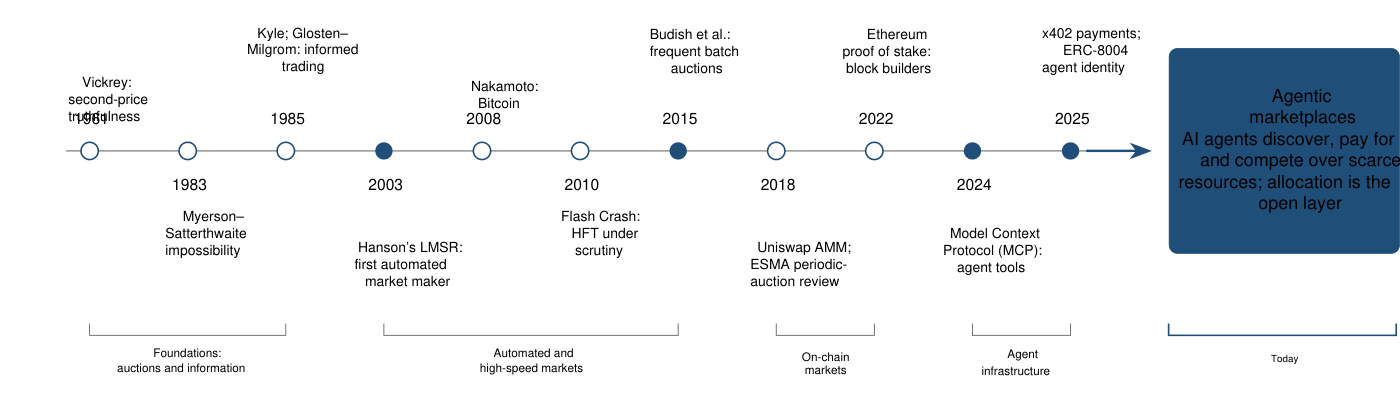
Market microstructure studies how trading rules turn orders into prices and allocations. Those rules have been rebuilt repeatedly: for floor traders, electronic limit order books and high-frequency trading, batch auctions and dark pools, blockchains run by automated market makers and block builders, and now AI agents that discover, pay for, and compete over resources. This survey traces that evolution through one question: can a market allocate scarce goods efficiently and fairly without participants revealing everything they know and want? Each technological shift moved the binding constraint of market design from trader rationality to speed, to control over transaction ordering, to the dimensionality of what participants can report. Impossibility results persist; only their cost moves. We review evidence on high-frequency trading, trading venues, automated market makers, extractable value and algorithmic collusion, and identify allocation as the missing layer of the agent-commerce protocol stack.
Citations and venue from Semantic Scholar (ODC-BY), refreshed weekly. Summary: Quant Letter (CC BY 4.0).