arXivML & AI Methods
LLM Trading Agents Earn Beta, Not Alpha: A Look-Ahead-Free Benchmark
A look-ahead-free benchmark of six language-model traders across three markets finds no significant alpha; market exposure explains 78% of returns and agent decisions match random sector picks.
Featured in No. 140 on 20 Nov 2026 · 3 days after release
- Released
- 17 Nov 2026
- First featured
- No. 140 · 20 Nov 2026
- Published in
- Not yet, as far as Semantic Scholar knows
- Fanfare
- 4 of 5
- Identifier
- arXiv:2611.19530
- Authors
- Jackson Wang
Abstract
From arXiv (CC0).
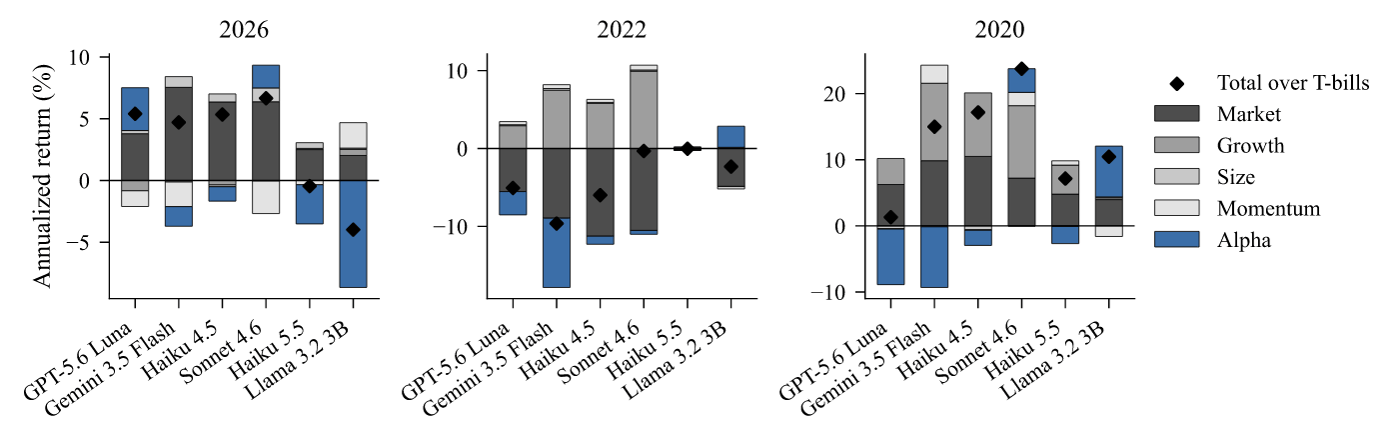
Large language model (LLM) trading agents now trade stocks for their users, and benchmarks rank models by their agents' returns. Yet a single run's return says little about skill. In our study, two runs of the same model that differed only in the random seed ended 5.2 points apart on average, so telling skill from luck takes many backtests across markets, models and seeds. However, live arenas trade each day only once, and backtests either use the few months after a model's training cutoff or run on years the model may remember, often with news joined to prices by calendar date. In this paper, we present rta-bench-1, a backtest over three US markets (a rally, a bear market and a crash). It shows each headline only after its publication minute, plays each period blind and named, and checks every run for look-ahead. It also splits each return into factor exposure and alpha and scores every decision against random choices of the same day and sector. In 91 runs of six models from four vendors, no alpha was significant, market and style exposure accounted for a median 78% of the return, and the decisions did no better than random stocks of the same sector. The agents bought the stocks with the most positive news, yet in ablations they earned as much without their headlines. Still, the agents carried out rules reliably, since a single cash rule in the prompt cut a GPT-based agent's share in stocks by 30.3 points in all six pairs. Builders should therefore supply the edge themselves and report exposures and alpha, and benchmarks should replay news by publication time.
Citations and venue from Semantic Scholar (ODC-BY), refreshed weekly. Summary: Quant Letter (CC BY 4.0).