Local Stochastic Volatility Iterations
A calibration method determines leverage factors for local stochastic volatility models by fixed-point iteration, reproducing S&P 500 implied volatility surfaces within basis points of observed quotes.
Featured in No. 140 on 20 Nov 2026 · 4 days after release
- Released
- 16 Nov 2026
- First featured
- No. 140 · 20 Nov 2026
- Published in
- Not yet, as far as Semantic Scholar knows
- Fanfare
- 2 of 5
- Identifier
- arXiv:2611.18214
- Authors
- Christian Bayer et al.
Abstract
From arXiv (CC0).
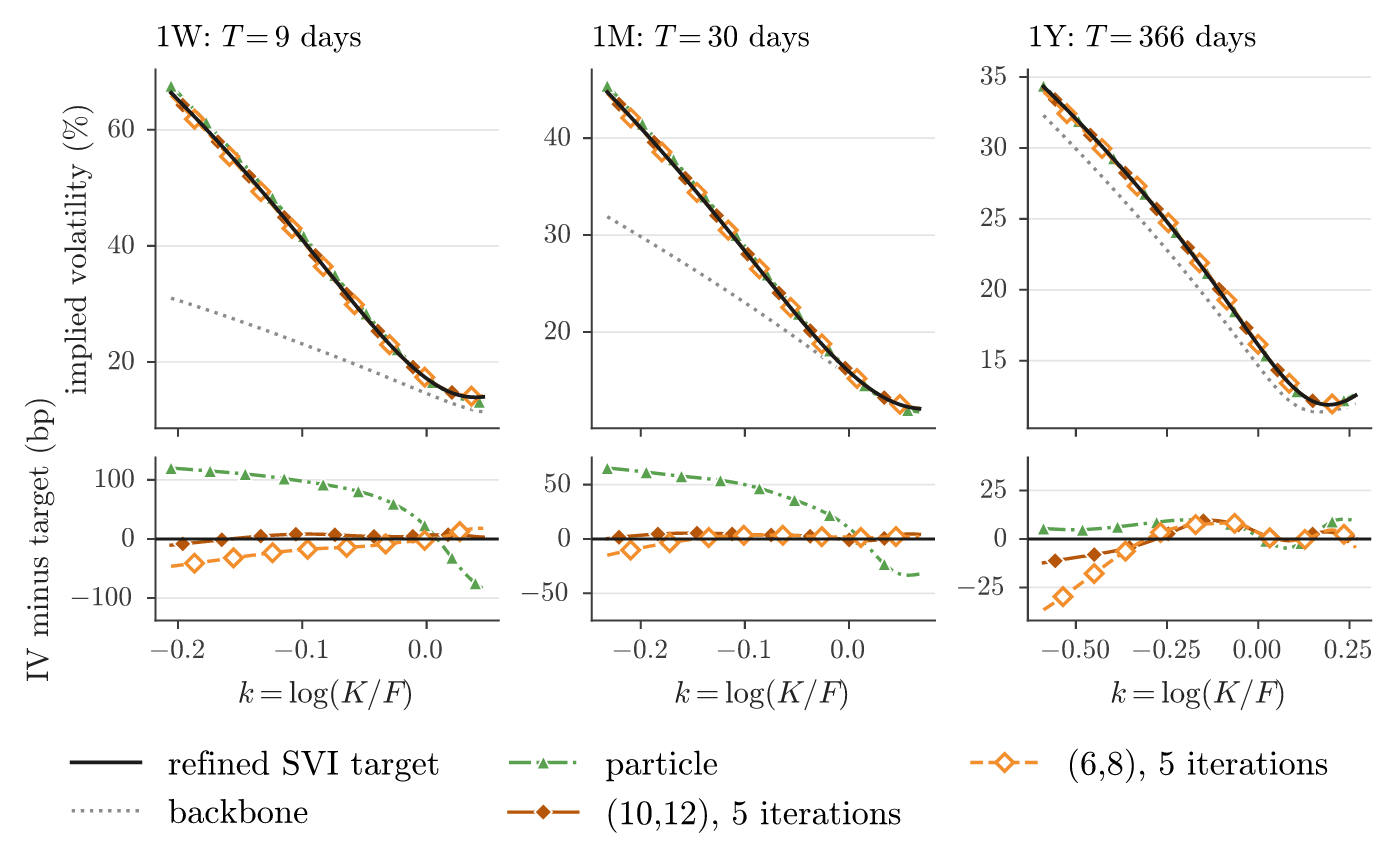
We propose a calibration method for local stochastic volatility models that determines the leverage factor by a fixed-point iteration. Each iteration simulates the model with the current leverage factor and approximates the conditional expectation of the stochastic variance given the spot by a single regression in time and state, with a quasi-likelihood loss for positive responses. The resulting leverage factor is a smooth function of time and spot with relatively few parameters, which can in addition be refined directly against option quotes. We recalibrate the leverage factor to S&P 500 index options on the day of an interest rate announcement, keeping the parameters of a two-factor Bergomi model calibrated four weeks earlier. After five iterations, leverage factors with 63 and 143 coefficients reproduce the implied volatility surface fitted to the quotes within a few basis points over the quoted strikes, the smaller one except in the left wing, and further iterations change them little. A few regularized Gauss-Newton steps against the quotes then bring 87% and 95% of the liquid quotes inside their bid-ask intervals.
Citations and venue from Semantic Scholar (ODC-BY), refreshed weekly. Summary: Quant Letter (CC BY 4.0).