Global Seasonality Factor Investing
The research identifies five seasonality anomalies across bond, commodity and equity futures; slower seasonal patterns produce positive net returns after costs while fast patterns do not.
Featured in No. 139 on 13 Nov 2026 · on release day
- Released
- 13 Nov 2026
- First featured
- No. 139 · 13 Nov 2026
- Published in
- Not yet, as far as Semantic Scholar knows
- Fanfare
- 3 of 5
- Identifier
- arXiv:2611.15657
- Authors
- Andrew Butler et al.
Abstract
From arXiv (CC0).
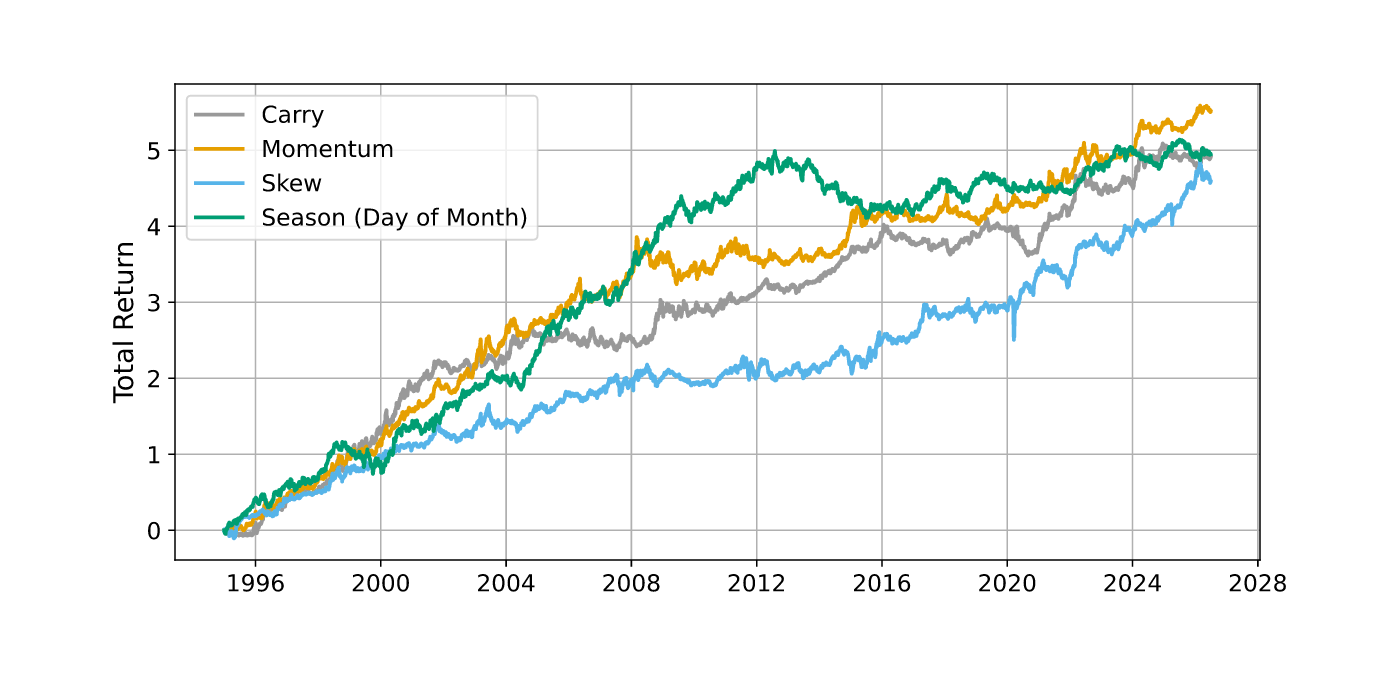
We study seasonality as a factor for predicting risk-adjusted returns across global futures markets. We document five seasonality anomalies that, in aggregate, are pervasive across bond, commodity and equity markets. We demonstrate that each seasonality factor produces excess returns that are not reasonably explained by established global time series carry, momentum and skewness factors. We apply recent innovations in statistical learning and fit nonlinear seasonality models at the individual market level, thereby allowing each feature-market pair to express its unique seasonal prediction pattern. We discuss candidate economic rationales for the existence and persistence of each seasonality anomaly. Walk-forward out-of-sample testing demonstrates that fast-moving seasonal patterns, such as day-of-week and day-of-month, produce strong gross performance but with extremely high turnover, resulting in negative performance net of transaction costs. In contrast, slower-moving seasonal patterns, such as day-of-quarter, day-of-half-year and day-of-year, produce positive gross performance and, with the exception of day-of-quarter, positive net performance. An equal-weight ensemble of seasonality models produces an out-of-sample Sharpe ratio that is competitive with, and uncorrelated to, established global time series factor portfolios. Empirical results demonstrate that adding seasonality to a global factor portfolio increases the out-of-sample Sharpe ratio by approximately $30\%$ over the full evaluation period.
Citations and venue from Semantic Scholar (ODC-BY), refreshed weekly. Summary: Quant Letter (CC BY 4.0).