The Cryptocurrency Trend Factor Revisited: Predictive Information, Portfolio Construction, and Pricing Claims
A code audit of the cryptocurrency trend factor reveals that after correcting for future-information use and technical-indicator issues, the factor's alpha becomes statistically insignificant and cannot replace momentum.
Featured in No. 138 on 6 Nov 2026 · 3 days after release
- Released
- 3 Nov 2026
- First featured
- No. 138 · 6 Nov 2026
- Published in
- Not yet, as far as Semantic Scholar knows
- Fanfare
- 3 of 5
- Identifier
- arXiv:2611.01951
- Authors
- Yifei Wang and Zhenling Pang
Abstract
From arXiv (CC0).
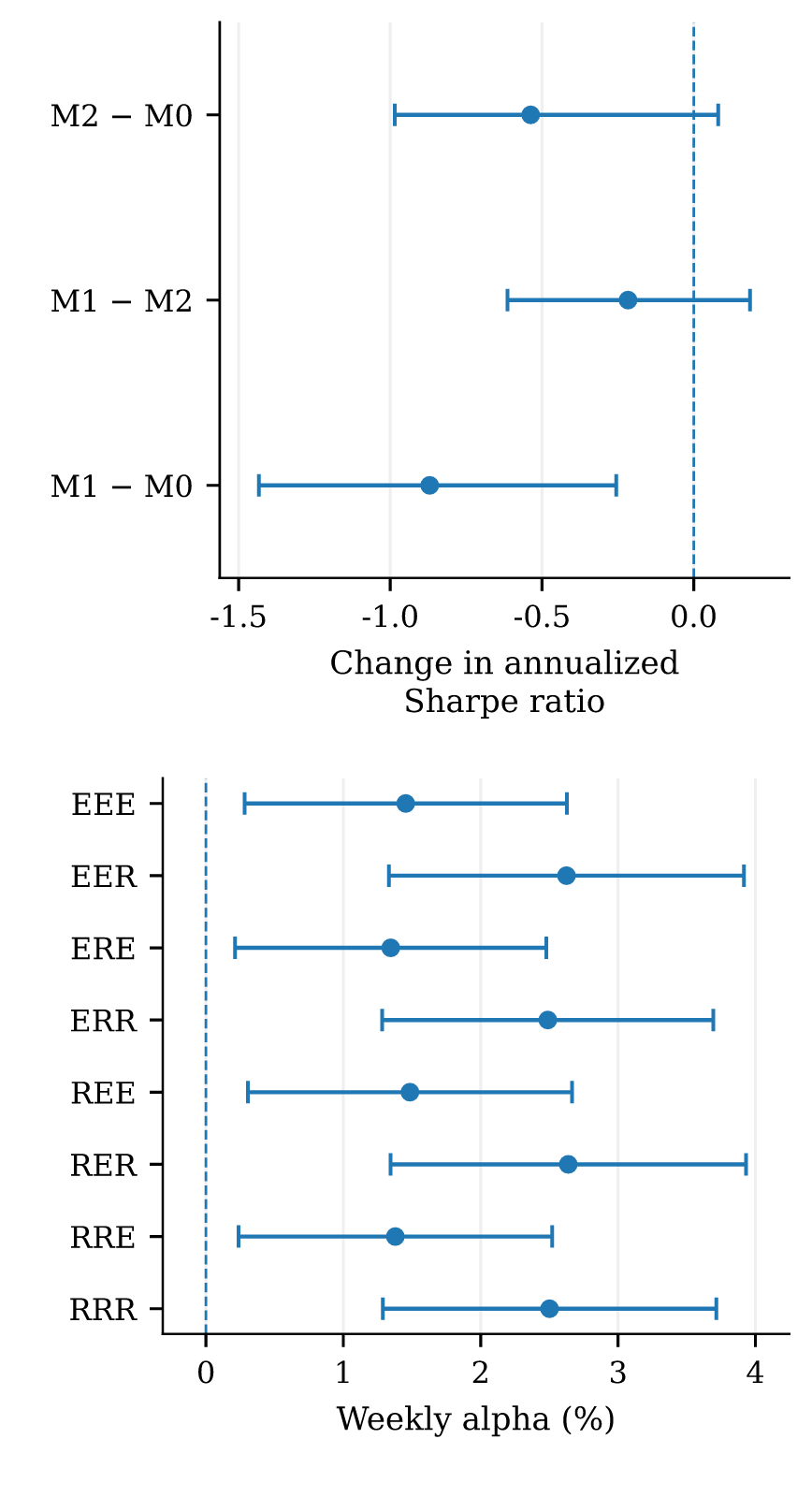
We reassess five economic claims about the cryptocurrency trend factor (CTREND): cross-sectional return predictability, high risk-adjusted performance, incremental information beyond market, size, and momentum, the ability to replace momentum in factor models, and robustness among large and liquid coins and after trading costs. Our reconstruction and code audit identify issues in information timing, technical indicators, forecast coverage, portfolio formation, and return accounting. We first correct future-information use and related settlement rules, then implement broader corrections to indicators, forecast availability, and portfolio accounting. Without additional coin exclusions, the first stage changes CTREND's mean weekly gross return from 4.07% to 4.25%, annualized Sharpe ratio from 2.08 to 1.48, and weekly alpha relative to published market, size, and momentum factors from 2.77% to 3.06%. After comprehensive correction, these become 0.05%, 0.01, and -1.38%; the alpha is no longer significant. Replacing momentum with CTREND yields an advantage in maximum squared Sharpe ratios of 0.058 in the original implementation, 0.024 after the first-stage correction, and -0.0185 after comprehensive correction, with a statistically significant overall decline. Mean weekly gross returns for the largest 100 coins change from 2.93% to 3.99% to 1.00%, while mean weekly net returns for the full long-short portfolio under the lowest assumed trading costs change from 2.93% to 3.35% to -0.87%. These findings show that reported performance and factor-substitution gains depend materially on implementation and sample composition. We distinguish predictive information, an independent return premium, and the incremental value of replacing an existing factor as separate economic claims.
Citations and venue from Semantic Scholar (ODC-BY), refreshed weekly. Summary: Quant Letter (CC BY 4.0).