arXivML & AI Methods
Market-Conditioned JEPA: Learning from Unpredictable Market Shocks
The study conditions self-supervised learning on market factors to improve prediction of returns, exposure, risk, and liquidity across minute-level stock data.
Featured in No. 139 on 13 Nov 2026 · 2 days after release
- Released
- 11 Nov 2026
- First featured
- No. 139 · 13 Nov 2026
- Published in
- Not yet, as far as Semantic Scholar knows
- Fanfare
- 3 of 5
- Identifier
- arXiv:2611.13572
- Authors
- Yuqi Wang et al.
Abstract
From arXiv (CC0).
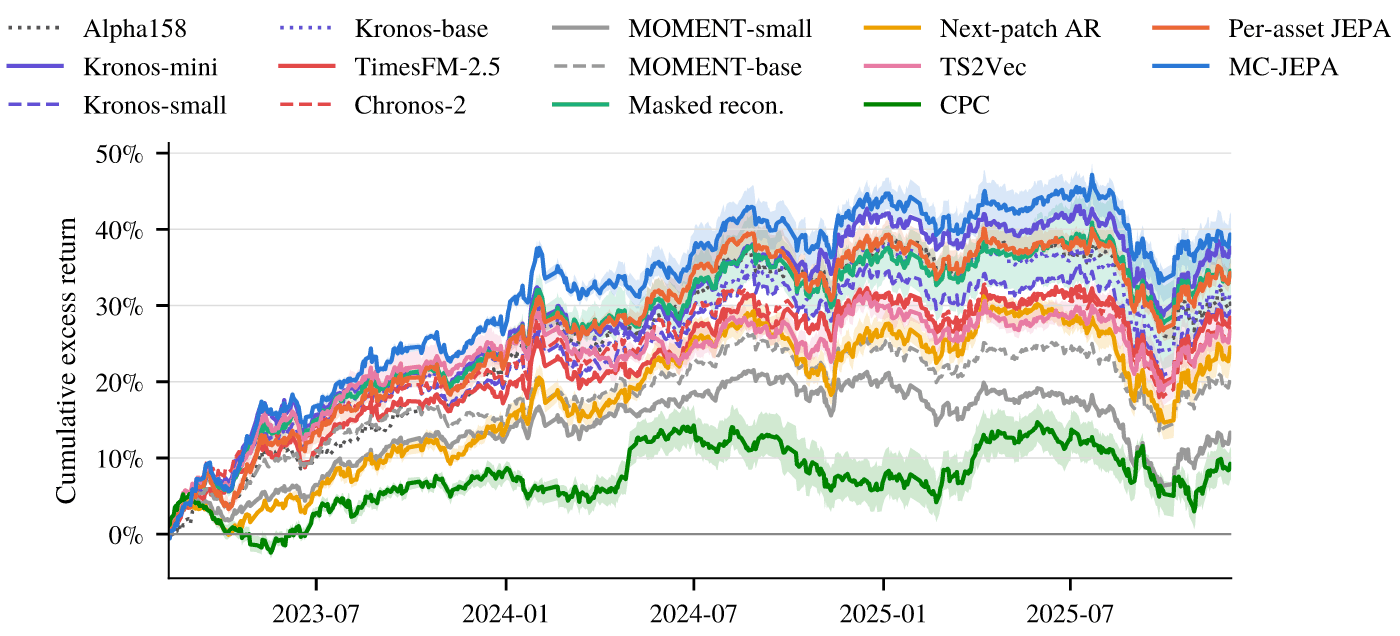
Much of the variation in financial time series is driven by market-wide shocks that cannot be predicted from an asset's own history. Per-asset self-supervised learning treats this variation as irreducible noise. Under a latent factor model, we show that conditioning prediction on the realized market factor makes the asset's market exposure necessary for optimal prediction, while reducing the noise against which the asset-specific component is learned. Building on this insight, we introduce Market-Conditioned JEPA (MC-JEPA), a joint-embedding predictive architecture for financial time series. During training, we construct a leave-one-out market condition for each asset from the future target embeddings of other assets and incorporate it through factor loadings derived from the asset's own representation. On 11 years of minute-level Chinese A-share data, MC-JEPA improves over per-asset JEPA across nine targets spanning returns, market exposure, risk, and liquidity, with the strongest and most statistically significant gains in exposure, risk, and liquidity. It achieves the best RankIC on all liquidity targets and on return horizons from two hours to five days, outperforming time-series foundation models and self-supervised baselines, and delivers the best portfolio performance in a historical backtest. Ablations show that the return and exposure gains require the condition to be aligned with the realized market movement. After restoring the volatility scale removed by normalization, the predictor's factor loadings rank stocks by market beta nearly as well as a supervised probe, without labels. A synthetic factor-model study with known parameters shows that conditioning improves the recovery of both market exposure and the asset-specific component.
Citations and venue from Semantic Scholar (ODC-BY), refreshed weekly. Summary: Quant Letter (CC BY 4.0).