Hidden Tails: Certifying Tail-Risk Claims under Selective Labels
The research derives bounds on conditional value-at-risk when outcome data is hidden, enabling statistical certificates for tail-risk claims across predictors.
Featured in No. 139 on 13 Nov 2026 · 3 days after release
- Released
- 10 Nov 2026
- First featured
- No. 139 · 13 Nov 2026
- Published in
- Not yet, as far as Semantic Scholar knows
- Fanfare
- 2 of 5
- Identifier
- arXiv:2611.12713
- Authors
- El Mustapha Mansouri
Abstract
From arXiv (CC0).
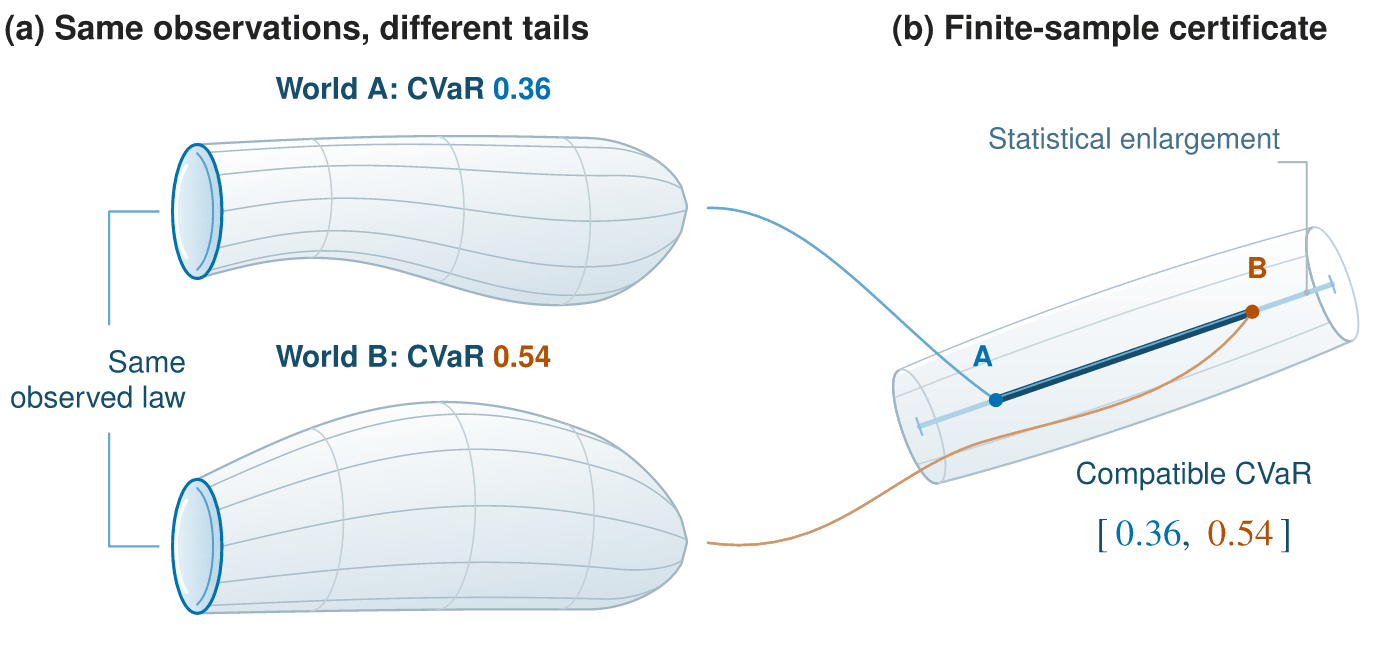
Historical decisions determine which outcomes are observed, potentially concealing a predictor's largest errors. Even unlimited data from the same observation process can therefore leave population tail risk unresolved. Here we derive sharp bounds on conditional value-at-risk, the average loss in a specified upper tail, for binary outcomes and bounded losses. These bounds span exactly the risks compatible with the observations and a stated limit on how outcome odds differ between observed and hidden cases at the same covariate values. Under stated regularity conditions, calibrated statistical certificates cover these ranges simultaneously across candidate predictors, supporting risk limits and model comparisons while separating statistical uncertainty from persistent ambiguity. For a fixed predictor and loss threshold, we derive a minimum-cost allocation for reducing excess-loss ambiguity by prioritizing hidden outcomes according to ambiguity removed per unit cost. This allocation treats audited population contributions as known and retains the original sensitivity bounds separately for audited and still-hidden outcomes. In controlled masking experiments with known loan repayments, recovering about 16% of hidden labels removes a median 61% of estimated fixed-threshold ambiguity, compared with 16% for random recovery. These results connect population tail-risk claims to the available evidence and identify where additional outcomes can sharpen their assessment.
Citations and venue from Semantic Scholar (ODC-BY), refreshed weekly. Summary: Quant Letter (CC BY 4.0).