Polynomial-Preserving Processes and Volatility Modelling in Discrete Time
Discrete-time volatility models preserving polynomial moments reduce implied volatility root mean squared errors by 8–41% versus benchmarks across options spanning 1996–2023.
Featured in No. 139 on 13 Nov 2026 · 3 days after release
- Released
- 10 Nov 2026
- First featured
- No. 139 · 13 Nov 2026
- Published in
- Not yet, as far as Semantic Scholar knows
- Fanfare
- 3 of 5
- Identifier
- arXiv:2611.10928
- Authors
- Maciej Augustyniak et al.
Abstract
From arXiv (CC0).
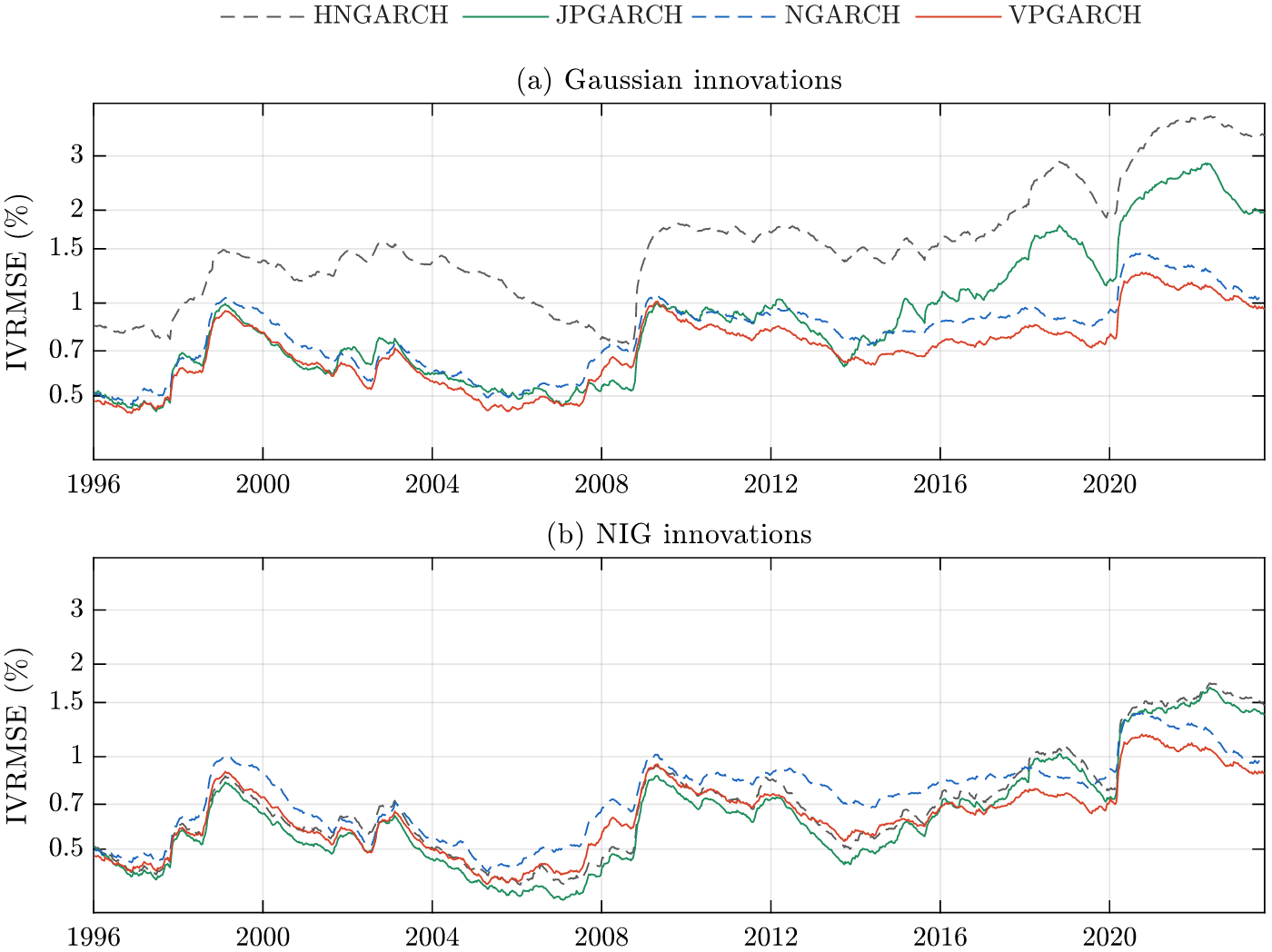
This paper develops a discrete-time framework for volatility modelling and derivative pricing based on polynomial preservation. The framework provides exact moments of arbitrary order and serial cross-moments of variance and return processes over any finite horizon through finite-dimensional matrix representations. This analytical tractability is maintained while accommodating flexible leverage and variance-of-variance dynamics and non-Gaussian innovations. We introduce two novel classes of stochastic volatility models that nest widely used discrete-time specifications and study their statistical properties. Under two distinct scaling regimes, we establish weak convergence to polynomial diffusions and jump-diffusions and convergence of polynomial moments, linking discrete-time moment recursions to continuous-time matrix-exponential formulas. An empirical analysis of S\&P~500 returns and a large panel of options spanning 1996--2023 shows that the proposed specifications improve return fit and reduce mean weekly implied volatility root mean squared errors by approximately 8--41\% relative to their nested benchmarks, depending on the variance dynamics and innovation distribution.
Citations and venue from Semantic Scholar (ODC-BY), refreshed weekly. Summary: Quant Letter (CC BY 4.0).