A Rough Instantaneous Squared VIX Model for Term Structure and Option Pricing
A rough-memory VIX model with Mittag-Leffler decay improves term-structure fit and out-of-sample option pricing, with larger gains during elevated volatility and shorter maturities.
Featured in No. 138 on 6 Nov 2026 · on release day
- Released
- 6 Nov 2026
- First featured
- No. 138 · 6 Nov 2026
- Published in
- Not yet, as far as Semantic Scholar knows
- Fanfare
- 3 of 5
- Identifier
- arXiv:2611.07120
- Authors
- Tianfeng Yang et al.
Abstract
From arXiv (CC0).
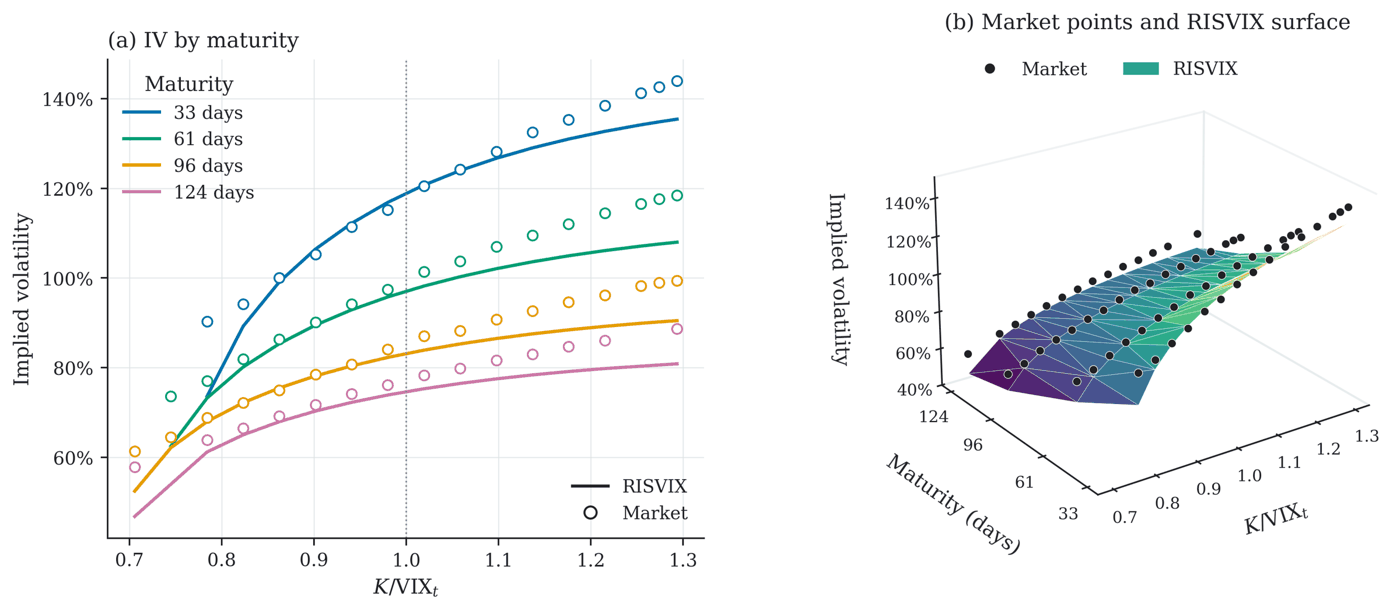
The VIX term structure provides forward-looking measures of market uncertainty across horizons, while VIX options allow investors to hedge volatility risk. This paper proposes a rough instantaneous squared VIX (RISVIX) model by introducing fractional memory into the conventional Markovian framework. We derive an explicit representation of the VIX term structure governed by Mittag--Leffler decay and a semi-closed-form pricing formula for VIX options based on an affine Fourier--Laplace transform. These results support a two-step calibration procedure that estimates memory, mean reversion, and date-specific initial states from VIX term-structure indices before calibrating the remaining distributional parameters to VIX option prices. Using daily VIX term-structure indices and VIX option quotes from January 2018 to June 2025, we find that RISVIX improves upon the Markovian benchmark in fitting the VIX term structure, with larger gains during elevated-volatility periods and for its slope and curvature. RISVIX also improves out-of-sample option pricing, reducing MSE and MAE by 13.06\% and 6.33\%, respectively, with larger gains at shorter maturities and in high-VIX states. These findings suggest that the gains from fractional memory are particularly pronounced when volatility is elevated and can be obtained within a tractable direct model of VIX derivatives. Comparisons with additional benchmarks from the recent literature also show improvements to varying degrees in both VIX term-structure fitting and option pricing.
Citations and venue from Semantic Scholar (ODC-BY), refreshed weekly. Summary: Quant Letter (CC BY 4.0).