Neural Score-Driven Volatility and Risk Forecasting
A score-driven volatility model using neural networks to represent innovation density flexibly outperforms Gaussian and Student-t benchmarks, especially during high-volatility periods like COVID-19.
Featured in No. 138 on 6 Nov 2026 · 1 day after release
- Released
- 5 Nov 2026
- First featured
- No. 138 · 6 Nov 2026
- Published in
- Not yet, as far as Semantic Scholar knows
- Fanfare
- 2 of 5
- Identifier
- arXiv:2611.05778
- Authors
- Qianli Zhao et al.
Abstract
From arXiv (CC0).
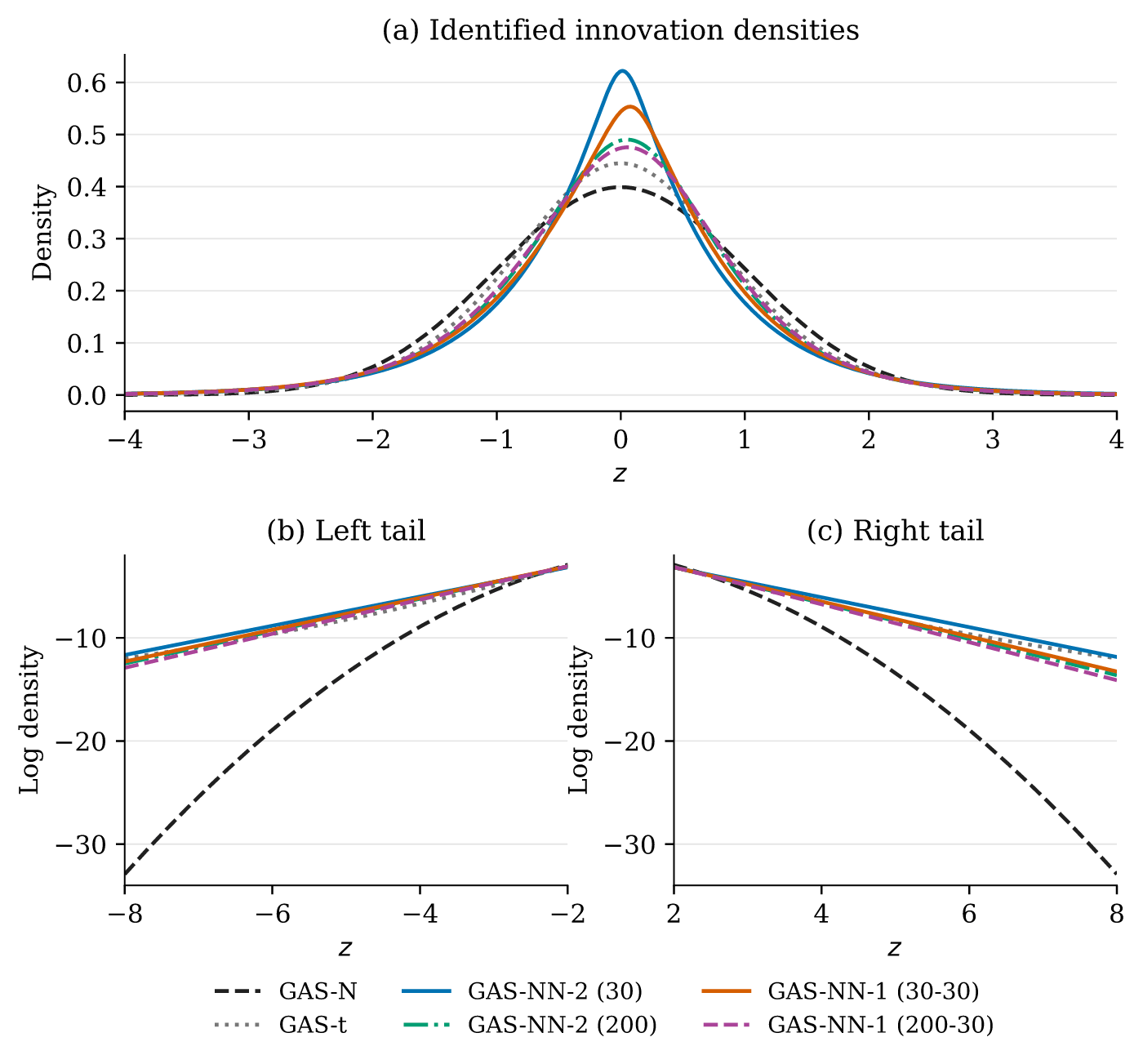
We develop a score-driven volatility model in which no particular parametric innovation distribution needs to be specified. The proposed method relies on a lightweight neural network to represent the negative score of the innovation density. By integrating and normalizing the learned score and imposing location-scale identification, we recover a flexible innovation density that can accommodate asymmetry, including negative skewness commonly observed in financial returns. Two estimation procedures are considered. A two-step procedure estimates the neural score by score matching and subsequently fits the volatility recursion with the identified density held fixed. A one-step procedure jointly refines the neural and volatility parameters under the conditional likelihood. We illustrate the practical relevance of the proposed method using eight international equity indices, with a separate evaluation of the high-volatility first half of 2020. The results show that the neural score-driven models are competitive with Gaussian and Student-$t$ GAS benchmarks that require a prespecified parametric innovation distribution, with particularly strong performance during the COVID-19 period.
Citations and venue from Semantic Scholar (ODC-BY), refreshed weekly. Summary: Quant Letter (CC BY 4.0).