arXivLLMs & Text
Thinking Fast, Trading Late: System One Decision Models vs the Market
A pre-registered blinded test finds that language-model readings of company news lose their predictive power in real time and that commercial models identify masked companies in two-thirds of cases.
Featured in No. 138 on 6 Nov 2026 · 2 days after release
- Released
- 4 Nov 2026
- First featured
- No. 138 · 6 Nov 2026
- Published in
- Not yet, as far as Semantic Scholar knows
- Fanfare
- 4 of 5
- Identifier
- arXiv:2611.03985
- Authors
- Amir Dehkordi et al.
Abstract
From arXiv (CC0).
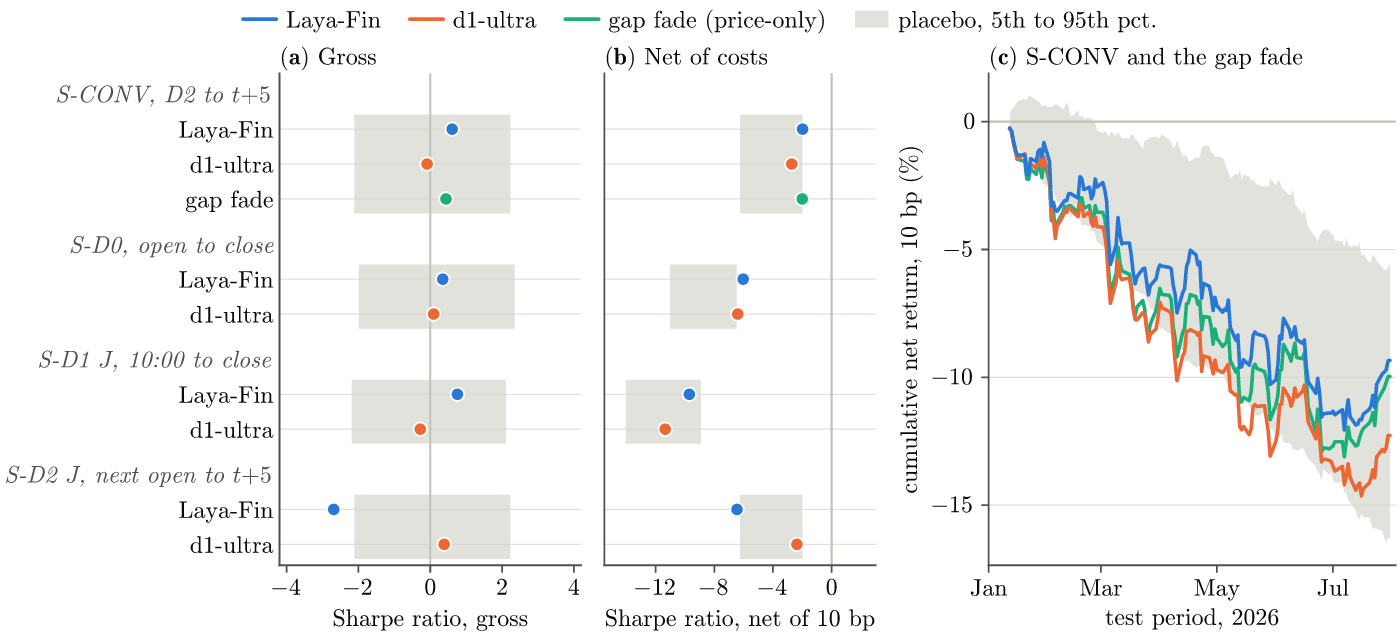
Large language models (LLMs) read company news at scale, and backtests suggest that their readings predict stock returns. We ask how much of that predictability survives a test that rules out look-ahead, memorization and selection. We propose OLIVIA, a protocol for such tests: point-in-time inputs with company identities masked, selection on validation data only, an analysis plan frozen by cryptographic hash, and a test period unblinded once through a logged lock. We apply it to AI decision models, non-generative language models that return probabilities for typed questions, reading news about S&P 500 stocks: an open-weights model we fine-tuned on 2024-2025 data, three commercial models and standard baselines. The fine-tuned model's signal replicated on two validation quarters (daily information coefficients 0.055 and 0.065) but fell to 0.020 (t = 1.7) on the blinded January-July 2026 test. The commercial models' readings line up with the overnight move to the open (information coefficient 0.074 to 0.077) but not with the move after it, so the news is priced by the time a trader can act on it at the open. No model can tell over- from under-reaction, and no pre-registered strategy survives costs and a deflated Sharpe ratio. Commercial models identify masked companies in 62% to 74% of cases against a 28% baseline: masking hides names, not companies. The market reads the news first.
Citations and venue from Semantic Scholar (ODC-BY), refreshed weekly. Summary: Quant Letter (CC BY 4.0).