arXivLLMs & Text
MintEval: Do LLMs Implement the Trading Strategy You Asked For? A Behavioural-Equivalence Benchmark for Natural-Language-to-Strategy Code
Introduces a benchmark that compares LLM-generated trading code to reference strategies bar by bar on identical data, revealing silent failures in implementation despite passing functional tests.
Featured in No. 134 on 9 Oct 2026 · 4 days after release
- Released
- 5 Oct 2026
- First featured
- No. 134 · 9 Oct 2026
- Published in
- Not yet, as far as Semantic Scholar knows
- Fanfare
- 3 of 5
- Identifier
- arXiv:2610.03080
- Authors
- Siyu Wang et al.
Abstract
From arXiv (CC0).
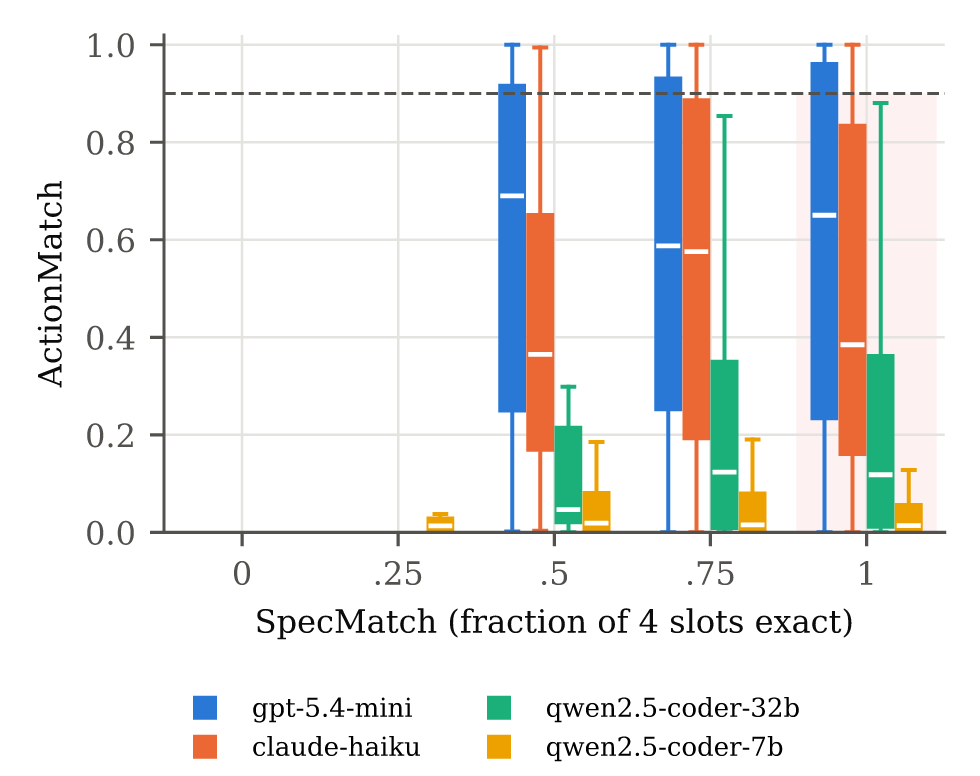
Large language models are moving from producing trading signals to writing the code that executes them. The failure mode of the second role is silent: generated code runs, a backtest plots, yet the risk logic that the trader described is not the logic being executed. Existing code benchmarks test functional correctness on unit tests and finance benchmarks test forecasting; neither measures whether an implementation behaves like the strategy that was asked for. We introduce MintEval, a benchmark in which reference strategies are generated programmatically from a library of composable building blocks, back-translated into colloquial trader instructions, and re-implemented by the model under test. Generated and reference programs are executed bar by bar on identical market data and frictions, and compared on their actions rather than on code similarity or profit: alpha is differenced away. MintEval v0 contains 800 tasks on BTCUSDT 15-minute data, stratified by an execution-measured state-span complexity tau that is decoupled from description length. Low-cost models reach a mean ActionMatch of at most 0.544 and reproduce at most 0.087 of tasks exactly; on a stratified subset of 200 tasks a frontier model (Claude Opus 5.5) reaches 0.889 and reproduces 0.575 exactly, yet still fails silently on 0.275 of tasks. Given a menu of building blocks, models identify the strategy almost perfectly, yet 79.2% of the implementations whose specification was read correctly diverge on more than 10% of active bars. The LLM judge of a recent strategy-generation benchmark, applied verbatim, accepts every one of these silent failures.
Citations and venue from Semantic Scholar (ODC-BY), refreshed weekly. Summary: Quant Letter (CC BY 4.0).