Predicting Factor Decay: ML Models for Cross-Factor Predictability Erosion
Machine learning models predict when cross-factor predictability will erode, achieving high C-index on held-out pairs and finding that stronger signals decay faster.
Featured in No. 138 on 6 Nov 2026 · 2 days after release
- Released
- 4 Nov 2026
- First featured
- No. 138 · 6 Nov 2026
- Published in
- Not yet, as far as Semantic Scholar knows
- Fanfare
- 2 of 5
- Identifier
- arXiv:2611.03668
- Authors
- Chorok Lee
Abstract
From arXiv (CC0).
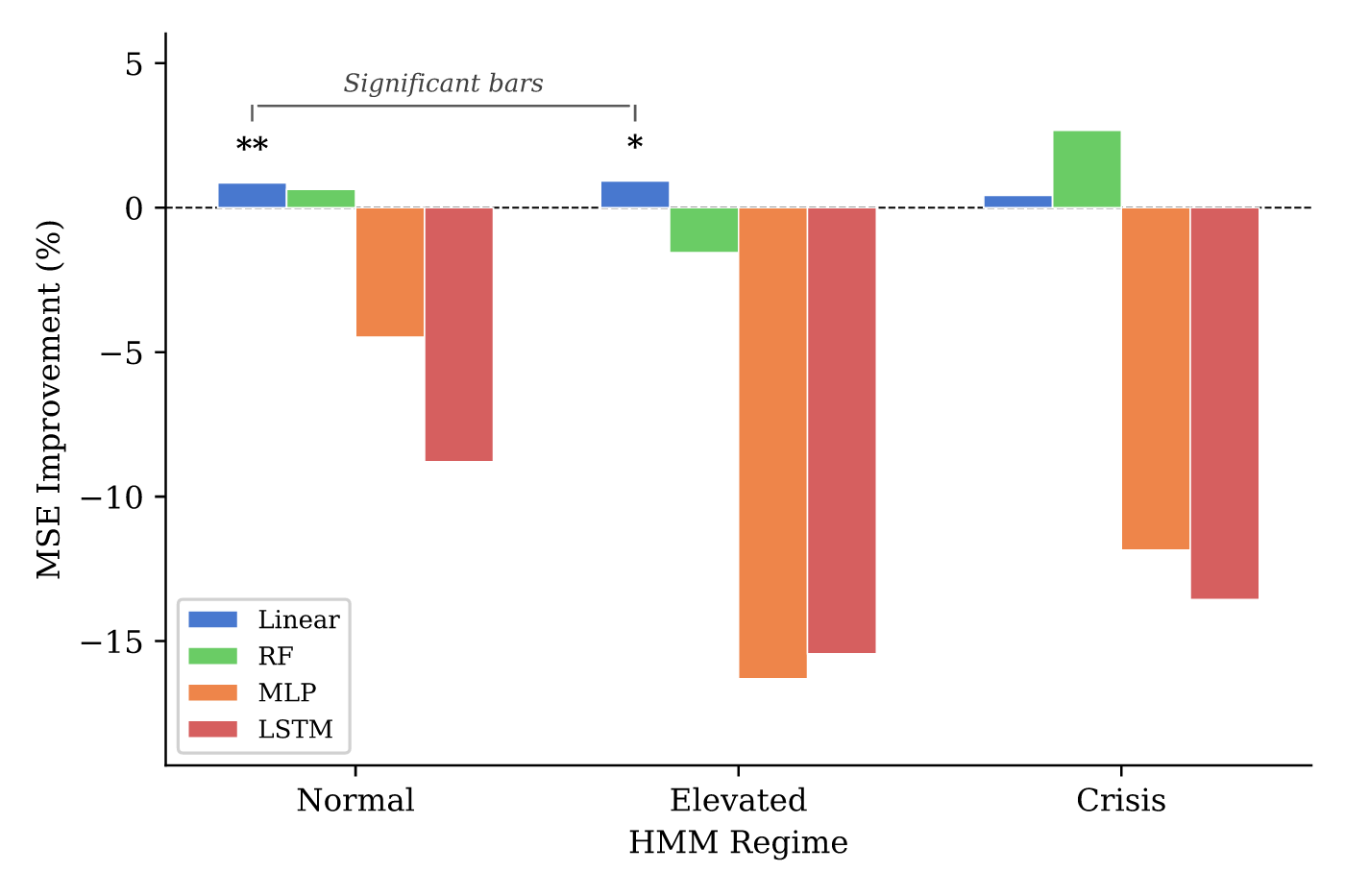
We develop ML models that predict when cross-factor predictability will erode, enabling prospective risk management. A decay prediction model achieves C-index $= 0.93$ on held-out factor pairs, providing early warning of signal erosion---the key predictor is initial signal strength: stronger signals decay faster (``regression to the mean''). An online regime detector enables real-time classification with 6.6-day average detection delay. Prior work explains why factors decay (arbitrage, publication effects); we predict when decay will occur. Limitation: The primary HML$\to$SMB signal does not replicate in post-break OOS (2013--2024); this null result is consistent with genuine decay but limits confirmatory claims. Motivation: Among 30 directed Fama-French factor pairs (1990--2024), predictability targeting the Size factor (SMB) decays fastest. Of 7 pairs showing exponential decay ($R^2 > 0.3$), 4 target SMB (Mkt-RF$\to$SMB, CMA$\to$SMB, HML$\to$SMB, RMW$\to$SMB; half-lives 2.4--4.1 years). This SMB-concentration pattern motivates the predictive models. Methodology: Using a regime-conditional Granger framework with Student-$t$ HMMs, we document structural breaks clustering around June 1998 ($p < 10^{-10}$). A pre-break OOS test (HMM trained 1990--1995, tested 1996--2007) confirms signals existed: HML$\to$SMB shows $p = 0.013$ (Elevated) and $p < 0.001$ (Crisis). The primary HML$\to$SMB signal does not replicate in post-break OOS (2013--2024), consistent with genuine decay rather than overfitting---after ${\sim}6$ half-lives, the expected signal is $<$1% of its 1990s peak. International analysis finds 2/4 non-US markets with Bonferroni-surviving OOS effects; correction for full specification search was not applied, so results remain exploratory.
Citations and venue from Semantic Scholar (ODC-BY), refreshed weekly. Summary: Quant Letter (CC BY 4.0).