Penalize the Common Trade: A Collision-Aware Layer for Learned Portfolios
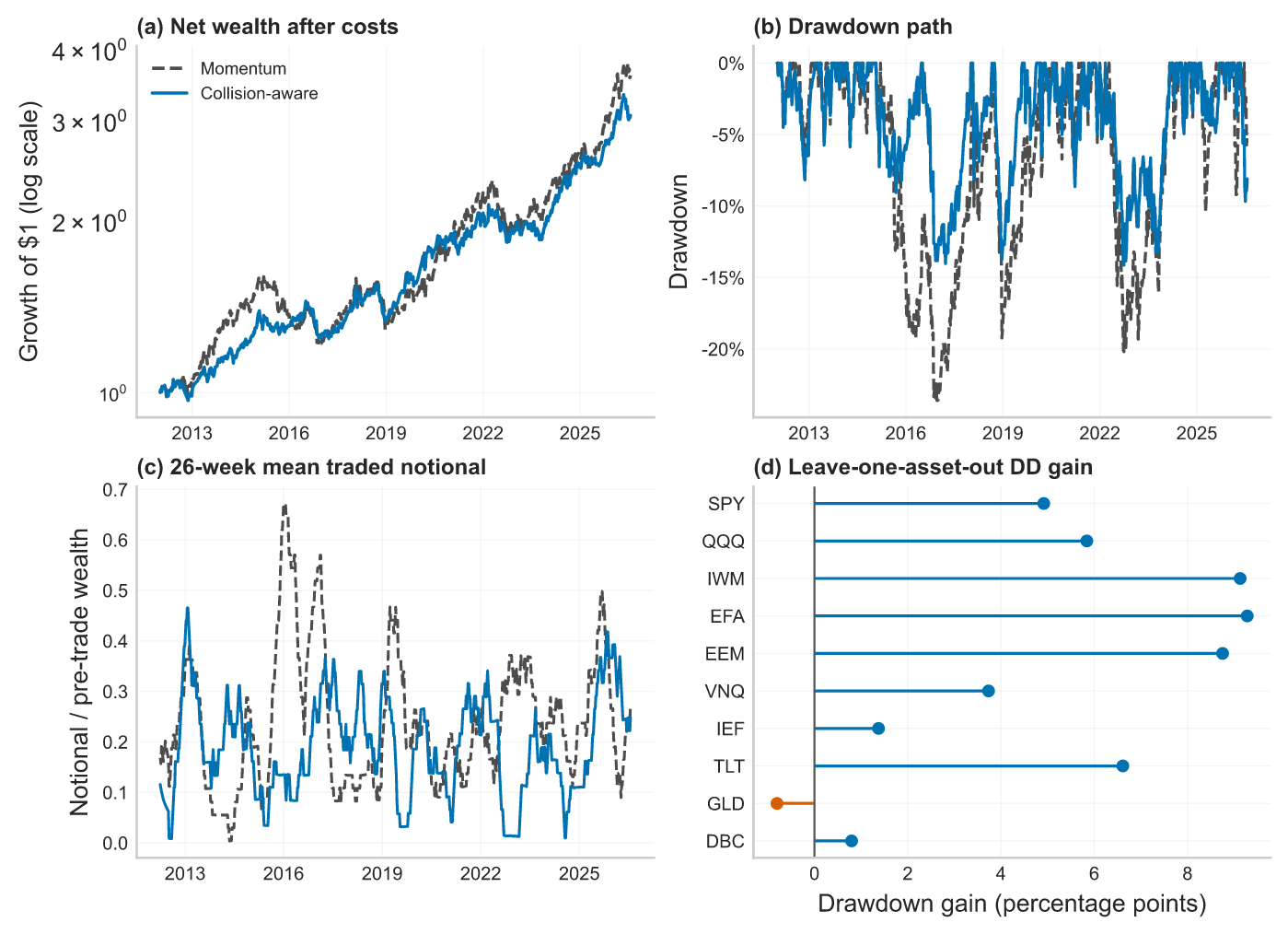
A post-model layer that reduces portfolio concentration by penalizing shared exposures cuts maximum drawdown from 23.6% to 14.1% on a cross-asset test.
Featured in No. 138 on 6 Nov 2026 · 3 days after release
- Released
- 3 Nov 2026
- First featured
- No. 138 · 6 Nov 2026
- Published in
- Not yet, as far as Semantic Scholar knows
- Fanfare
- 3 of 5
- Identifier
- arXiv:2611.03453
- Authors
- Eric Benhamou et al.
Abstract
From arXiv (CC0).
Different learning systems can make nearly the same trade when they share data, objectives, or representations. The market then sees decision concentration even if the models look diverse. We call exposure to this shared direction a signal collision. A linear-impact game shows the basic externality: each allocator chooses too much common exposure because it does not bear the full price effect imposed on others. An overlap-dependent toll recovers the social choice, and a feedback model gives the exact gain at which return-responsive allocation becomes unstable. We also state the restrictive spectral conditions under which a leading eigenportfolio can reveal the collision direction. These results motivate a simple post-model layer: subtract a penalty for loading on the recent common return mode before forming the portfolio. In a frozen panel of ten liquid cross-asset ETFs, 760 completed weeks from January 2012 through July 2026, and exact self-financing costs of 10 basis points per dollar traded, this layer changes maximum drawdown from 23.6% to 14.1%, volatility from 12.6% to 10.7%, and excess-return Sharpe from 0.664 to 0.667. A volatility-matched momentum diagnostic still draws down 19.9%. Paired stationary-bootstrap uncertainty is wide: the 95% interval for drawdown improvement is $[-3.3,18.4]$ percentage points and includes zero. The result establishes a reproducible risk-control association and specifies the holdings-and-flow validation needed to attribute the common direction to AI crowding. AI-use disclosure. Generative AI tools, including OpenAI Codex, assisted manuscript preparation. For this preprint version, Codex assisted with LaTeX editing, author and venue metadata, compilation, and layout checks.
Citations and venue from Semantic Scholar (ODC-BY), refreshed weekly. Summary: Quant Letter (CC BY 4.0).