arXivTrading, Microstructure & Execution
Herding or Racing? Decomposing Cross-Account Order-Flow Persistence in On-Chain Markets
Decomposing cross-account order-flow persistence on decentralized exchanges, the study isolates two components and finds that on-chain herding mostly reflects arbitrageurs racing to centralized prices, not independent traders.
Featured in No. 138 on 6 Nov 2026 · 3 days after release
- Released
- 3 Nov 2026
- First featured
- No. 138 · 6 Nov 2026
- Published in
- Not yet, as far as Semantic Scholar knows
- Fanfare
- 3 of 5
- Identifier
- arXiv:2611.02616
- Authors
- Yichong Bai and Dingyue Kan
Abstract
From arXiv (CC0).
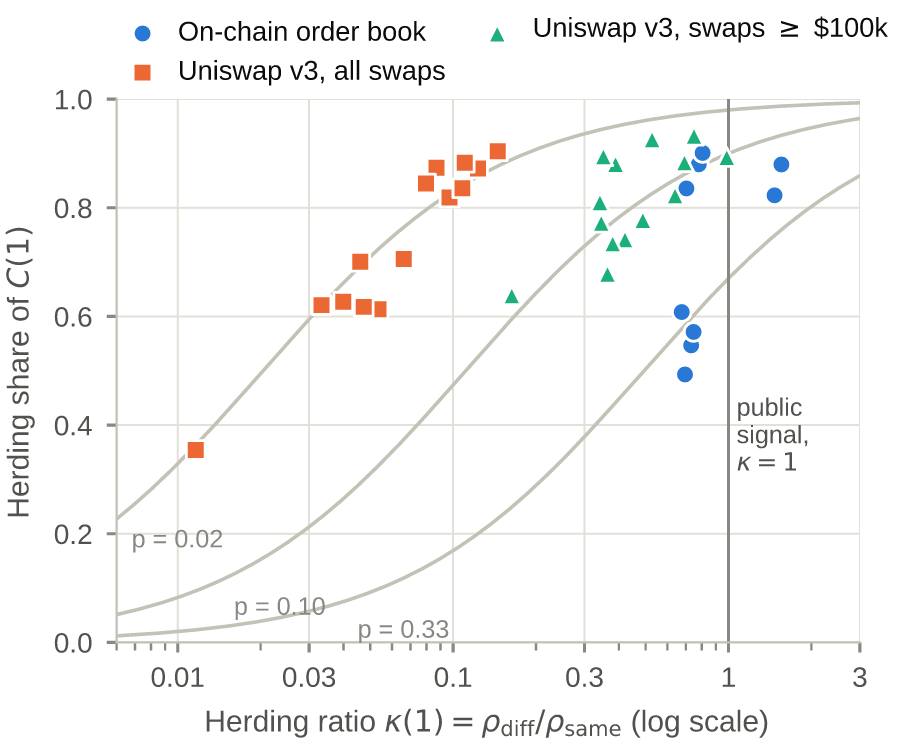
Most of the autocorrelation in trade signs on decentralized exchanges comes from pairs of trades sent by different wallets. For Uniswap v3, this has been read as herding dominating order splitting -- the reverse of what equity markets show. We show that this herding share mixes two quantities: the probability $p$ that consecutive orders come from the same account, which is small when thousands of wallets are trading, and the ratio $κ$ of cross-account to same-account sign correlation. For any $p$, $κ$ equals one under the public-signal benchmark of Tóth et al. and zero under independent order splitting. On Uniswap v3 USDC-WETH (one week each in 2023 and 2024), the herding share is 0.65-0.86, but $κ$ is only 0.05-0.10. On a fully on-chain EVM limit order book, the herding share is similar (0.61-0.87), but $κ$ is 0.72-0.76; among Uniswap swaps above USD 100k, it is 0.34-0.52. Where $κ$ is high, cross-account co-movement is mostly a race for the price on a centralized exchange. It is concentrated in orders a few blocks apart, and a cross-fitted gradient-boosted filter that sees only Binance data removes about three quarters or more of it. This race flow accounts for most of the losses of liquidity providers. We recommend reporting $κ$ alongside the herding share and modeling on-chain order flow as splitting traders plus arbitrageurs who respond to the centralized-exchange price.
Citations and venue from Semantic Scholar (ODC-BY), refreshed weekly. Summary: Quant Letter (CC BY 4.0).