arXivTrading, Microstructure & Execution
Learning AI Agents, Market Makers, and Stress in Automated Markets
The paper models learning traders on automated market makers, showing herds and arbitrage-dominated markets have identical statistics yet stress episodes differing unboundedly in length, and that maker-taker pricing restores stability.
Featured in No. 138 on 6 Nov 2026 · 3 days after release
- Released
- 3 Nov 2026
- First featured
- No. 138 · 6 Nov 2026
- Published in
- Not yet, as far as Semantic Scholar knows
- Fanfare
- 3 of 5
- Identifier
- arXiv:2611.01799
- Authors
- Irene Aldridge
Abstract
From arXiv (CC0).
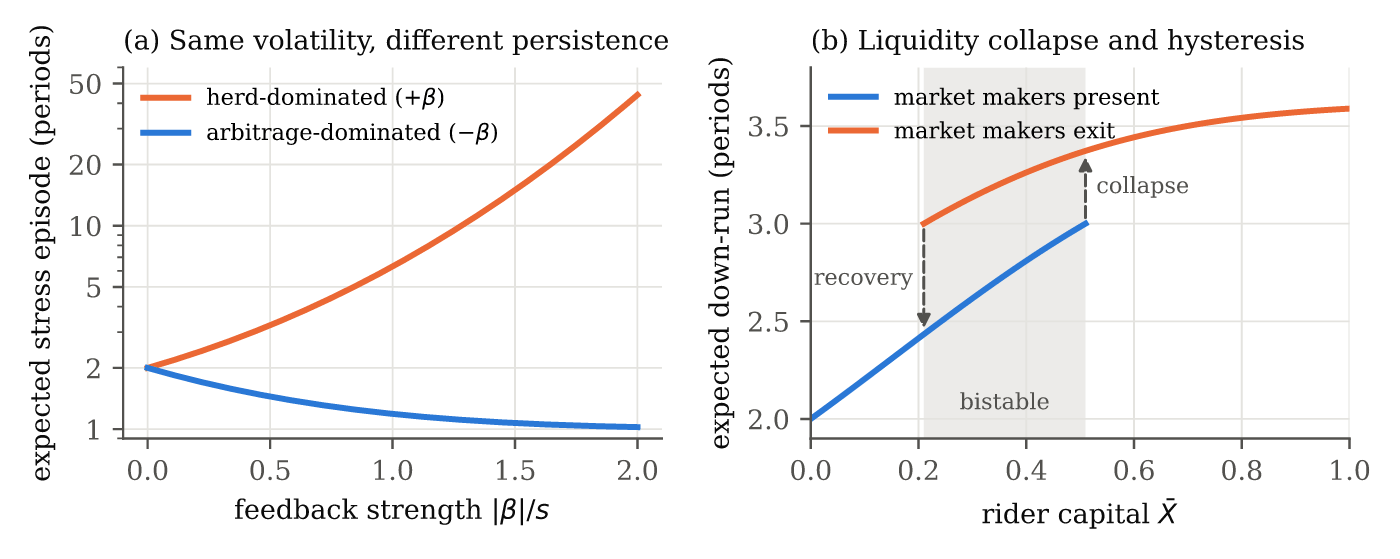
Automated markets increasingly route order flow from learning trading agents through automated market makers (AMMs). We model trader archetypes as AI agents defined by their reward functions and analyze the feedback they create on a constant-product AMM. Herd-dominated and arbitrage-dominated markets of equal size have identical return distributions and turnover, so no rule based on volatility, value-at-risk, stress frequency, or volume can tell them apart; yet their stress episodes differ in length by a factor unbounded in the feedback-to-noise ratio $β/s$. Serial statistics identify the feedback sign from $Θ((s/β)^2\log(1/δ))$ observations, and this rate is tight. When agents trade together, profit-seeking agents ride herds rather than lean against them, leading to all-or-nothing participation. Spread-earning market makers restore stability but make liquidity fragile, with discontinuous collapse and hysteresis; maker--taker pricing, not a uniform fee, is the effective instrument.
Citations and venue from Semantic Scholar (ODC-BY), refreshed weekly. Summary: Quant Letter (CC BY 4.0).