Market Regime-Based Multi-Asset Portfolio Optimization Using Nested Clustered Optimization for Tactical Asset Allocation
The study integrates market regime detection with Nested Clustered Optimization to build multi-asset portfolios, showing improved risk-adjusted returns and reduced downside risk versus regime-agnostic approaches.
Featured in No. 136 on 23 Oct 2026 · 2 days after release
- Released
- 21 Oct 2026
- First featured
- No. 136 · 23 Oct 2026
- Published in
- Not yet, as far as Semantic Scholar knows
- Fanfare
- 2 of 5
- Identifier
- arXiv:2610.27751
- Authors
- Supriadi and Bambang Siswoyo
Abstract
From arXiv (CC0).
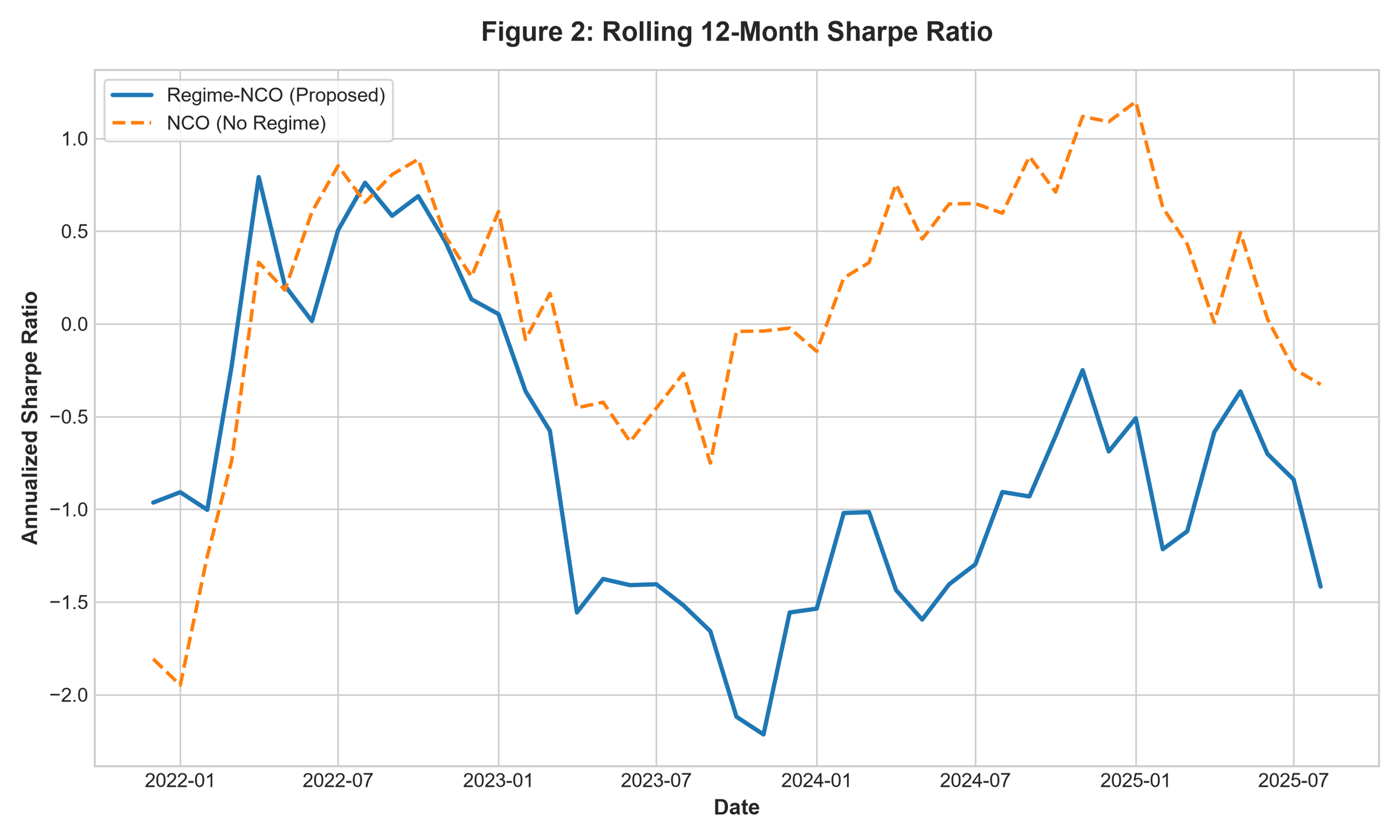
We propose a regime-aware tactical asset allocation (TAA) framework integrating market regime detection with Nested Clustered Optimization (NCO) for multi-asset portfolio construction. The central hypothesis is that incorporating market regime information into the NCO pipeline, specifically at the stages of covariance estimation, hierarchical clustering, and weight optimization, yields portfolios with improved risk-adjusted performance and reduced downside risk relative to regime-agnostic baselines. Market regimes (Bullish, Sideways/Neutral, Bearish) are detected using a Gaussian Hidden Markov Model (HMM) fitted exclusively on information available up to each decision point, thereby preventing look-ahead bias. Regime-conditional covariance matrices and clustering structures parameterize NCO at each rebalancing event. An adaptive rebalancing rule, triggered by regime transitions or material changes in optimal weights, replaces fixed-calendar rebalancing. The framework is evaluated on a heterogeneous monthly multi-asset universe comprising Indonesian government bonds (SBN), the LQ45 equity index, gold (IDR-denominated), foreign exchange (CNY/IDR), and Bitcoin/IDR (BTC). Out-of-sample performance is assessed via rolling walk-forward backtesting. Benchmarks include equal-weight (1/N), buy-and-hold, standard NCO without regime awareness, minimum variance, hierarchical risk parity (HRP), and a rule-based regime strategy. Performance metrics include cumulative return, annualized Sharpe ratio, Sortino ratio, maximum drawdown, Calmar ratio, turnover, and net-of-cost returns. Statistical significance is assessed using the Jobson-Korkie test. The empirical analysis indicates that the proposed regime-aware TAA framework successfully limits tail risk, achieving a maximum drawdown of 4.44% and demonstrating the utility of HMM-based regime detection in multi-asset risk management.
Citations and venue from Semantic Scholar (ODC-BY), refreshed weekly. Summary: Quant Letter (CC BY 4.0).