arXivTrading, Microstructure & Execution
Probabilistic Limit Order Book Forecasting with Conditional Diffusion Models
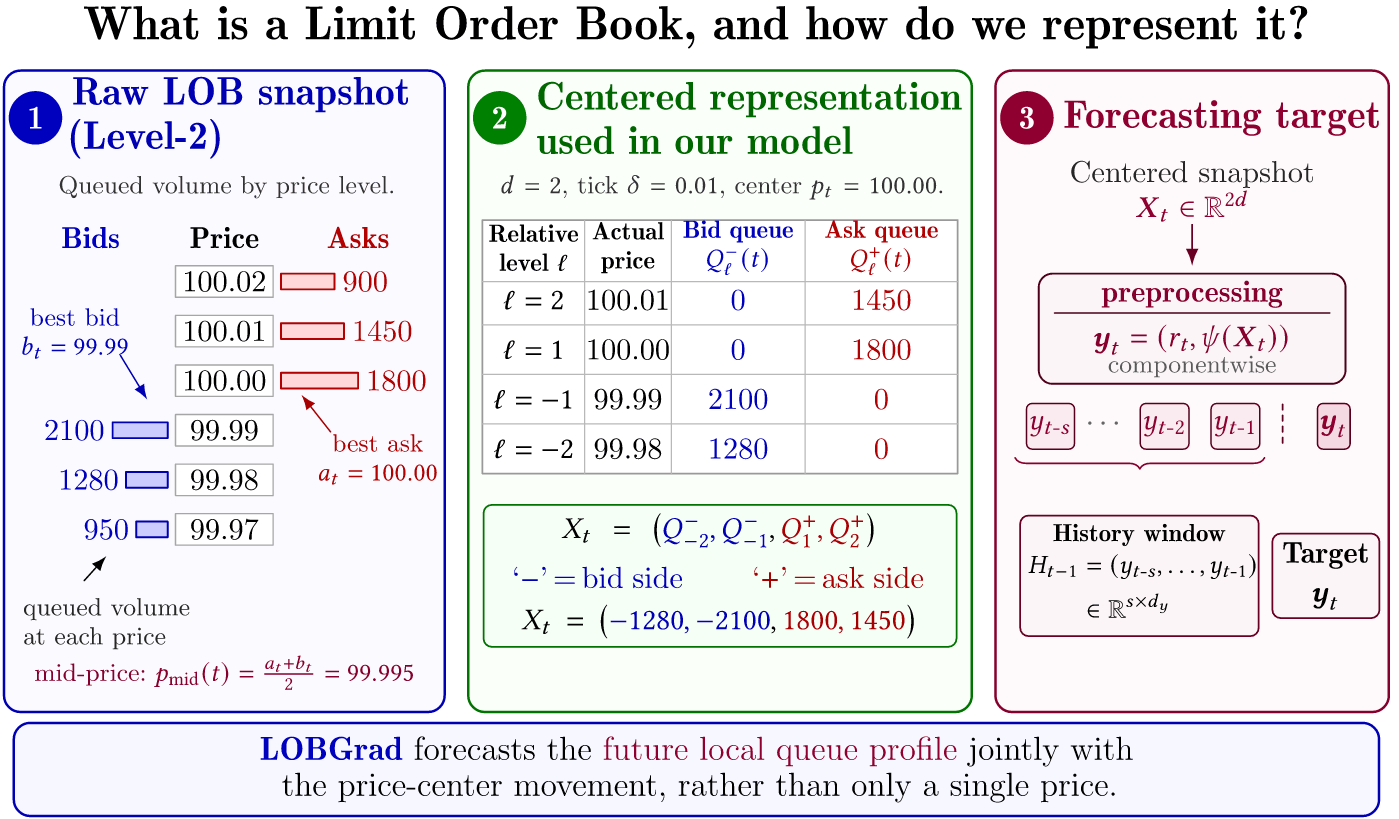
LOBGrad combines autoregressive encoders with diffusion models for limit-order-book forecasting, reproducing microstructure facts and providing calibrated predictive intervals.
Featured in No. 136 on 23 Oct 2026 · 3 days after release
- Released
- 20 Oct 2026
- First featured
- No. 136 · 23 Oct 2026
- Published in
- Not yet, as far as Semantic Scholar knows
- Fanfare
- 2 of 5
- Identifier
- arXiv:2610.25495
- Authors
- Junyu Chen et al.
Abstract
From arXiv (CC0).
Modeling limit order book (LOB) dynamics is central to market forecasting and execution-strategy evaluation. While diffusion models achieve strong empirical performance, existing LOB snapshot models typically lack a learned recurrent encoder and formal statistical guarantees. We introduce LOBGrad, a conditional DDPM framework for probabilistic LOB forecasting that combines an autoregressive RNN encoder with a diffusion-based generator. In particular, we establish an excess-risk oracle inequality for the one-step DDPM noise-prediction objective under exponential mixing and regularity assumptions. We further show that, under contractive dynamics, the dependence on the conditioning-window length can be reduced to a dependence on the latent-state dimension. Experiments on BTC/USDT, GOOGL, and META show that LOBGrad improves on its encoder-free diffusion ablation across all reported queue metrics and obtains competitive results against other baselines. It also reproduces the key stylized facts of LOB microstructure, and yields reasonably calibrated queue-based predictive intervals. A stylized downstream task illustrates the potential value of the generated forecasts.
Citations and venue from Semantic Scholar (ODC-BY), refreshed weekly. Summary: Quant Letter (CC BY 4.0).