arXivTrading, Microstructure & Execution
Adversarial Post-Training of Foundation Models for High-Frequency Trading
Wasserstein GAN post-training on limit order book foundation models cuts error accumulation and improves realism by 17%, outperforming continued pre-training with far lower compute cost.
Featured in No. 136 on 23 Oct 2026 · 3 days after release
- Released
- 20 Oct 2026
- First featured
- No. 136 · 23 Oct 2026
- Published in
- Not yet, as far as Semantic Scholar knows
- Fanfare
- 3 of 5
- Identifier
- arXiv:2610.25604
- Authors
- Alexandre Bismuth et al.
Abstract
From arXiv (CC0).
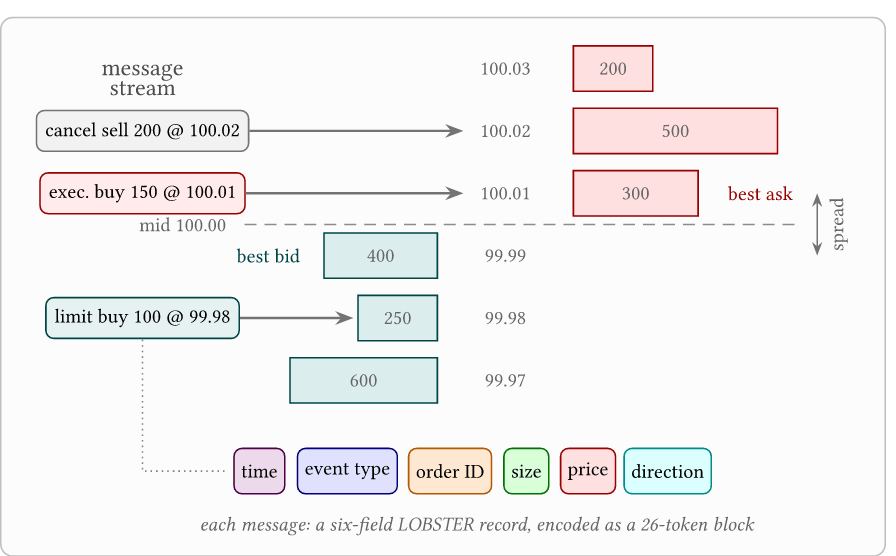
While autoregressive foundation models trained on limit order book (LOB) data show state-of-the-art performance for market simulation, pre-training with cross-entropy neither penalizes the compounding of sampling errors over free-running rollouts nor targets desired market properties. We introduce a post-training method for LOB foundation models using a Wasserstein generative adversarial network (GAN) objective. A critic, trained online on rollouts through the true, non-differentiable matching engine, guides updates from evolution strategies over rank-4 LoRA perturbations of the pre-trained generator, under a KL trust region. For efficiency, we use EGGROLL (Evolution Guided GeneRal Optimisation via Low-rank Learning), a memory-efficient variant of evolution strategies. On a held-out panel, adversarial post-training improves LOB-Bench realism by 17.6% (WS-21) and 17.0% (Mean-$L_1$), while selection-matched random-perturbation and compute-matched continued-pre-training controls yield no improvement. Post-training is thus a necessary stage that more pre-training does not replace. Per-position divergence measurements show that it slows error accumulation over 500-message rollouts from $3.1\times$ to $2.3\times$. Adversarial post-training is also inexpensive, requiring under 50M training tokens and 12 GPU-hours per seed, three orders of magnitude below the 48B-token pre-training budget. Ablations over critic inputs, optimizers, and the population-rollout trade-off, together with an analysis of reward hacking, yield practical design guidelines for adversarial post-training.
Citations and venue from Semantic Scholar (ODC-BY), refreshed weekly. Summary: Quant Letter (CC BY 4.0).