Structured SDEs for Realized GARCH: Continuous-Time Volatility Modelling and Component-Level Analysis
A continuous-time volatility model incorporating realized measures forecasts one-day-ahead integrated variance, showing strong out-of-sample performance relative to GARCH and related benchmarks across 17 equity indices.
Featured in No. 135 on 16 Oct 2026 · 2 days after release
- Released
- 14 Oct 2026
- First featured
- No. 135 · 16 Oct 2026
- Published in
- Not yet, as far as Semantic Scholar knows
- Fanfare
- 2 of 5
- Identifier
- arXiv:2610.17732
- Authors
- Hongyu Yao et al.
Abstract
From arXiv (CC0).
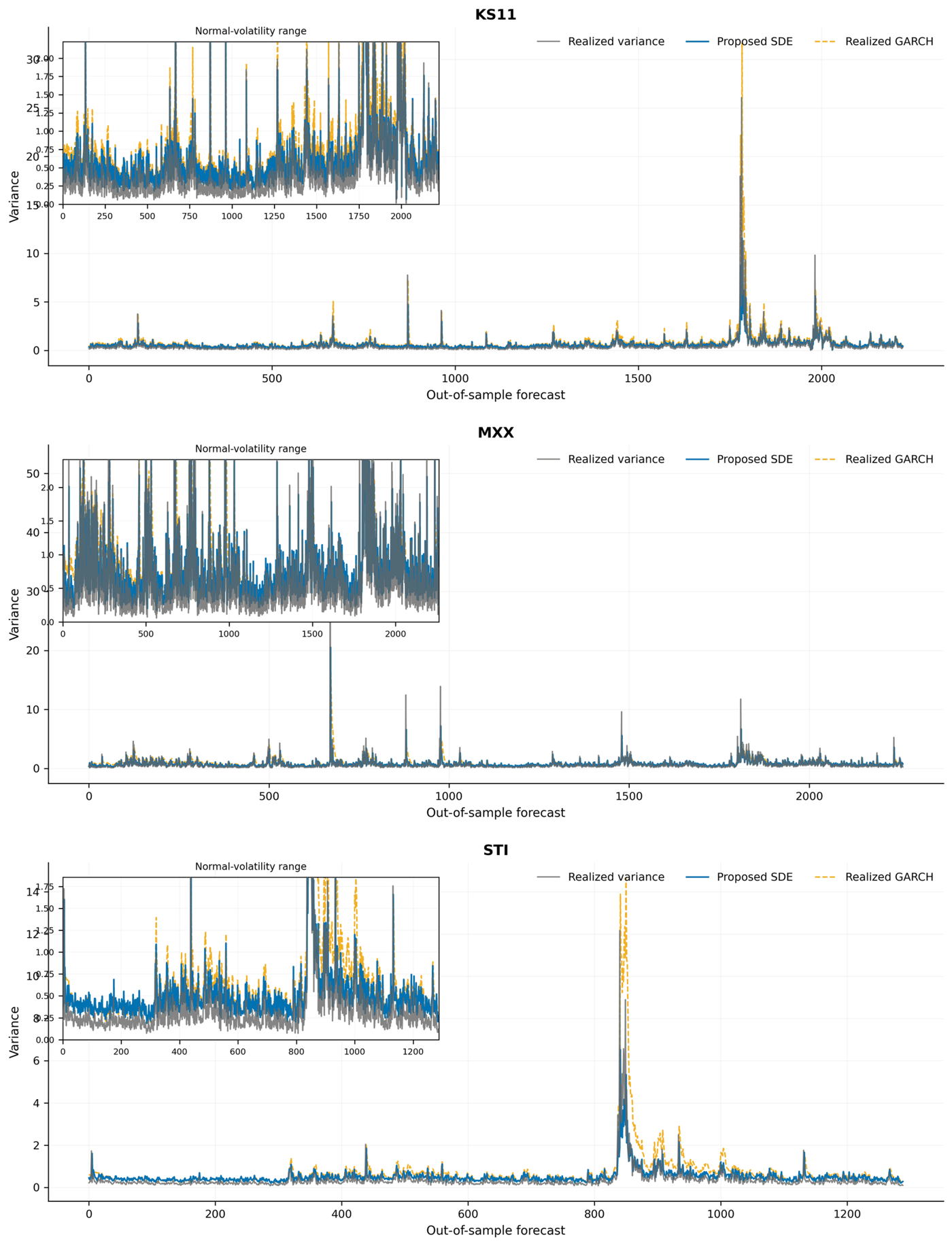
We propose a structured continuous-time stochastic volatility model for one-day-ahead integrated-variance forecasting. The model introduces a jointly evolving realized-measure state that feeds directly into latent variance dynamics, while correlated Brownian innovations capture return-linked dependence. Parameters are estimated through simulation-based predictive learning, and Monte Carlo simulation forecasts integrated variance. Across 17 equity indices, the proposed model shows strong out-of-sample performance relative to GARCH, GARCH-Itô, Realized GARCH, HAR, and HEAVY benchmarks under QLIKE, MSE, and MAE. Ablation results show that realized-measure feedback provides substantial incremental forecasting value within the proposed framework, while return-linked Brownian dependence contributes more modest complementary gains. The results support incorporating measurement-driven information directly into continuous-time latent volatility dynamics to improve integrated-variance forecasting.
Citations and venue from Semantic Scholar (ODC-BY), refreshed weekly. Summary: Quant Letter (CC BY 4.0).