MLP-Initialized Reinforcement Learning for Exit Timing in SPX Short-Straddle Portfolios
An MLP-initialized reinforcement-learning framework optimizes exit timing for short-straddle options, achieving 37.54% cumulative return and a Sharpe ratio of 1.705 out-of-sample over 2024-2026.
Featured in No. 135 on 16 Oct 2026 · 4 days after release
- Released
- 12 Oct 2026
- First featured
- No. 135 · 16 Oct 2026
- Published in
- Not yet, as far as Semantic Scholar knows
- Fanfare
- 3 of 5
- Identifier
- arXiv:2610.13126
- Authors
- Jianning Wang et al.
Abstract
From arXiv (CC0).
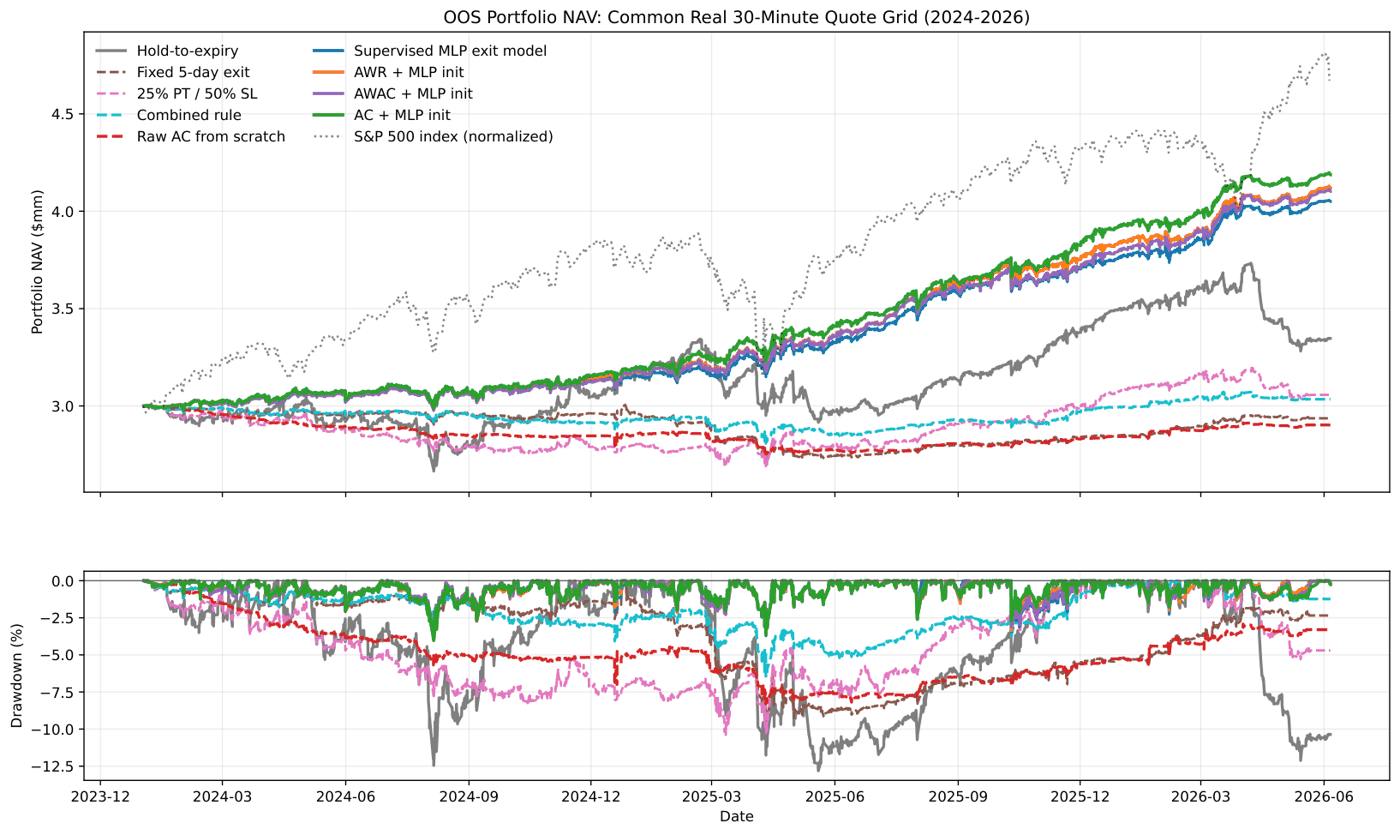
This paper studies exit timing for SPX short-straddle portfolios using a two-stage supervised and reinforcement-learning framework. Historical episodes first generate ex-post optimal hold/exit labels for training a multilayer perceptron (MLP) using only contemporaneously available state variables at deployment. The trained MLP then initializes reinforcement-learning actors that are fine-tuned with a risk-aware trading reward. Out-of-sample evaluation over 2024-2026 shows that the supervised MLP substantially outperforms passive holding and representative fixed-time and profit-and-loss-based exit rules. Across seven independent seeds, MLP-initialized Actor-Critic averages 37.54% cumulative return and a Sharpe ratio of 1.705, compared with 35.01% and 1.651 for the supervised MLP. Actor-Critic trained from scratch averages only 0.18% return. These findings show that oracle-guided supervised learning provides a stable foundation for reward-based policy fine-tuning in a sparse and path-dependent option-exit problem.
Citations and venue from Semantic Scholar (ODC-BY), refreshed weekly. Summary: Quant Letter (CC BY 4.0).