arXivML & AI Methods
The Agentic ETF: How Agentic Trading Becomes an Asset Class
Proposes that large-language-model-driven trading agents delegated to autonomous execution define a nascent asset class, mapping infrastructure layers and projecting potential trillions in assets by 2030.
Featured in No. 134 on 9 Oct 2026 · 2 days after release
- Released
- 7 Oct 2026
- First featured
- No. 134 · 9 Oct 2026
- Published in
- Not yet, as far as Semantic Scholar knows
- Fanfare
- 3 of 5
- Identifier
- arXiv:2610.06856
- Authors
- Amandeep Singh
Abstract
From arXiv (CC0).
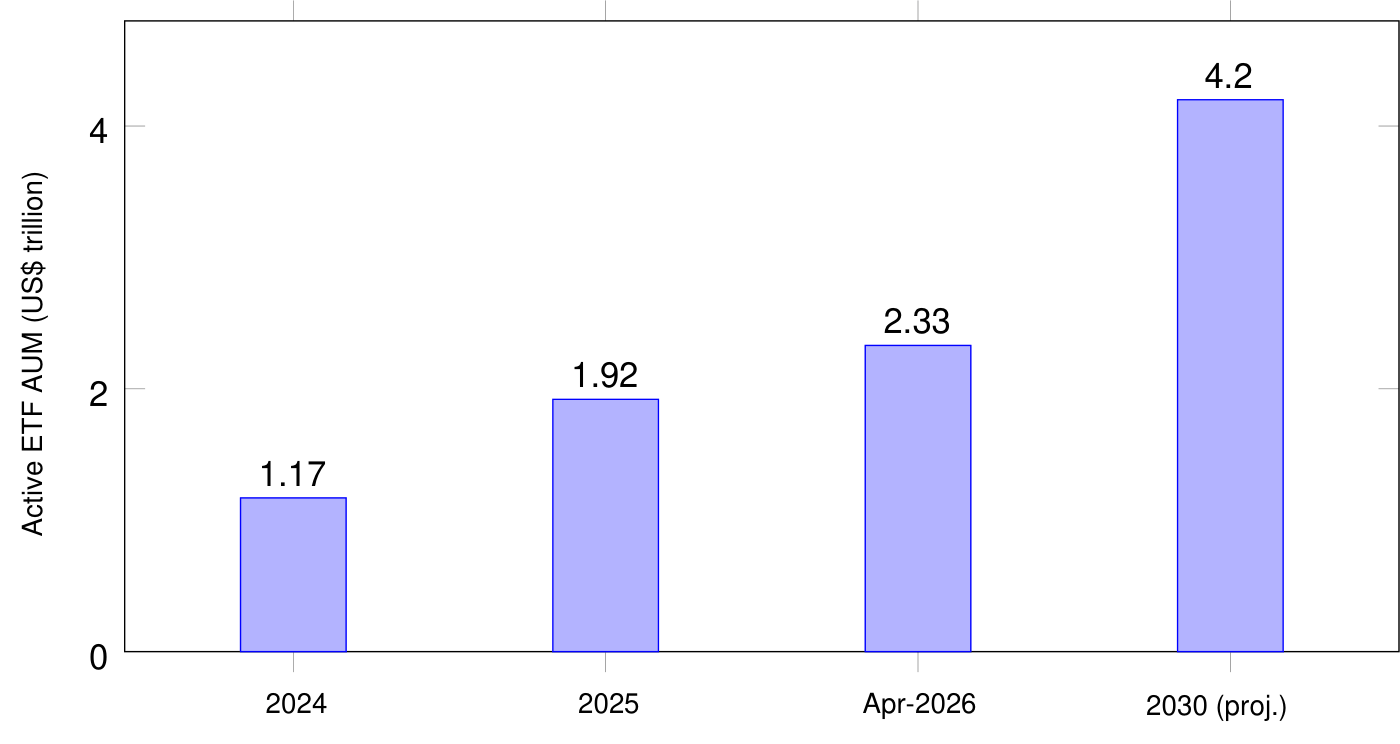
Three structural trends are converging in public markets: the exchange-traded fund (ETF) has become the dominant fund wrapper, actively managed ETFs are the fastest-growing segment within it, and algorithmic systems now mediate the overwhelming majority of trading volume. We argue that their intersection defines a nascent asset class -- the \emph{Agentic ETF}, a fund whose investment process is delegated to autonomous, large-language-model-driven trading agents that reason over data and execute without a human in the loop. We define agentic trading and distinguish it from rule-based algorithmic trading and robo-advice, decompose the agentic-trading infrastructure into six layers, and identify the incumbent players and structural gaps at each layer. We then present ScalarField.io as a reference implementation of an integrated agentic-trading stack -- spanning a unified multi-venue execution registry, isolated strategy agents with continuous broker reconciliation, first-party market data, and metered compute -- and map its primitives to each layer of the stack. A transparent, assumption-stated sizing exercise suggests the Agentic ETF could plausibly reach hundreds of billions to low trillions of dollars in assets under management by 2030.
Citations and venue from Semantic Scholar (ODC-BY), refreshed weekly. Summary: Quant Letter (CC BY 4.0).