AlphaPADI: Formulaic Alpha Discovery via Pool-Aware Hierarchical Discrete Diffusion
Introduces a hierarchical discrete diffusion framework that generates pools of formulaic alphas by reconstructing complete candidate pools under current context and maximizing joint predictive performance and inner diversity.
Featured in No. 134 on 9 Oct 2026 · 3 days after release
- Released
- 6 Oct 2026
- First featured
- No. 134 · 9 Oct 2026
- Published in
- Not yet, as far as Semantic Scholar knows
- Fanfare
- 3 of 5
- Identifier
- arXiv:2610.04959
- Authors
- Yanzheng Jin et al.
Abstract
From arXiv (CC0).
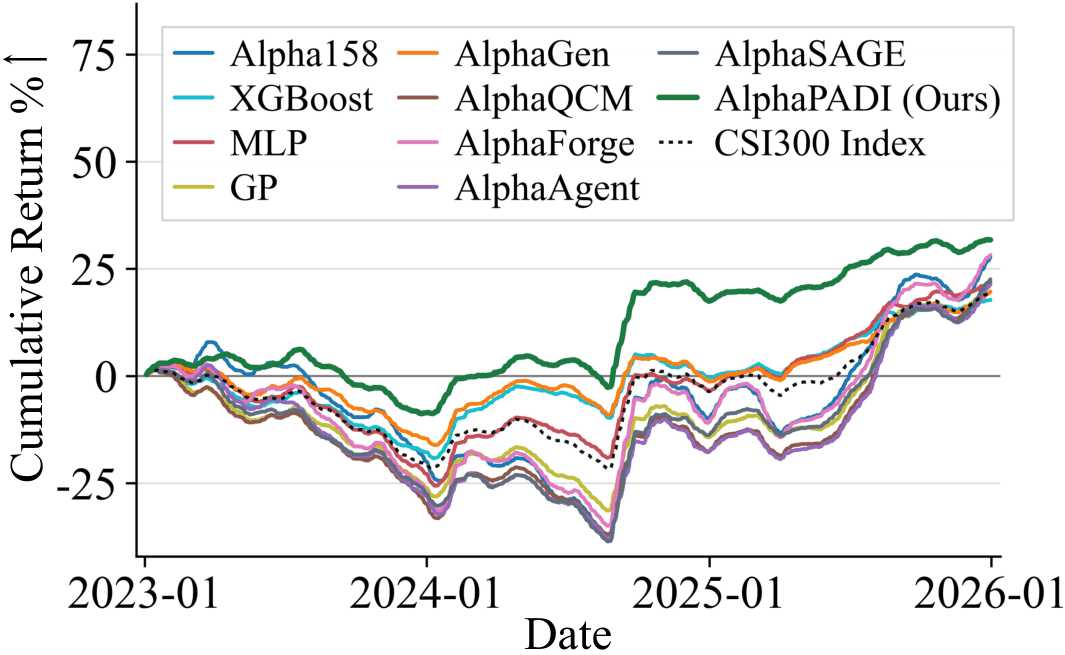
Formulaic alpha discovery seeks symbolic expressions that predict cross-sectional asset returns. In deployment, multiple formulas are combined into an alpha pool, where each formula is valued through the complementary information it contributes to joint predictive performance. While Reinforcement Learning and Generative Flow Networks have emerged as promising paradigms for generating formulaic alphas, existing frameworks face three related challenges. First, generating formulas individually leaves pool context and inter-formula complementarity outside the generative state. Second, formula-wise generation lacks a unified mechanism for preserving and revising structures at different levels. Third, pool-level rewards jointly reflect predictive performance and redundancy but cannot be differentiated directly through symbolic evaluation to train the generator. To overcome these challenges, we introduce AlphaPADI (Formulaic Alpha Discovery via Pool-Aware Hierarchical Discrete Diffusion), a novel framework built around three components: (1) grammar-constrained buffer initialization that constructs syntactically valid pool candidates, (2) pool-aware hierarchical diffusion that reconstructs complete pools at multiple structural scales under the current pool context, and (3) reward-guided pool refinement that evaluates joint predictive performance and inner diversity, updates the elite buffer, and trains the reverse model through reconstruction and preference learning. Empirical results on the Chinese and U.S. stock markets demonstrate that AlphaPADI outperforms the evaluated baselines in both predictive and portfolio performance, thereby validating pool-aware generation as an effective framework for automated alpha discovery.
Citations and venue from Semantic Scholar (ODC-BY), refreshed weekly. Summary: Quant Letter (CC BY 4.0).