Beneath the VIX: Probability, Severity, and Uncertainty Shocks
Separating risk-neutral shortfall probability from conditional severity in option prices shows that severity accounts for 91.5 percent of recession log premium movements, supplying joint empirical restrictions on uncertainty and economic activity.
Featured in No. 134 on 9 Oct 2026 · 3 days after release
- Released
- 6 Oct 2026
- First featured
- No. 134 · 9 Oct 2026
- Published in
- Not yet, as far as Semantic Scholar knows
- Fanfare
- 3 of 5
- Identifier
- arXiv:2610.03849
- Authors
- Todd B. Walker
Abstract
From arXiv (CC0).
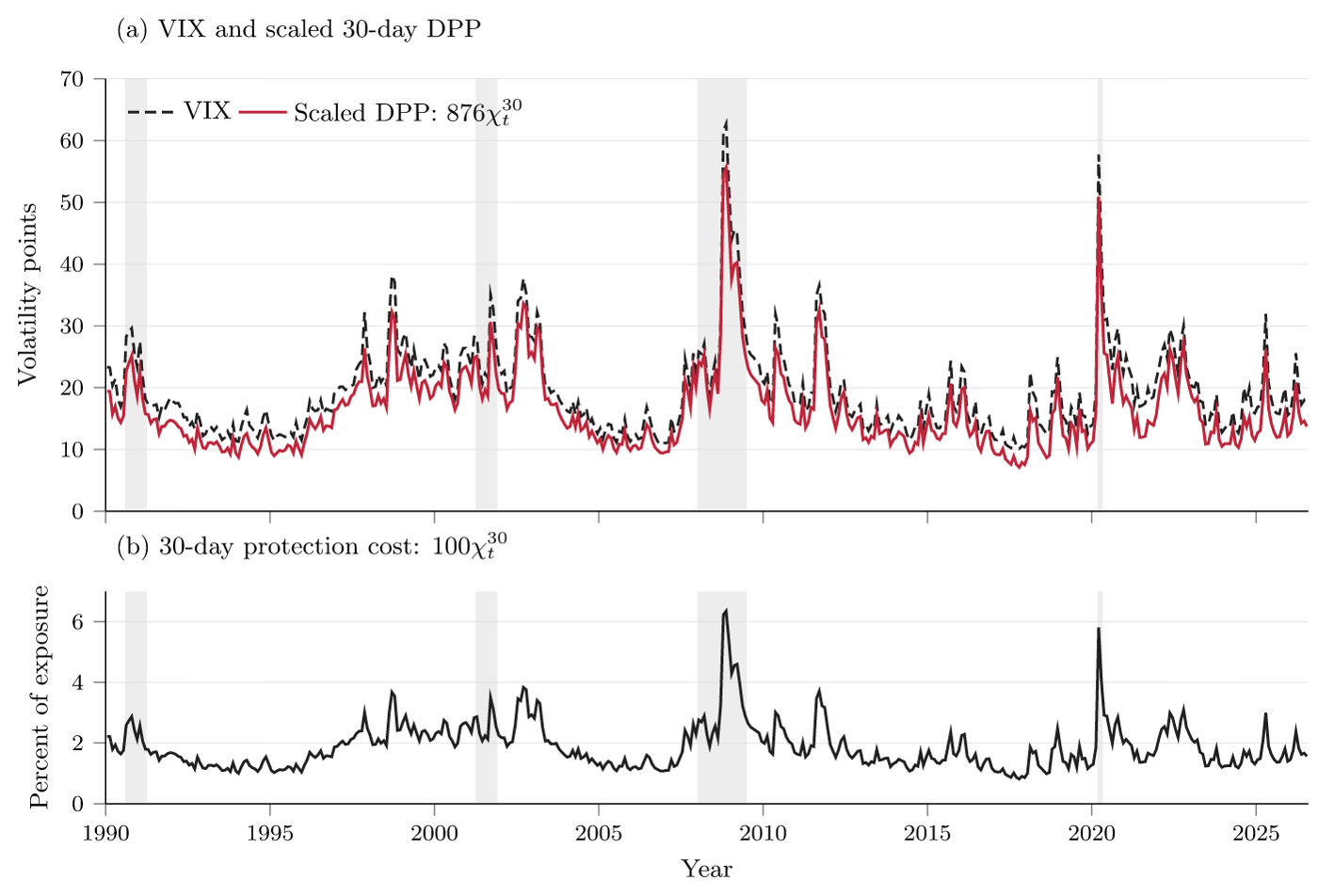
Implied stock-market volatility is widely used to identify uncertainty shocks and discipline models of their macroeconomic effects. This paper gives distributional content to the option-price variation underlying these exercises. A normalized at-the-money forward put price, the Downside Protection Premium (DPP), closely tracks the VIX and preserves the principal macroeconomic responses in the specifications examined. Its price and local strike slope separate risk-neutral shortfall probability from conditional severity. Severity accounts for almost all monthly premium comovement and 91.5 percent of the recession log premium. Conditional gains also rise substantially, while conditional losses remain larger in phase averages. Despite this severity dominance, quotations across strikes frequently exclude a common-scale explanation, conditional on the maintained forward and premium construction. Realized-volatility and future-volatility-news innovations both raise protection costs primarily through severity, yet produce different estimated employment responses in common impact-severity units; simultaneous significance depends on the inference formulation. Together, these findings supply joint empirical restrictions on the connection between uncertainty, option prices, and economic activity.
Citations and venue from Semantic Scholar (ODC-BY), refreshed weekly. Summary: Quant Letter (CC BY 4.0).