When Hedging Changes the Payoff: Option Replication with Price Impact and Execution Costs
The study shows how hedging a derivative via trading the underlying changes its payoff when execution generates price impact and costs, deriving pricing equations and replication conditions.
Featured in No. 133 on 2 Oct 2026 · 2 days after release
- Released
- 30 Sep 2026
- First featured
- No. 133 · 2 Oct 2026
- Published in
- Not yet, as far as Semantic Scholar knows
- Fanfare
- 2 of 5
- Identifier
- arXiv:2609.36257
- Authors
- David Itkin and Leandro Sánchez-Betancourt
Abstract
From arXiv (CC0).
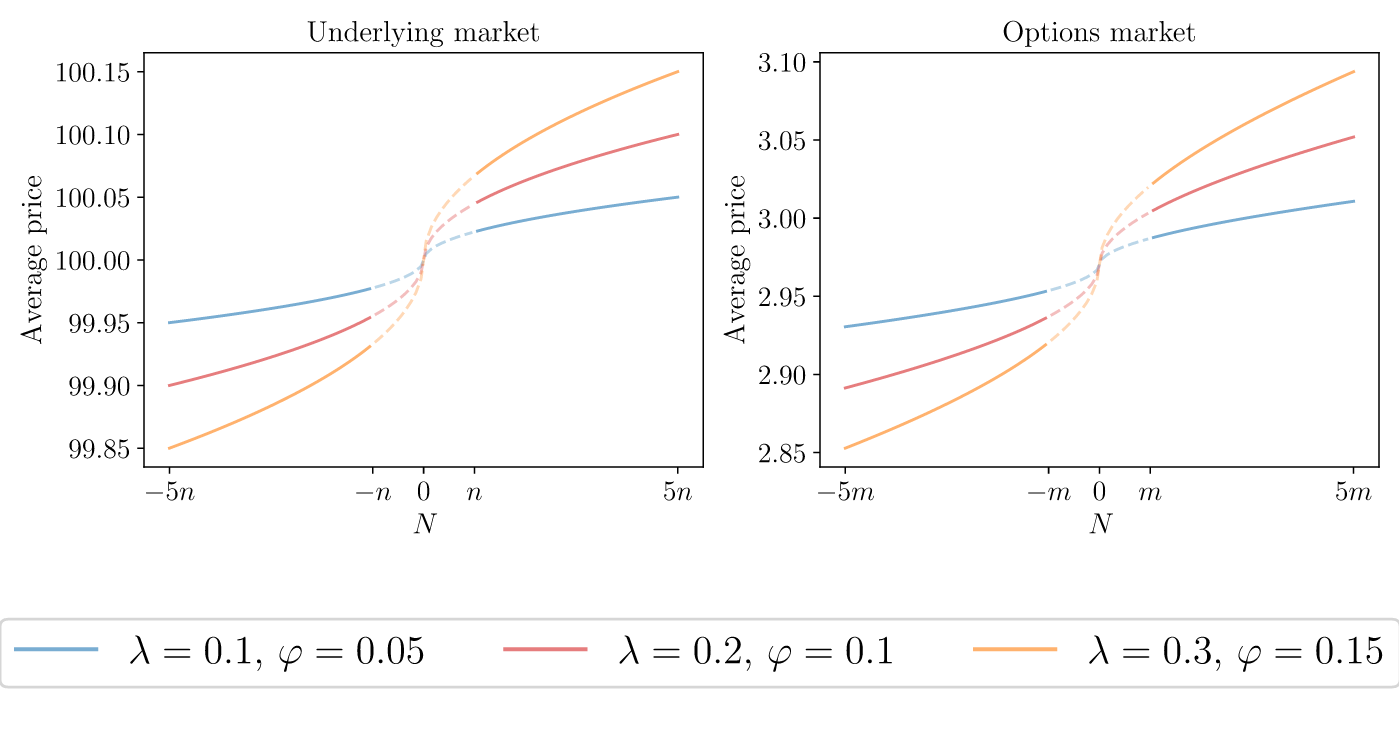
Hedging a derivative by trading the underlying asset changes the payoff that the hedging intended to replicate. We study this phenomenon when trading generates price impact and execution costs. In a binomial model, we characterize replication through a fixed-point equation. In continuous time, we derive a nonlinear pricing PDE whose implicit terminal condition captures the nature of the moving target problem of the hedger. For monotone convex Lipschitz payoffs (such as calls and puts) we establish exact replication under midpoint execution costs. Numerical experiments illustrate: (i) how price impact shifts the effective strike, (ii) the non-linear dependence of the option price on the number of contracts, (iii) how execution costs smooth terminal holdings, (iv) the extent to which the hedger's own trading can bring an otherwise worthless option into the money, and (v) we explain the spread and the shape of the limit order book in the options market based on the price impact and the shape of the limit order book of the underlying.
Citations and venue from Semantic Scholar (ODC-BY), refreshed weekly. Summary: Quant Letter (CC BY 4.0).