arXivCrypto & DeFi
Stablecoin Runs as Safe-Asset Stress Signals: Episode-Level Evidence for Central Bank Surveillance
During panic-driven runs, five-day stablecoin redemptions of one billion dollars predict three-month bill yield declines of 8.5 basis points, signaling flight to quality.
Featured in No. 140 on 20 Nov 2026 · on release day
- Released
- 20 Nov 2026
- First featured
- No. 140 · 20 Nov 2026
- Published in
- Not yet, as far as Semantic Scholar knows
- Fanfare
- 3 of 5
- Identifier
- arXiv:2611.26180
- Authors
- Ahmad Qadi et al.
Abstract
From arXiv (CC0).
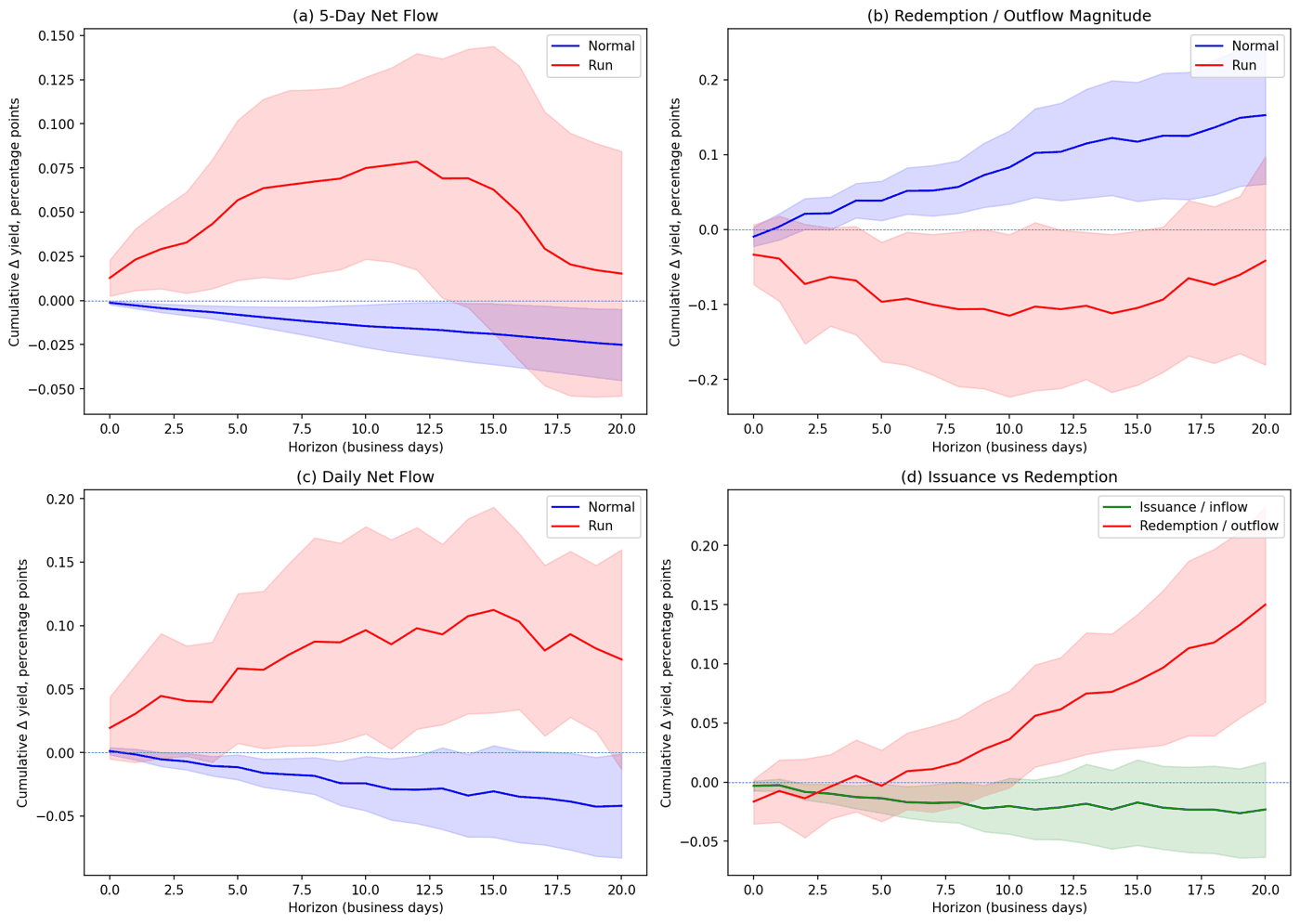
This paper asks whether stablecoin runs carry information about U.S. Treasury yields. Using daily data on USDT, USDC and BUSD from 2021 to 2025 and five stress episodes, it measures flows from changes in token units rather than market capitalisation, which removes the phantom inflows the standard measure records when tokens lose their peg. Flows have no stable relationship with yields in normal periods. During the three panic-driven runs, a one-billion-dollar five-day redemption is associated with an 8.5 basis point fall in the three-month bill yield within ten trading days, while two regulatory episodes carry no such signal. The response is broad across maturities and has the opposite sign to what reserve liquidation predicts, which points to flight to quality. The effect is led by the TerraUSD collapse and corroborated by the USDC/SVB run. Five-day redemptions of roughly USD 2 to 3 billion during a panic mark the scale at which stablecoin stress becomes informative for surveillance.
Citations and venue from Semantic Scholar (ODC-BY), refreshed weekly. Summary: Quant Letter (CC BY 4.0).