arXivLLMs & Text
FinVeriQA: Financial Research Agents for Question Answering: Routing, Retrieval, MCP Tool Use, and Provenance-Aware Evidence Verification
A multi-agent research system routes questions, retrieves SEC data, computes ratios in Python, and validates cited evidence; a compact routing model outperforms language models on task assignment.
Featured in No. 140 on 20 Nov 2026 · on release day
- Released
- 20 Nov 2026
- First featured
- No. 140 · 20 Nov 2026
- Published in
- Not yet, as far as Semantic Scholar knows
- Fanfare
- 2 of 5
- Identifier
- arXiv:2611.25071
- Authors
- Meenakshi Rajpurohit et al.
Abstract
From arXiv (CC0).
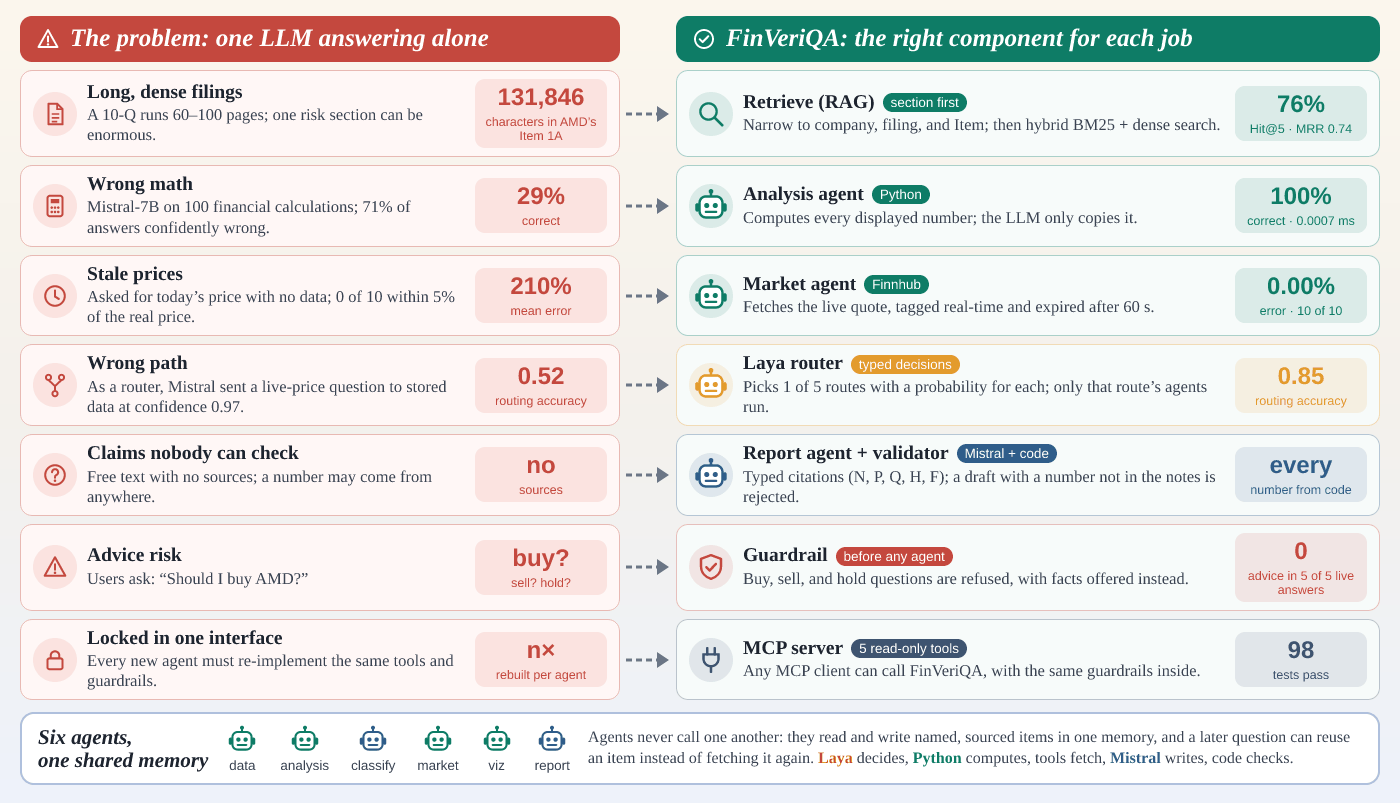
Large language models (LLMs) write fluent financial analyses but miscompute ratios, recall stale prices, and route questions to the wrong tool with high confidence. We ask which component should do each job in a financial question-answering assistant, and study it with FinVeriQA, an open-source multi-agent research prototype over SEC filings and live market data: a compact typed-decision model (Laya) routes each question and screens out advice requests, Python computes every number, retrieval and tools fetch evidence, Mistral-7B writes a cited answer, a code validator checks that cited IDs exist and that numbers match computed notes, and a Model Context Protocol (MCP) server exposes the pipeline. In live experiments, Laya routed better than Mistral-7B (0.85 vs. 0.52; overall 0.86 vs. 0.68, McNemar p = 0.0003); a 12B Mistral decided no better, and DeepSeek-R1-8B decided better (0.79 vs. 0.68, p = 0.0192) but about 9.9 times more slowly. Mistral-7B computed 29% of 100 financial calculations correctly against 100% for Python, a live quote cut price error from 210% to 0.00%, and hybrid retrieval reached 76% Hit@5 on 50 filing questions. Yet in a live case study, both agent answers passed validation while describing AMD sample data under NVIDIA's and Alphabet's names. A controlled upper-bound study on the FinRank benchmark explains why: when one figure in the shared evidence is corrupted, self-consistency stays confident (agreement 0.55 to 0.59 while accuracy falls from 0.50 to 0.00), and a shared-evidence check (the kind our validator performs) catches 35% of the errors, whereas a check against the original passage catches 77% ($p = 5.96 \times 10^{-8}$); for DeepSeek-R1-8B, 68% vs. 90%. Verification must be independent of the evidence the writer saw.
Citations and venue from Semantic Scholar (ODC-BY), refreshed weekly. Summary: Quant Letter (CC BY 4.0).