arXivML & AI Methods
DDSL: Iterative Self-Labeling for Financial Market States
An iterative self-labeling framework couples a Viterbi labeler with a Transformer classifier through feedback, lifting market-state classification F1 by 78-96% over single-pass methods.
Featured in No. 140 on 20 Nov 2026 · 2 days after release
- Released
- 18 Nov 2026
- First featured
- No. 140 · 20 Nov 2026
- Published in
- Not yet, as far as Semantic Scholar knows
- Fanfare
- 2 of 5
- Identifier
- arXiv:2611.22958
- Authors
- Xianbin Gu et al.
Abstract
From arXiv (CC0).
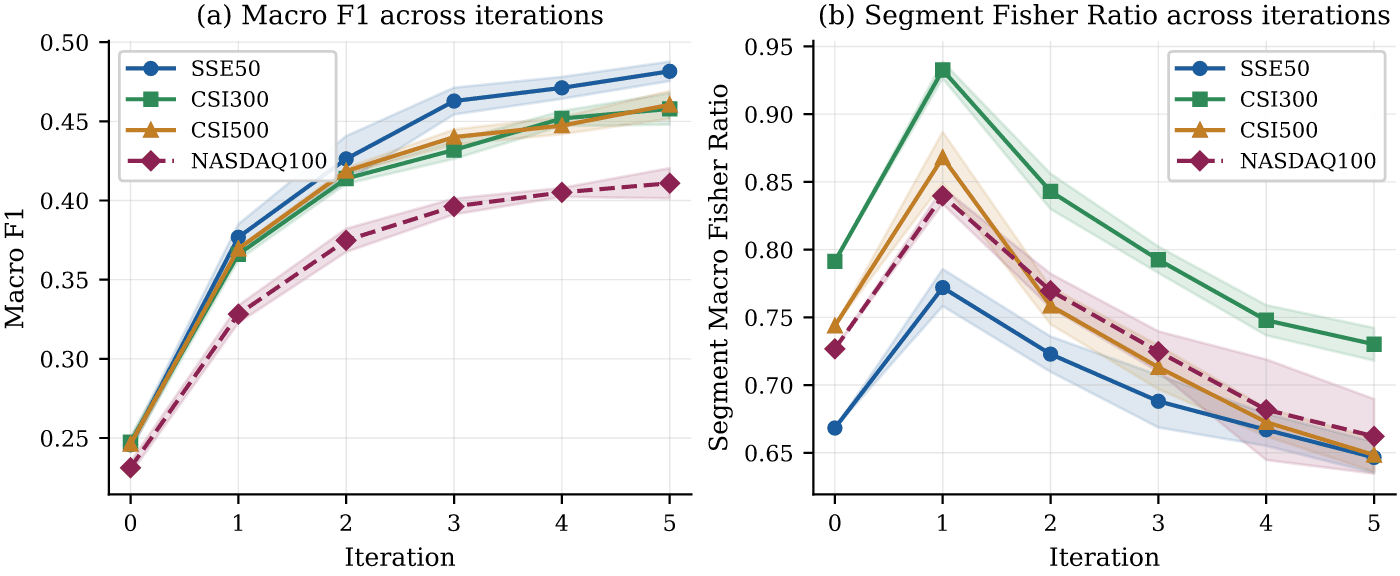
Financial market states lack a unique ground truth and must therefore be constructed from price data. Conventional labeling methods typically define states independently of the downstream classifier, leaving unresolved whether the resulting labels can be recovered from information available at prediction time. We propose DDSL, an iterative self-labeling framework that couples a price- and grammar-guided Viterbi labeler with a Transformer classifier through model feedback. DDSL constructs a nine-state representation that jointly encodes current and future market trends while retaining structured price emissions and temporal constraints throughout refinement. Experiments on SSE50, CSI300, CSI500, and NASDAQ100 show that DDSL increases held-out joint-state macro F1 by 78%-96% over single-pass dynamic-programming labeling. An independent GRU classifier that never participates in the labeling loop reproduces the same trend, while label entropy and class coverage remain stable, indicating that the gain transfers across architectures and is not caused by label collapse. We further show that learnability is controlled by both iteration and the model-feedback weight $β_{\mathrm{model}}$. Iterative gains diminish as successive label systems converge, whereas stronger feedback increasingly widens the performance gap between the feedback Transformer and the independent GRU. Increased learnability is accompanied by declining segment-level price-feature separation after an initial improvement. Finally, a non-anticipative event study provides partial external validation: refinement strengthens a conditional BEAR$\rightarrow$BULL reversal signal on the three A-share datasets, while the corresponding effect has the opposite sign on NASDAQ100. These results position DDSL as a structured framework for constructing market-state labels whose learnability can be explicitly controlled and evaluated.
Citations and venue from Semantic Scholar (ODC-BY), refreshed weekly. Summary: Quant Letter (CC BY 4.0).